Skip to content
Briefings are running a touch slower this week while we rebuild the foundations.See roadmap
Drones: Industry & Defence
21MAY

Northrop banks two drone awards in one week

4 min read
11:11UTC

Northrop Grumman won a $325.5 million Army contract for RangeHawk on Friday 15 May, then was named a preferred payload provider for the Pentagon's 200,000-drone Common UAS Payload programme three days later. The bookends sit at opposite ends of the capability spectrum.

TechnologyDeveloping
Key takeaway

Northrop has bought into both ends of the drone capability spectrum inside five days.

Northrop Grumman won a $325.5 million Army cost-plus-fixed-fee award on Friday 15 May for RangeHawk, a Global Hawk-airframe HALE (high-altitude, long-endurance) drone built to collect telemetry on hypersonic and long-range weapon tests. The contract obligates $65.6 million in FY2026 research, development, test and evaluation funding at award and runs through May 2031 1. Three days later, on Monday 18 May, Northrop was named one of five preferred payload providers under the Pentagon's Drone Dominance Common UAS Payload programme, supplying standardised fuze, warhead and interface modules to the 30,000-unit initial tranche of the 200,000-by-2027 Group 1 FPV programme at roughly $5,000 per drone 2.

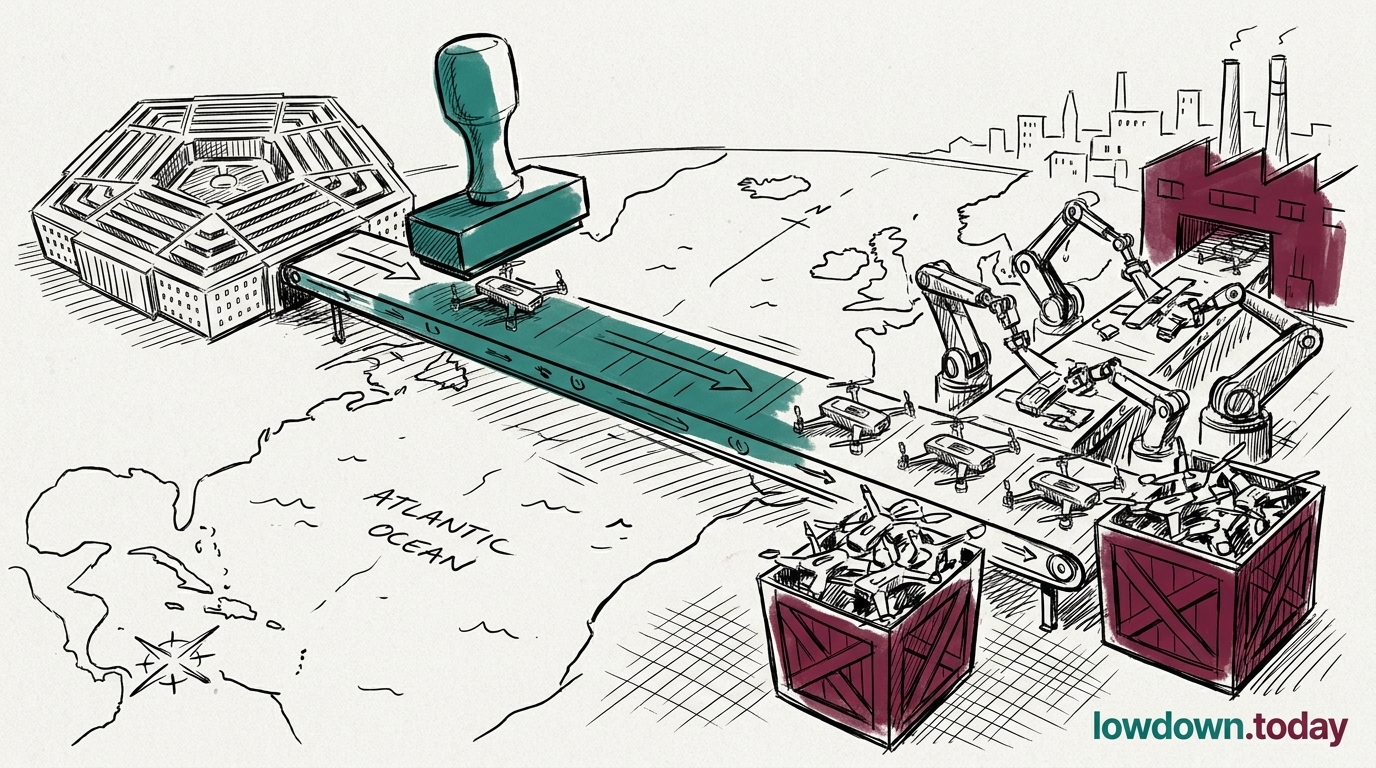
The pair sit at opposite ends of the capability spectrum, and that is the industry signal. A bespoke HALE platform for hypersonic test data lives in heritage-prime territory; a commodity payload for disposable Group 1 munitions is the attritable end Anduril and Skycutter have been treated as owning. Northrop stepped into both ends in the same week. The dual win sits inside the FY2027 Defense Autonomous Warfare Group budget context, which lifted from $225.9 million to $54.6 billion in a single cycle .

The Anduril-versus-primes framing that ran through Updates #6 to #8 now reads differently. Lockheed Martin's SANC counter-UAS disclosure , RTX's reusable Coyote disclosure and BAE Systems's May trading update guiding 7-9% growth with drones as a priority had each suggested heritage primes were defending the high-end while startups owned the attritable mass. Northrop's payload role at $5,000 per drone, sitting against RangeHawk's $325.5 million telemetry brief, suggests the primes are not losing the attritable-mass era. They are entering both ends of it simultaneously.

Whoever sits on the Common UAS Payload interface specification captures recurring revenue across every FPV airframe procured under Drone Dominance, regardless of platform OEM. Northrop's preferred-provider status puts it on that standard-setting layer for at least the first 30,000 units.

Deep Analysis

In plain English

Northrop Grumman is one of the US military's biggest contractors, best known for building the B-21 stealth bomber. In the same week in May, it won two very different drone contracts. The first, worth $325.5 million, is for a specialised drone called RangeHawk that flies very high and collects data while the military tests hypersonic weapons. Hypersonic weapons travel faster than five times the speed of sound, and tracking them requires a plane that can stay airborne for 34 hours above 60,000 feet. The second contract is more unusual: Northrop was named one of five preferred suppliers of the explosive payload fitted to cheap, disposable attack drones in the Pentagon's 200,000-drone programme. One is a bespoke surveillance tool; the other is a component supplier for mass-produced weapons. Both contracts landed in the same week.

Deep Analysis
Root Causes

RangeHawk is a direct consequence of the US hypersonic test range capacity problem: the DoD needs persistent high-altitude telemetry collection for hypersonic weapon tests, and the Global Hawk airframe is the only platform in the US inventory with the combination of 60,000-foot ceiling, 34-hour endurance, and payload capacity to carry phased-array antenna suites. Northrop holds this position by default; no startup has an HALE airframe in the US inventory that could compete.

The Drone Dominance payload role reflects a different structural dynamic: DoD programme managers in large-volume attritable programmes prefer a Tier 1 prime on the effects module because liability for weapons safety, fuze certification, and warhead handling requires a company with the institutional quality management system to absorb federal audit.

Startups can build airframes faster and cheaper; they cannot absorb the regulatory overhead of weapons certification at volume without partnering with a prime.

What could happen next?
  • Meaning

    Northrop's preferred-provider status on Common UAS Payload sets a de facto interface standard for Group 1 FPV effects modules; any competitor that wins future Drone Dominance airframe contracts must design to Northrop's fuze and warhead specifications.

    Medium term · Assessed
  • Opportunity

    RangeHawk's Global Hawk lineage positions Northrop to win hypersonic test range contracts beyond the initial $325.5M award as the US hypersonic weapon test cadence accelerates through FY2028.

    Medium term · Assessed
  • Risk

    Cost-plus structure on RangeHawk creates schedule incentive asymmetry: Northrop earns fee on every dollar spent, so there is no structural pressure to deliver under budget before May 2031.

    Long term · Assessed
First Reported In

Update #9 · Schmidt's Perennial wins $500M drone deal

CSIS· 21 May 2026
Read original
Different Perspectives
Institutional investors and defence-sector equity markets
Perennial's IDIQ gives revenue-visibility that earlier Schmidt ventures lacked; Northrop's dual award places a heritage prime on the attritable-payload standard-setting layer analysts had reserved for startups. Rheinmetall at €650 per share, up from €500 in January, prices auto-grade drone conversion as margin-accretive; DroneShield's ASIC probe introduces a governance-discount variable proxy advisers will apply at the 29 May AGM.
Korean defence-industrial sector (LIG Nex1, Hanwha Aerospace)
LIG Nex1's $2.2 billion Cheongung-III win and the KUS-FS service introduction together close Seoul's sovereign layered air-defence stack; both firms face multi-year backlog revisions on the Korea Exchange. The unresolved sensor-to-shooter integration risk between Hanwha's LAMD sensors and LIG Nex1's Cheongung-III engagement layer sits publicly unaddressed ahead of the 2029 fielding date.
Ukrainian export regulator (SSEC)
Ukraine's wartime export ban blocks Gulf sales of combat-proven interceptors at $2,100 to $2,500 per unit while Perennial Autonomy, built on Ukrainian combat data, wins a $500 million US IDIQ. Perennial's Merops, credited with 4,000-plus Russian drone kills in Ukraine, can now reach NATO allies via Munich; a direct Ukrainian sale to those same buyers remains legally blocked.
DJI and Autel Robotics
Autel's Ralls Corp filing attacks the classified-evidence foundation of its Covered List designation; DJI's parallel Ninth Circuit case has quantified $1.56 billion in 2026 regulatory losses. Both companies are now betting the D.C. Circuit will extend due-process protections to FCC product certification, a constitutional route that does not require contesting the intelligence allegations directly.
US Pentagon defence-industrial-base policy
JIATF-401's IDIQ names Perennial the benchmark holder while Anduril's $20 billion Lattice vehicle and Northrop's Drone Dominance payload role run in parallel lanes; the DoD bet is that named holders at each tier cut order-to-delivery cycles. The Section 232 clock 54 days overdue signals the administration treats FCC and FAR exclusions as sufficient to manage Chinese market access.
European defence procurement community
Germany's three-tier award demonstrates that EU member states can fund loitering-munition production at scale without single-supplier dependency, and Perennial's Munich line gives procurement offices a domestic-source justification for Merops orders outside US Foreign Military Sales channels. The Bundeswehr's split across Helsing, Stark and Rheinmetall has become the reference architecture other European buyers are mapping their own industrial bases against.
