Skip to content
Briefings are running a touch slower this week while we rebuild the foundations.See roadmap
Drones: Industry & Defence
21MAY

DHS, Shield AI and a Section 232 clock still running

4 min read
11:11UTC

DHS staged $250 million in FEMA counter-drone grants across 11 World Cup host states on Thursday 14 May. Five days later, Shield AI was contracted onto LUCAS for an autumn swarm demo. The Section 232 UAS tariff decision passed 54 days overdue with no Commerce report.

TechnologyDeveloping
Key takeaway

DHS funded World Cup security, Shield AI bridged onto attritable strike, and the tariff lever stayed cold.

The Department of Homeland Security announced on Thursday 14 May that FEMA had staged $250 million in counter-drone grants across 11 FIFA World Cup host states and the National Capital Region ahead of the 11 June tournament start 1. The grants flow through DHS sub-agencies including CBP, ICE and the Programme Executive Office for UAS/C-UAS, and they sit inside a broader $1.5 billion DHS C-UAS contract vehicle disclosed earlier in the spring. World Cup security has acted as the forcing function for DHS counter-drone procurement in the same way the Iran Gulf campaign acted as the Pentagon's.

Shield AI was contracted on Tuesday 19 May to integrate its Hivemind Foundation Model onto LUCAS, the $35,000 Low-cost Uncrewed Combat Attack System reverse-engineered from Iran's Shahed-136, for an operational swarm demo planned in autumn 2026 2. The contract extends Hivemind from its earlier home on V-BAT, where Shield AI built the autonomous-flight stack as a CCA-wingman tier, into the attritable attack swarm. LUCAS's lineage is the structural detail: a US drone built from the airframe Iran flew against Saudi Aramco in 2019 and Russia flew against Ukraine from October 2022 has now been wired into the Pentagon's autonomy stack of record.

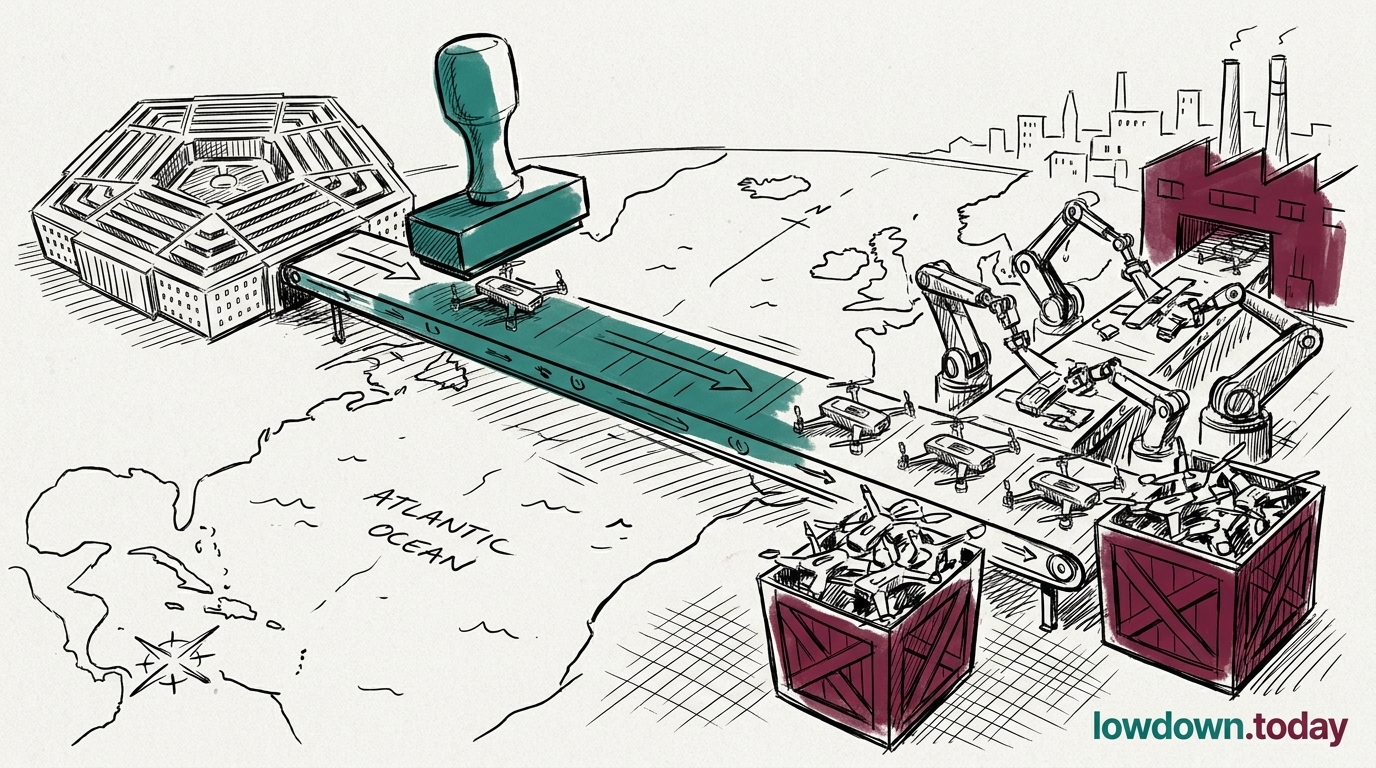
The Section 232 UAS Investigation remained 54 days overdue as of 21 May, against the 28 March statutory deadline, with no Commerce report transmitted to the President. The tariff route the administration opened in July 2025 has now been visibly overtaken by the federal procurement bar and FCC Covered List exclusions covered in the Autel filing above, which together cut DJI and Autel from federal contracts and FCC equipment authorisations regardless of any tariff. The longer Commerce holds the report, the more the executive branch tacitly concedes the regulatory work is being done elsewhere .

Deep Analysis

In plain English

Three separate US counter-drone stories moved in the same week. First, the government gave $250 million to the 11 states hosting 2026 World Cup matches to buy equipment that can detect and jam drones over stadiums. The football starts on 11 June. Second, a company called Shield AI agreed to connect its autonomous flight software, Hivemind, to LUCAS, a cheap American strike drone that was originally reverse-engineered from an Iranian drone design. The plan is to demonstrate a swarm of these attack drones flying autonomously in autumn 2026. Third, a government investigation into whether Chinese drones should face additional trade tariffs passed its legal deadline by 54 days with no decision announced. The investigation was opened in July 2025 and was supposed to report back to the President by March 2026.

What could happen next?
  • Opportunity

    Shield AI's Hivemind integration on LUCAS, if the autumn 2026 swarm demo succeeds, creates the first publicly confirmed US attritable-autonomy swarm capability; success would accelerate Drone Dominance procurement timelines and potentially position Hivemind as the mandatory software stack on Group 1 FPV strike drones.

    Short term · Assessed
  • Meaning

    The Section 232 investigation running 54 days overdue, alongside active FCC Covered List litigation from both DJI and Autel, signals the administration is managing Chinese drone market access through regulatory instruments rather than tariffs, avoiding the trade-retaliation risk a formal tariff proclamation would carry.

    Medium term · Assessed
  • Risk

    FEMA counter-drone grants deployed without a civil-impact framework may leave permanent RF-jamming infrastructure in 11 US cities operating under state police authority rather than a federal regulatory standard, creating spectrum-management conflicts with medical devices and licensed non-military drone operators.

    Medium term · Suggested
First Reported In

Update #9 · Schmidt's Perennial wins $500M drone deal

Punchbowl News· 21 May 2026
Read original
Different Perspectives
Institutional investors and defence-sector equity markets
Perennial's IDIQ gives revenue-visibility that earlier Schmidt ventures lacked; Northrop's dual award places a heritage prime on the attritable-payload standard-setting layer analysts had reserved for startups. Rheinmetall at €650 per share, up from €500 in January, prices auto-grade drone conversion as margin-accretive; DroneShield's ASIC probe introduces a governance-discount variable proxy advisers will apply at the 29 May AGM.
Korean defence-industrial sector (LIG Nex1, Hanwha Aerospace)
LIG Nex1's $2.2 billion Cheongung-III win and the KUS-FS service introduction together close Seoul's sovereign layered air-defence stack; both firms face multi-year backlog revisions on the Korea Exchange. The unresolved sensor-to-shooter integration risk between Hanwha's LAMD sensors and LIG Nex1's Cheongung-III engagement layer sits publicly unaddressed ahead of the 2029 fielding date.
Ukrainian export regulator (SSEC)
Ukraine's wartime export ban blocks Gulf sales of combat-proven interceptors at $2,100 to $2,500 per unit while Perennial Autonomy, built on Ukrainian combat data, wins a $500 million US IDIQ. Perennial's Merops, credited with 4,000-plus Russian drone kills in Ukraine, can now reach NATO allies via Munich; a direct Ukrainian sale to those same buyers remains legally blocked.
DJI and Autel Robotics
Autel's Ralls Corp filing attacks the classified-evidence foundation of its Covered List designation; DJI's parallel Ninth Circuit case has quantified $1.56 billion in 2026 regulatory losses. Both companies are now betting the D.C. Circuit will extend due-process protections to FCC product certification, a constitutional route that does not require contesting the intelligence allegations directly.
US Pentagon defence-industrial-base policy
JIATF-401's IDIQ names Perennial the benchmark holder while Anduril's $20 billion Lattice vehicle and Northrop's Drone Dominance payload role run in parallel lanes; the DoD bet is that named holders at each tier cut order-to-delivery cycles. The Section 232 clock 54 days overdue signals the administration treats FCC and FAR exclusions as sufficient to manage Chinese market access.
European defence procurement community
Germany's three-tier award demonstrates that EU member states can fund loitering-munition production at scale without single-supplier dependency, and Perennial's Munich line gives procurement offices a domestic-source justification for Merops orders outside US Foreign Military Sales channels. The Bundeswehr's split across Helsing, Stark and Rheinmetall has become the reference architecture other European buyers are mapping their own industrial bases against.
