Skip to content
You can now search across every topic, entity and event.What's new
Data Centres: Boom and Backlash
28JUN

DOE lets PJM switch off data centres

4 min read
12:23UTC

The US Department of Energy gave grid operator PJM authority on 18 May to curtail data centres running their own backup generation, its second such emergency order in 2026, as a heat event with 40 GW of plant offline pushed the 14-state grid toward rolling blackouts.

IndustryDeveloping
Key takeaway

Behind-the-meter generation, built to escape grid rules, has been reclassified as the grid's interruptible reserve.

For three days from 18 May the US Department of Energy (DOE) gave grid operator PJM Interconnection, which runs the 14-state mid-Atlantic and midwest network, authority to curtail data centres equipped with their own backup generation. PJM activated it during a heat event with more than 40 GW of plant out for maintenance and a peak-load forecast of 135,961 MW, with Maryland and Virginia under the most strain. 1 The DOE called it the second such emergency order in 2026.

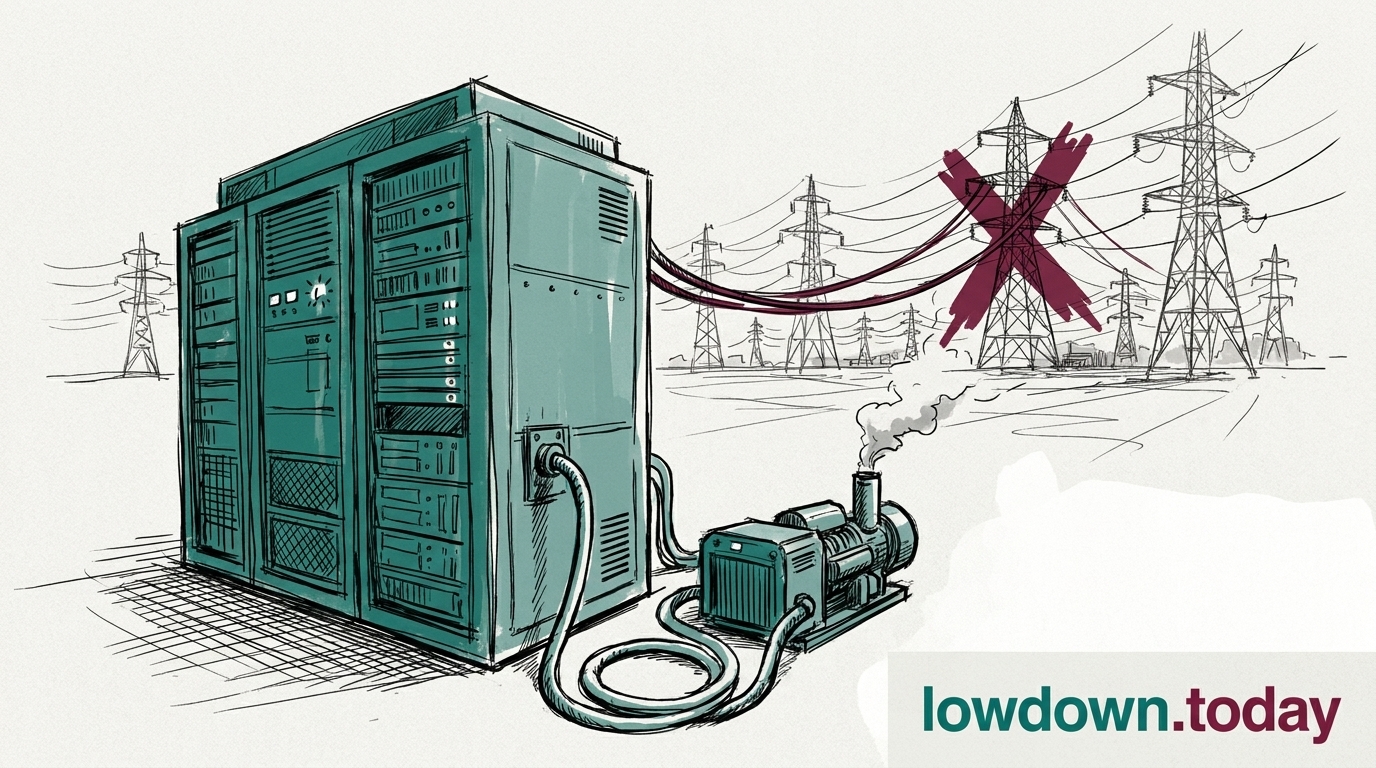
The instrument is Section 202(c), the Federal Power Act emergency power that lets the energy secretary order generation or curtailment to keep the lights on. Its target marks the shift. Operators spent the past year building behind-the-meter (BTM) generation, private gas turbines and engines sited inside the campus fence, to escape the grid-connection queue and congestion pricing. xAI won approval for 41 turbines at Colossus and Meta commissioned a 366 MW BTM gas array at El Paso for that reason . GE Vernova's 80 GW turbine backlog and the IEA's 15-27 GW US onsite-gas projection had made that load class visible enough for regulators to name it . The first concrete federal action treats the fleet as the grid's shock-absorber, the load to drop first.

That runs against what the industry was lobbying for. PJM was due to file its revised co-located load tariff on the same 18 May date , seeking recognition for generation so operators could sit behind it and avoid curtailment. The emergency order arrived first and ran the opposite way: BTM capacity as interruptible reserve, not as a shield.

Operators argue this is weather, not a rulebook, and they are partly right: 202(c) is an emergency tool and the permanent rule is still pending. Then count the orders. DOE has reached for this power twice in five months, naming the BTM-equipped load class specifically, which reads as a disposition rather than an accident.

Deep Analysis

In plain English

Data centres have been quietly building their own power plants, typically gas turbines inside the campus fence, to avoid waiting years for a grid connection. They called this going "behind the meter" (BTM), meaning on their side of the utility's measurement point. When a heat wave hit in May, the US Department of Energy (DOE) used a rarely-invoked law called Section 202(c) of the Federal Power Act to give PJM, the company that runs the electricity grid across 14 states, the authority to switch those private data-centre generators off first during a crisis. The paradox: the generation operators built to be independent from the grid became the grid's emergency shock-absorber. PJM manages power for 65 million people from Illinois to the Atlantic coast and was running low on spare capacity during the heat event.

Deep Analysis
Root Causes

PJM's forward capacity auction cleared at roughly eight times the prior year's cost in 2026 and, for the first time in the grid's history, could not procure 100 per cent of its required capacity reserve. The structural driver: PJM peak demand was effectively flat from 2005 to 2020; data-centre load growth of approximately 5 per cent annually since 2021 has compressed a decade of planning margin into five years.

The BTM legal definition under FERC rules sat at 20 MW as the threshold above which co-located load must interconnect to the grid like any other large load. FERC's April 2026 rejection of PJM's bid to redefine that threshold left a gap: operators above 20 MW with BTM generation sat in a legal grey zone the emergency order exploited before the permanent rule closed it.

What could happen next?
  • Precedent

    Two Section 202(c) orders in five months naming the same BTM load class establish a regulatory posture that the end-June RM26-4-000 rule will either confirm or contradict.

    Short term · Assessed
  • Risk

    Operators with 100-400 MW of BTM gas now face the possibility that capital spent to escape the grid queue can be conscripted as interruptible reserve during summer peak without compensation.

    Immediate · Assessed
  • Opportunity

    Non-gas firm power procurement (solar-plus-storage, geothermal, nuclear) gains a regulatory-risk-reduction premium that changes the economics of renewable PPAs for hyperscalers.

    Medium term · Assessed
First Reported In

Update #4 · Grid wins power to switch off data centres

Utility Dive· 26 May 2026
Read original
Causes and effects
This Event
DOE lets PJM switch off data centres
The order inverts the industry's behind-the-meter strategy: operators built private gas generation to escape the grid queue, and the first concrete federal action treats that same fleet as the grid's first curtailment target.
Led to
Meta buys Wyoming solar from Enbridge
The DOE's Section 202(c) curtailment of BTM-equipped data centres accelerated Meta's pivot to non-gas firmed power, motivating the Wyoming solar-plus-storage deal with Enbridge.
Occurred 18 May 2026
Read story →
Baker Hughes drills geothermal for Meta
The regulatory curtailment risk now attached to BTM gas motivated Meta's anchor commitment to XGS Energy's enhanced-geothermal project as gas-free 24/7 baseload.
Occurred 18 May 2026
Read story →
PJM warns 13 governors on grid costs
DOE's 202(c) curtailment order over BTM data-centre generators created the reliability context that accelerated PJM's September Backstop Procurement timeline.
Occurred 19 May 2026
Read story →
DOE curtailment order faces taking claim
The DOE 202(c) order (ID:3627) is the instrument under challenge; the rehearing taking claim is a direct response to that specific order.
Occurred 28 May 2026
Read story →
Virginia floats a fee on backup gas
DOE's 202(c) curtailment order on BTM gas is the federal instrument the Virginia capacity fee would price at state level.
Occurred 16 Jun 2026
Read story →
Chevron builds Microsoft a gas plant
Operators build BTM generation like Project Kilby specifically to bypass the grid queue that DOE has twice ordered curtailed under 202(c)
Occurred 22 Jun 2026
Read story →
Virginia taxes power behind the meter
Virginia taxes the same BTM generation the DOE has twice ordered curtailed; both instruments now apply to the same load class
Occurred 22 Jun 2026
Read story →
Amazon lifts India bet to $48bn
US grid constraints and BTM curtailment risk drive hyperscaler capital toward India, where grid consent is faster and no equivalent curtailment regime exists
Occurred 25 Jun 2026
Read story →
Ireland codes a 900 MW load-loss limit
EirGrid's FRT curtailment procedure parallels DOE's Section 202(c) curtailment authority granted to PJM against the same backup-equipped-load risk.
Occurred 29 Jun 2026
Read story →
Different Perspectives
Global hyperscale operators
Operators are still filing gigawatt-scale campuses and Meta is proceeding with its $10bn Lebanon, Indiana site despite the county-level bans nearby, betting Q2 capex outruns the patchwork of restrictions. Industry framing casts New York's freeze, Oregon's surcharge and Indiana's bans as taxes and levies that push build-out toward faster-permitting jurisdictions such as India and the Gulf.
EirGrid
EirGrid
EirGrid set a 900 MW instantaneous demand-loss ceiling because a single voltage dip can trip many data centres onto backup power at once, risking imbalance above 1,150 MW. It wrote the limit into a standing procedure rather than waiting for an emergency to force one.
US host communities and ratepayers
Prince William residents backed the 8-0 denial of Dulles South over the Occoquan watershed, drinking water for eight million people, while Oregon's approved tariff cuts residential bills 1.3% by charging large loads 29% more. Their position: consent and cost-attribution belong in law, not left to a developer's or a utility's discretion.
Hassan Allam Digital Infrastructure
Hassan Allam Digital Infrastructure, an Egyptian conglomerate rather than a foreign hyperscaler, reportedly secured a domestic hyperscale licence with a $400m first phase, per single-source reporting still to be verified. It reads as home-grown sovereign compute ambition, building national capacity rather than importing a US or Gulf operator's campus.
Damac Digital
Damac Digital
Damac Digital keeps building toward roughly 6,000 megawatts of hyperscale capacity across 13 countries while Virginia taxes power and New York weighs a freeze. Every dollar or month of delay a US state adds is capacity a Gulf developer can site somewhere with faster permitting and no equivalent levy.
Acequia communities, Santa Fe County
Santa Fe County commissioners voted unanimously on 2 July to freeze any data centre over one megawatt, citing the acequia irrigation commons that has shared scarce water since Spanish colonial rule. They expect the low threshold to draw the same Fifth Amendment challenge RCM Hill brought against Hill County, Texas.

