Skip to content
You can now search across every topic, entity and event.What's new
Autonomous Systems: Land & Sea
12AUG

Ukrainian drone crews deploy in Gulf

3 min read
14:17UTC

The country that spent three years asking for Patriot batteries is now running counter-drone operations across four Gulf states — against the same drones Russia fires at its own cities.

TechnologyDeveloping
Key takeaway

Ukraine's crews are now the world's only battle-hardened counter-Shahed specialists, making their deployment a strategic commodity.

Ukrainian counter-drone crews are now operating in Qatar, Saudi Arabia, the UAE, and at a US military base in Jordan 1. They are intercepting the same Shahed-pattern drones that Russia fires at Ukrainian cities nightly — now launched by Iran at Gulf targets with the aid of Russian satellite intelligence 2.

The timeline compressed fast. On 2 March, Ukraine offered counter-drone expertise to non-NATO states . On 5 March, Trump publicly asked Zelenskyy for help . On 7 March, Zelenskyy called Saudi Crown Prince Mohammed bin Salman directly . By 9 March, Ukrainian personnel were in theatre across four countries. A capability built through three years of defending against nightly Shahed barrages — learning radar signatures, interception angles, electronic warfare countermeasures — became exportable the moment the same drones appeared over Riyadh and Abu Dhabi.

The Foundation for Defense of Democracies reported on 12 March that Russia provides Iran with satellite imagery detailed enough to guide strikes on US command posts and radar sites 3. The FDD is a hawkish advocacy institution and its specific target characterisations should be read accordingly. But the core claim — Russian intelligence support to Iranian targeting — is corroborated by Al Jazeera and Kyiv Independent 4 5. Ukrainian crews are defending installations that Russian satellites help Iran locate. Moscow's partnership with Tehran and its war against Kyiv have converged in the same airspace over the Arabian Peninsula.

A country that watched more Patriot interceptors expended in three days of the Iran war than it received in three years now provides the air defence that Gulf States and the US military need. That operational dependency did not exist a month ago.

Deep Analysis

In plain English

Ukraine's soldiers have spent three years being targeted by Russian-designed drones every night. No other military on Earth has accumulated comparable real combat experience stopping these specific weapons. Gulf states, suddenly facing the same drones, are hiring those crews to defend their oil facilities and military bases. It is the equivalent of a city that survived years of flooding hiring its engineers to build flood defences for wealthier neighbours — while the floods continue at home.

Deep Analysis
Synthesis

Ukraine is monetising its suffering. Three years of forced experimentation under fire produced tactical expertise no training exercise can replicate. That expertise is now a geopolitical currency, enabling Ukraine to build security relationships with wealthy states that can provide financial resources outside Western aid channels.

The deployment transforms Ukraine from aid recipient to security provider — a status shift with significant implications for any future peace negotiation.

Root Causes

Western air defence architecture was designed during the Cold War for peer-state ballistic missiles, not saturation attacks by cheap commercial-component drones. The PAC-3 MSE was never intended to be fired at $200 Shaheds. This structural mismatch — doctrine written for a different threat category — left Gulf states without a cost-viable response when the actual threat materialised.

Escalation

The deployment creates an undeclared three-way confrontation: Russian intelligence guides Iranian drones, Ukrainian crews intercept them on Gulf soil. Neither Moscow nor Kyiv has formally acknowledged this dynamic. A Ukrainian crew casualty in the Gulf — or a successful Russian intelligence operation that defeats a Ukrainian-defended position — could force public acknowledgement of a conflict that currently has no diplomatic framework to manage it.

What could happen next?
  • Precedent

    An active combatant nation deploying operational military crews abroad while under mass bombardment establishes a new template for wartime power projection by smaller states.

    Long term · Assessed
  • Risk

    If a Ukrainian crew is killed or captured in the Gulf, the undeclared Russia–Ukraine proxy confrontation on Gulf soil becomes impossible to manage without a public diplomatic framework.

    Short term · Suggested
  • Opportunity

    Gulf security relationships built on Ukrainian counter-drone expertise could yield financial and diplomatic support that reduces Kyiv's dependence on Western political cycles and appropriation processes.

    Medium term · Suggested
  • Consequence

    Russia must now weigh whether sharing satellite intelligence with Iran is worth accelerating and deepening Ukraine's strategic partnerships with wealthy Gulf states.

    Short term · Assessed
First Reported In

Update #4 · Ukraine pivots to drone exporter

Al Jazeera· 15 Mar 2026
Read original
Different Perspectives
Conservative opposition
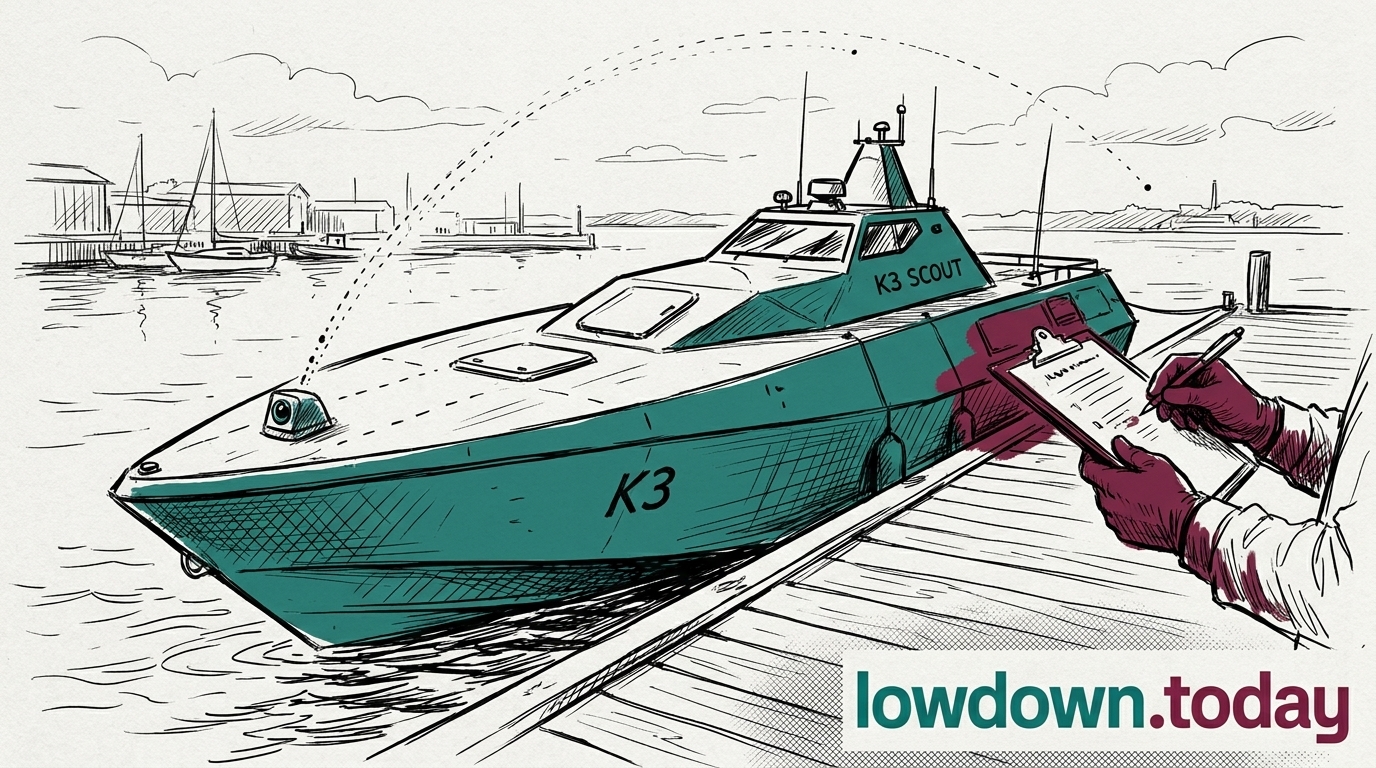
The Conservative opposition called on the Government on 9 August to 'urgently audit' equipment for hidden Chinese components, after the Telegraph's K3 SCOUT report. No named MP has been quoted on the record; the call came at party level, alongside the Ministry of Defence's own 10 August statement that no data had been compromised.
Netherlands Ministry of Defence
The Netherlands Ministry of Defence authorised Dutch Naval Design on 4 August to design 12-metre anti-submarine warfare uncrewed vessels for the Dutch-Belgian frigate programme, and to buy an adapted Compact FLASH dipping sonar from Thales Underwater Systems France. The order commits money and a named supplier while Britain's own certification body remains at the market-engagement stage.
Kraken Technology Group
Kraken Technology Group is a UK maritime-defence company based in Portsmouth that builds the K3 SCOUT, and crossed a $1bn valuation in July on a single-sourced $175m raise. The camera components reached the fleet under a third party's written security assurance, which the Platform Authority, which does not yet exist, was never positioned to check.
Navy Commercial
Navy Commercial
Navy Commercial at Whale Island published two notices on 5 August: 074032-2026, asking industry how to build a Platform Authority to certify uncrewed vessels, and 074351-2026, a GBP10m multi-role USV testbed for the Defence Chief Technology Officer. Responses on the Platform Authority close 19 August, ten days after the cameras were found transmitting to China.
Ministry of Defence
Ministry of Defence
The Ministry of Defence said on 10 August that a routine cyber vulnerability assessment found the camera fault, and a thorough investigation found no evidence that MoD data or systems had been accessed, compromised or transmitted externally. It stripped the cameras of internet connectivity but did not say whether it acted against the supplier.
Thales
Thales
Thales converted its 6 July engaging accord with Exail into a definitive combination agreement on 30-31 July, but the tender offer for Exail's remaining shares now closes by early 2028, later than July's timetable implied. Thales integrates its new undersea prime while still bidding against Kongsberg and DRASS's 2027 target for the AUKUS Pillar II contest.
