Skip to content
You can now search across every topic, entity and event.What's new
Autonomous Systems: Land & Sea
12AUG

Trump asks Zelenskyy for drone help

2 min read
14:17UTC

The US president publicly asked Ukraine for help countering Iranian Shaheds — reversing three years of one-directional military assistance on the same day the peace talks froze.

TechnologyDeveloping
Key takeaway

Trump's public request permanently reframes Ukraine as a security provider, not merely an aid recipient.

On 5 March, President Trump publicly asked Zelenskyy for help countering Iranian Shahed drones in the Middle East. "Trump will take 'any assistance from any country,'" Fortune reported 1. The request came the same day the trilateral was suspended — and Kyiv moved to exploit the opening within 48 hours.

Since February 2022, the US-Ukraine military relationship has flowed in one direction: Javelins, HIMARS, Patriots, and Storm Shadows from Washington to Kyiv. Trump's request reversed that current. Ukraine has spent three years developing electronic warfare countermeasures, radar signature catalogues, and interception protocols against the same Iranian-manufactured Shahed-136 drones now threatening US forces and Gulf partners. No NATO member has equivalent operational data, because no NATO member has faced sustained Shahed bombardment at the scale Ukraine has — over 8,800 kamikaze drones in a single day by early March .

Ukraine had already announced on 2 March that it would package its counter-drone knowledge — radar signatures, interception angles, electronic warfare countermeasures — as exportable expertise for non-NATO states facing Iranian-pattern threats . Trump's public request turned that policy declaration into a live negotiation with the world's largest defence buyer. The political calculus is direct: Zelenskyy gains leverage with a US president who has been ambivalent about sustained Ukraine support, and Trump gets a capability gap addressed without the procurement timelines that plague the US defence industrial base. The Kyiv Independent reported that Ukraine's backing of the US-Israeli campaign against Iran was explicitly designed to build favour with Trump 2.

Deep Analysis

In plain English

Since Russia invaded in 2022, the basic dynamic has been simple: the US and allies give Ukraine weapons, Ukraine fights Russia. Trump publicly asking Ukraine for military help — specifically counter-drone expertise — reverses that arrangement. Ukraine has spent three years learning to intercept Iranian Shahed drones through battlefield trial and error, and is now the world's most practised operator in this domain. By making the request publicly, Trump implicitly acknowledged that Ukraine has something Washington urgently needs. That acknowledgement cannot be quietly retracted — it is now part of the public record that Kyiv can cite whenever Washington applies pressure on other issues.

Deep Analysis
Synthesis

Trump's public request creates a record of US dependence on Ukrainian expertise that Zelenskyy can invoke in any future negotiation where Washington pressures Kyiv toward territorial concessions. The request cannot be walked back. This shifts the implicit terms of the entire relationship in ways that persist beyond the immediate drone transaction.

Root Causes

The US request reflects a structural gap in Western defence procurement: the Pentagon's acquisition system optimises for high-end platforms and has no streamlined pathway to absorb battlefield-tested counter-drone innovation at speed. Ukraine's advantage is a direct product of wartime necessity bypassing the procurement bureaucracy that NATO allies cannot circumvent in peacetime.

What could happen next?
  • Opportunity

    Ukraine can condition knowledge transfer on concrete ceasefire commitments, creating leverage independent of military aid flows.

    Immediate · Assessed
  • Precedent

    A US president publicly requesting military assistance from an active warzone partner establishes Kyiv as a security provider in the international record.

    Long term · Assessed
  • Risk

    If Ukraine provides expertise without securing binding commitments in return, it depletes its most novel leverage before the most critical negotiating phase.

    Short term · Suggested
First Reported In

Update #3 · Iran war halts talks, drains air defences

Fortune· 9 Mar 2026
Read original
Different Perspectives
Conservative opposition
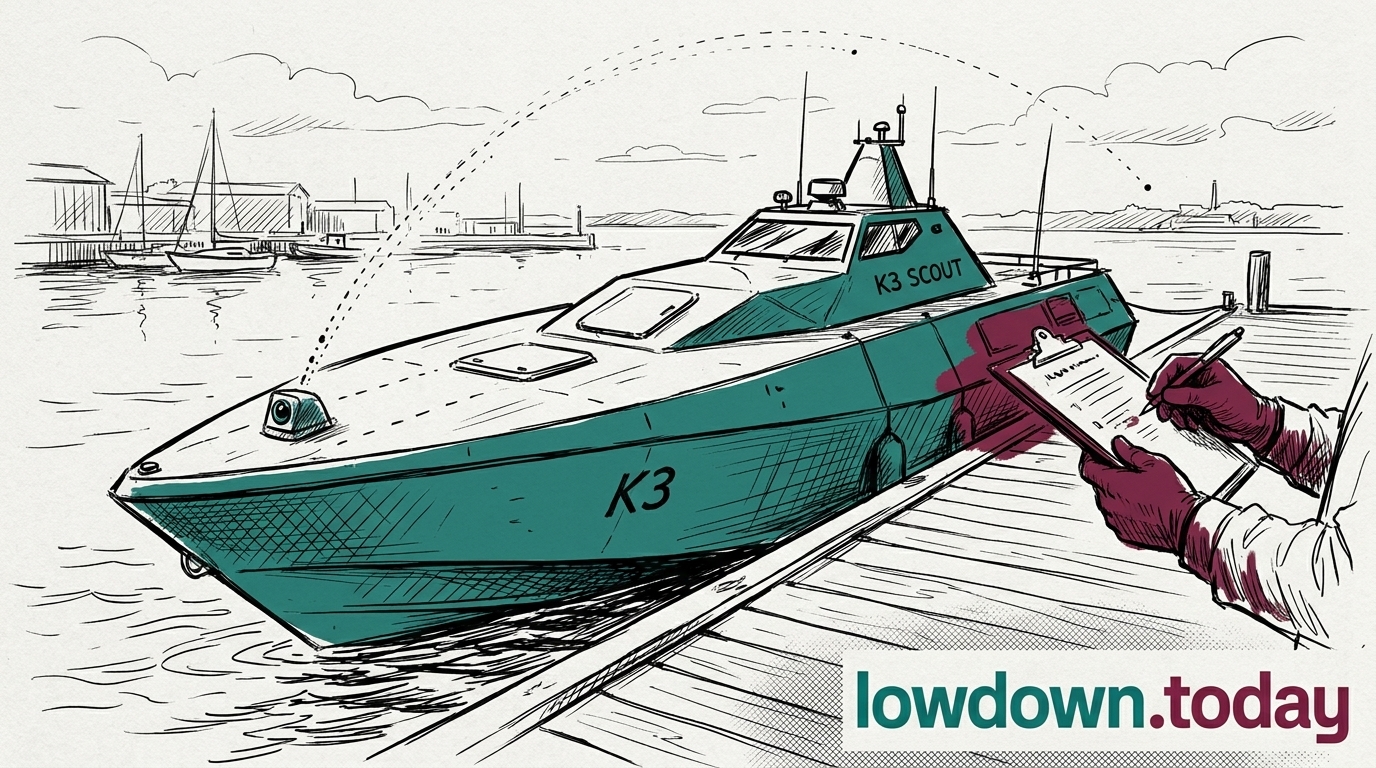
The Conservative opposition called on the Government on 9 August to 'urgently audit' equipment for hidden Chinese components, after the Telegraph's K3 SCOUT report. No named MP has been quoted on the record; the call came at party level, alongside the Ministry of Defence's own 10 August statement that no data had been compromised.
Netherlands Ministry of Defence
The Netherlands Ministry of Defence authorised Dutch Naval Design on 4 August to design 12-metre anti-submarine warfare uncrewed vessels for the Dutch-Belgian frigate programme, and to buy an adapted Compact FLASH dipping sonar from Thales Underwater Systems France. The order commits money and a named supplier while Britain's own certification body remains at the market-engagement stage.
Kraken Technology Group
Kraken Technology Group is a UK maritime-defence company based in Portsmouth that builds the K3 SCOUT, and crossed a $1bn valuation in July on a single-sourced $175m raise. The camera components reached the fleet under a third party's written security assurance, which the Platform Authority, which does not yet exist, was never positioned to check.
Navy Commercial
Navy Commercial
Navy Commercial at Whale Island published two notices on 5 August: 074032-2026, asking industry how to build a Platform Authority to certify uncrewed vessels, and 074351-2026, a GBP10m multi-role USV testbed for the Defence Chief Technology Officer. Responses on the Platform Authority close 19 August, ten days after the cameras were found transmitting to China.
Ministry of Defence
Ministry of Defence
The Ministry of Defence said on 10 August that a routine cyber vulnerability assessment found the camera fault, and a thorough investigation found no evidence that MoD data or systems had been accessed, compromised or transmitted externally. It stripped the cameras of internet connectivity but did not say whether it acted against the supplier.
Thales
Thales
Thales converted its 6 July engaging accord with Exail into a definitive combination agreement on 30-31 July, but the tender offer for Exail's remaining shares now closes by early 2028, later than July's timetable implied. Thales integrates its new undersea prime while still bidding against Kongsberg and DRASS's 2027 target for the AUKUS Pillar II contest.
