Skip to content
You can now search across every topic, entity and event.What's new
Autonomous Systems: Land & Sea
12AUG

Ukraine breaks ground on NATO-soil plant

2 min read
14:17UTC

Fire Point, the Ukrainian maker of the 3,000km Flamingo cruise missile, has begun building a rocket-fuel plant beside a Danish F-35 base, the first Ukrainian weapons production on NATO ground.

TechnologyDeveloping

Fire Point, the Ukrainian maker of the 3,000km Flamingo cruise missile, began building a solid-rocket-fuel plant at Skrydstrup, Denmark in early June, beside a Danish F-35 air base. Kyiv Post and Defence Express report it as the first Ukrainian weapons production on NATO (North Atlantic Treaty Organisation) soil 1. NATO is the 32-member collective defence alliance founded in 1949; until now its members supplied Ukraine, not the other way round.

That reverses the pipeline this topic has tracked for months. Western kit, money and combat data flowed into Ukraine; now Ukraine exports the manufacturing doctrine back out. President Volodymyr Zelensky proposed exactly this at the B9 and Nordic summit in mid-May, bilateral drone deals struck independent of US export approvals. Skrydstrup executes that policy in concrete and steel.

Ukraine built roughly 4 million drones in 2025, more than every NATO member combined, and targets 7 million in 2026 2. The plant on Danish soil also hands Russia a cleaner targeting argument than a hidden production line ever did. Russia's own drone and aircraft output is climbing fast, a parallel surge this briefing tracks separately .

Deep Analysis

In plain English

Fire Point is a Ukrainian company that builds a long-range missile called the Flamingo, capable of reaching targets 3,000 kilometres away. To make that missile work, you need solid rocket fuel, which is difficult to manufacture safely at scale. Ukraine's factories have been badly damaged by Russian attacks, so Fire Point is building its fuel plant in Denmark instead, next door to a Danish military airbase. This is the first time a Ukrainian weapons company has put a factory on NATO territory. It changes how Ukraine's war effort is plugged into the alliance: Ukraine is no longer just a recipient of weapons from NATO countries; it is now making weapons inside NATO.

Deep Analysis
Root Causes

Ukraine's domestic propellant production capacity was deliberately targeted by Russian missile strikes throughout 2023-2025. Fire Point's Flamingo requires solid rocket fuel that cannot be produced at adequate quality or scale inside Ukraine's depleted industrial base.

Denmark accepted the facility because its government had publicly committed to deeper bilateral defence cooperation with Ukraine at the B9 Nordic summit in May 2026 . Skrydstrup's co-location with an F-35 base is not coincidental: shared security perimeters reduce incremental protection costs for Denmark while signalling deterrence depth to Russia.

What could happen next?
  • Precedent

    Denmark hosting Fire Point opens a template for other NATO members to co-site Ukrainian production facilities, distributing Ukraine's defence industrial base across the alliance and hardening it against Russian strikes.

    Medium term · Assessed
  • Risk

    Russia may treat Skrydstrup as a legitimate military target under the laws of armed conflict, creating a new direct threat to Danish sovereign territory beyond the existing drone-incursion pattern.

    Short term · Suggested
  • Consequence

    NATO's legal directorate faces pressure to publish guidance on the co-belligerency question before additional facilities are announced; silence creates ambiguity that could be exploited by both Russia and domestic Danish politics.

    Short term · Assessed
First Reported In

Update #11 · Ukraine starts exporting the factory

Militarnyi· 7 Jun 2026
Read original
Different Perspectives
Conservative opposition
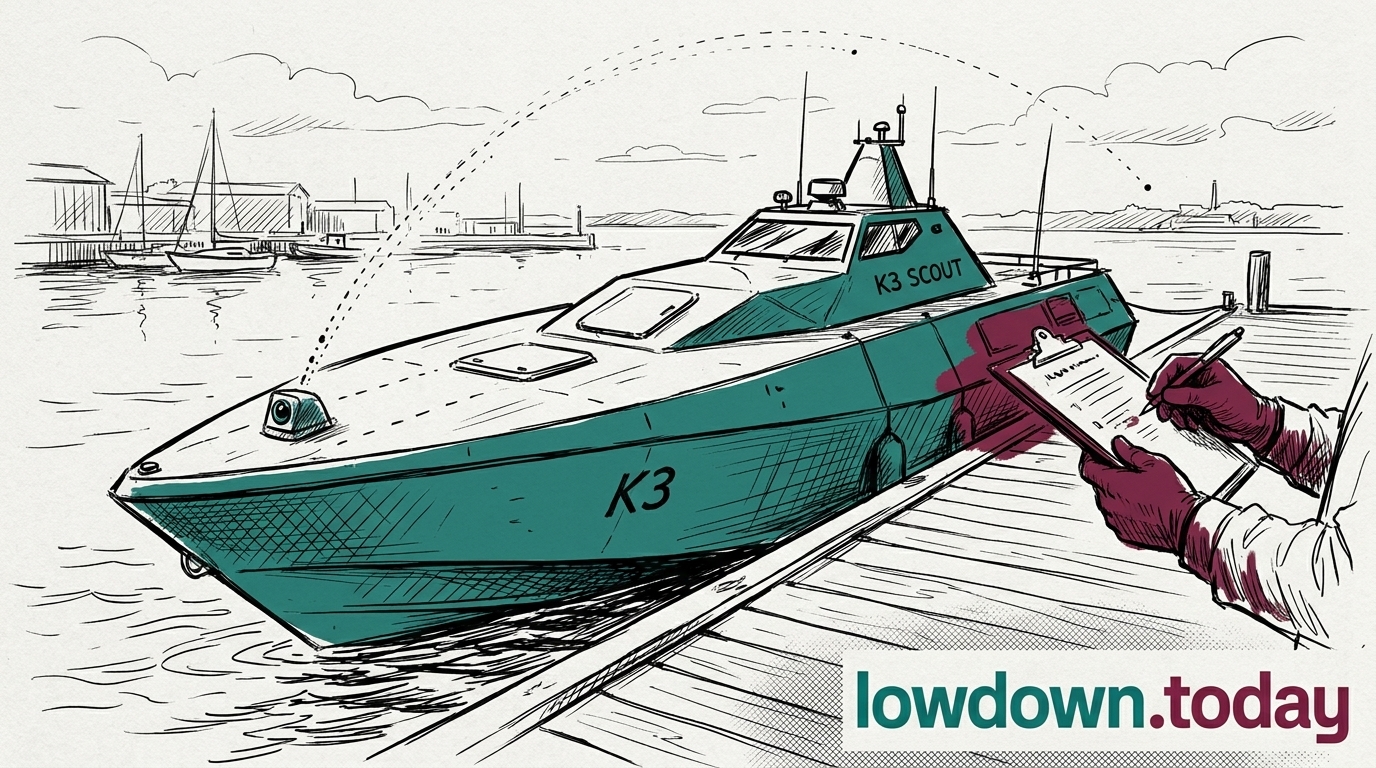
The Conservative opposition called on the Government on 9 August to 'urgently audit' equipment for hidden Chinese components, after the Telegraph's K3 SCOUT report. No named MP has been quoted on the record; the call came at party level, alongside the Ministry of Defence's own 10 August statement that no data had been compromised.
Netherlands Ministry of Defence
The Netherlands Ministry of Defence authorised Dutch Naval Design on 4 August to design 12-metre anti-submarine warfare uncrewed vessels for the Dutch-Belgian frigate programme, and to buy an adapted Compact FLASH dipping sonar from Thales Underwater Systems France. The order commits money and a named supplier while Britain's own certification body remains at the market-engagement stage.
Kraken Technology Group
Kraken Technology Group is a UK maritime-defence company based in Portsmouth that builds the K3 SCOUT, and crossed a $1bn valuation in July on a single-sourced $175m raise. The camera components reached the fleet under a third party's written security assurance, which the Platform Authority, which does not yet exist, was never positioned to check.
Navy Commercial
Navy Commercial
Navy Commercial at Whale Island published two notices on 5 August: 074032-2026, asking industry how to build a Platform Authority to certify uncrewed vessels, and 074351-2026, a GBP10m multi-role USV testbed for the Defence Chief Technology Officer. Responses on the Platform Authority close 19 August, ten days after the cameras were found transmitting to China.
Ministry of Defence
Ministry of Defence
The Ministry of Defence said on 10 August that a routine cyber vulnerability assessment found the camera fault, and a thorough investigation found no evidence that MoD data or systems had been accessed, compromised or transmitted externally. It stripped the cameras of internet connectivity but did not say whether it acted against the supplier.
Thales
Thales
Thales converted its 6 July engaging accord with Exail into a definitive combination agreement on 30-31 July, but the tender offer for Exail's remaining shares now closes by early 2028, later than July's timetable implied. Thales integrates its new undersea prime while still bidding against Kongsberg and DRASS's 2027 target for the AUKUS Pillar II contest.
