Skip to content
You can now search across every topic, entity and event.What's new
Autonomous Systems: Land & Sea
12AUG

Russia pushes on Kramatorsk from south

3 min read
14:17UTC

Pokrovsk fell in December. Russian forces are now grinding toward the twin cities that have anchored Ukraine's eastern defence for over a decade.

TechnologyAssessed
Key takeaway

Losing Kramatorsk-Sloviansk would collapse Ukraine's entire northern Donetsk defensive structure.

Pokrovsk fell to Russian forces in December 2025 after months of attritional urban combat. Russian troops are now advancing toward Kostiantynivka, the next fortified position on the approach to Kramatorsk and Sloviansk — the twin cities that have anchored Ukraine's eastern defence since 2014 1.

The operational sequence has been consistent since mid-2023. Russian forces took Bakhmut in May 2023 after approximately ten months of fighting, then Avdiivka in February 2024 after a four-month concentrated assault. Pokrovsk followed. Each capture removed a fortified node and shortened Russian supply lines for the next advance. Kostiantynivka is the final substantial urban position before the twin cities; its fall would open direct approach routes from the south toward Kramatorsk. The International Institute for Strategic Studies assessed in February 2026 that the trajectory in Donetsk is one of "escalation, not stalemate" 2.

Kramatorsk has functioned as the de facto capital of Ukrainian-held Donetsk since 2014, housing the regional military administration and command infrastructure for the eastern front. Sloviansk, fifteen kilometres north, carries particular weight: it was where Igor Girkin, a former Russian security service officer, led the armed seizure of government buildings in April 2014, initiating the armed conflict in the Donbas. Chief of the General Staff Gerasimov has framed the broader eastern operation as a sequential reduction of Ukrainian defensive nodes, and the advance from Pokrovsk toward Kostiantynivka follows that stated doctrine.

The military trajectory feeds directly into the diplomatic one. If Russian forces encircle or credibly threaten the twin cities, Ukraine's negotiating position at Abu Dhabi weakens materially — the territory under discussion shifts from contested to controlled. Ukraine's 300–400 sq km of February gains in the southern Zaporizhzhia–Dnipropetrovsk sector may represent an attempt to create counter-pressure: trading initiative in the south for time in the east, or building a bargaining chip that offsets Donetsk losses. Whether those southern gains hold through March — or whether Russia redeploys forces to contest them — will shape whether Ukraine enters the next negotiating round with leverage or without it.

Deep Analysis

In plain English

Pokrovsk was the main supply hub feeding Ukrainian troops across a wide stretch of the eastern front. With it gone, Russian forces can now attempt to surround Kramatorsk and Sloviansk — two cities that serve as headquarters, supply depots, and command centres for Ukraine's eastern defence. Think of them as the trunk from which all the eastern branches grow. If Russia encircles them, Ukraine faces the choice of catastrophic surrender or a chaotic withdrawal that could unravel the entire eastern line. This would be the largest single collapse of Ukrainian-held territory since Mariupol fell in April 2022.

Deep Analysis
Synthesis

The Pokrovsk-Kramatorsk axis is the hinge of the entire war's eastern phase. Russian capture of Kramatorsk-Sloviansk would produce the largest Ukrainian territorial collapse since Mariupol and fundamentally alter the negotiating geometry — giving Moscow a decisive military outcome to deploy in any talks, irrespective of progress elsewhere on the frontline.

Root Causes

Ukraine's inability to hold Pokrovsk reflects a structural manpower deficit: experienced battalions rotated too thin to hold every logistics node simultaneously. Ukraine's delayed conscription legislation in 2024 left critical sectors undermanned during the period when Pokrovsk was most vulnerable to encirclement.

Escalation

The advance toward Kostiantynivka indicates Russia has shifted operational mode from grinding attrition to deliberate encirclement. This is a qualitative escalation in ambition on the Donetsk axis, not merely incremental progress — it implies a campaign designed to achieve a decisive result rather than accumulate square kilometres.

What could happen next?
  • Risk

    Encirclement of Kramatorsk-Sloviansk would constitute the largest Ukrainian strategic collapse since the fall of Mariupol in April 2022.

    Medium term · Assessed
  • Consequence

    Loss of the twin cities would eliminate Ukraine's forward command-and-logistics infrastructure in northern Donetsk, forcing a wide westward retrenchment.

    Medium term · Assessed
  • Risk

    A decisive Russian operational victory on the Donetsk axis would strengthen Moscow's negotiating hand and reduce pressure to accept any territorial compromise.

    Short term · Suggested
  • Meaning

    The fall of Pokrovsk confirms that Ukraine's 2025 defensive posture in Donetsk was structurally unsustainable given the manpower and logistics constraints in play.

    Immediate · Assessed
First Reported In

Update #1 · Ukraine best month as Russia triples drones

IISS· 3 Mar 2026
Read original
Different Perspectives
Conservative opposition
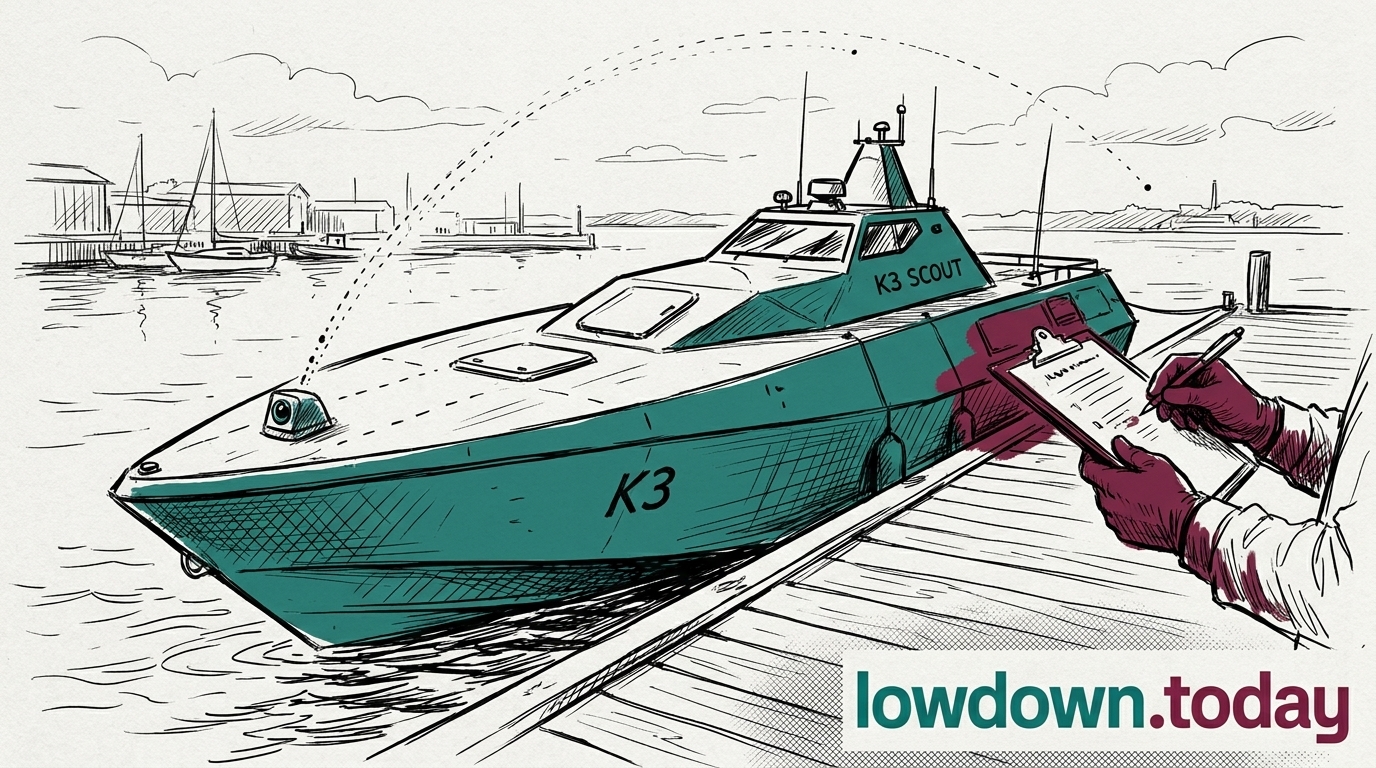
The Conservative opposition called on the Government on 9 August to 'urgently audit' equipment for hidden Chinese components, after the Telegraph's K3 SCOUT report. No named MP has been quoted on the record; the call came at party level, alongside the Ministry of Defence's own 10 August statement that no data had been compromised.
Netherlands Ministry of Defence
The Netherlands Ministry of Defence authorised Dutch Naval Design on 4 August to design 12-metre anti-submarine warfare uncrewed vessels for the Dutch-Belgian frigate programme, and to buy an adapted Compact FLASH dipping sonar from Thales Underwater Systems France. The order commits money and a named supplier while Britain's own certification body remains at the market-engagement stage.
Kraken Technology Group
Kraken Technology Group is a UK maritime-defence company based in Portsmouth that builds the K3 SCOUT, and crossed a $1bn valuation in July on a single-sourced $175m raise. The camera components reached the fleet under a third party's written security assurance, which the Platform Authority, which does not yet exist, was never positioned to check.
Navy Commercial
Navy Commercial
Navy Commercial at Whale Island published two notices on 5 August: 074032-2026, asking industry how to build a Platform Authority to certify uncrewed vessels, and 074351-2026, a GBP10m multi-role USV testbed for the Defence Chief Technology Officer. Responses on the Platform Authority close 19 August, ten days after the cameras were found transmitting to China.
Ministry of Defence
Ministry of Defence
The Ministry of Defence said on 10 August that a routine cyber vulnerability assessment found the camera fault, and a thorough investigation found no evidence that MoD data or systems had been accessed, compromised or transmitted externally. It stripped the cameras of internet connectivity but did not say whether it acted against the supplier.
Thales
Thales
Thales converted its 6 July engaging accord with Exail into a definitive combination agreement on 30-31 July, but the tender offer for Exail's remaining shares now closes by early 2028, later than July's timetable implied. Thales integrates its new undersea prime while still bidding against Kongsberg and DRASS's 2027 target for the AUKUS Pillar II contest.
