Skip to content
You can now search across every topic, entity and event.What's new
Autonomous Systems: Land & Sea
12AUG

286 clashes on 18 March — 2026 record

4 min read
14:17UTC

The Ukrainian front recorded 286 combat engagements and an estimated 1,710 Russian casualties on 18 March — both 2026 highs — with 7,466 kamikaze drones launched in a single day.

TechnologyDeveloping
Key takeaway

Russia is expending irreplaceable experienced personnel and costly munitions for no measurable territorial return.

The Ukrainian General Staff recorded 286 combat engagements on 18 March, the highest single-day total of 2026 and within reach of the all-time record of 311 set on 28 November 2025 1. Pokrovsk absorbed 72 assault actions and Kostiantynivka faced 46 — together accounting for 118 of the day's clashes. Estimated Russian casualties reached 1,710, the heaviest daily toll of the year 2. The aerial barrage was proportional: 7,466 kamikaze drones, 257 guided aerial bombs, and 78 airstrikes in a single 24-hour period.

The escalation was abrupt. On 17 March, the front recorded 171 engagements ; ground combat nearly doubled overnight. The concentration at Pokrovsk and Kostiantynivka confirms these as Russia's primary operational axes. Since Pokrovsk fell in December 2025 , Russian forces have pushed toward Kostiantynivka, aiming to encircle the KramatorskSloviansk twin cities that anchor Ukraine's eastern defence in Donetsk Oblast. The seizure of Hryshyne northwest of Pokrovsk days earlier removed what ISW and CEPA described as among the last defensible terrain before open steppe — the corridor between Pokrovsk and Kostiantynivka is now the front's centre of gravity.

The daily casualty figure of 1,710, if sustained over a month, would yield roughly 51,000 losses — well above the 30,000–32,000 monthly average recorded through early 2026 and more than double Russia's estimated recruitment of 22,000–22,700 per month. Commander-in-Chief Syrskyi reported a net personnel deficit of 9,000 per month in January . These are Ukrainian estimates; Russia does not publish comparable data. Mediazona's independent verification, drawn from obituaries, court records, and social media, had reached 203,300 confirmed Russian deaths by 13 March — a floor figure that by methodology undercounts total losses.

By 19 March, engagements dropped to 235 and drone volumes fell to 6,831, suggesting the 18 March peak was a surge rather than a new baseline. The broader trajectory is upward nonetheless: daily drone volumes have not fallen below 6,000 since mid-March, triple the 2025 average of 2,000–3,000 . Russia is expending personnel and munitions faster than it replaces them, yet continues to press both axes. The pattern points to a command decision to accept unsustainable attrition for territorial momentum — a calculation that depends on the Zaporizhzhia counteroffensive not forcing further redeployments south before the twin cities can be encircled.

Deep Analysis

In plain English

Russia launched nearly 7,500 suicide drones in a single day — roughly one every 12 seconds around the clock. Each drone costs tens of thousands of pounds to build and deploy. Despite this enormous outpouring of firepower, Russian forces achieved no breakthrough anywhere on the front. For Ukrainians, this means constant attacks on homes, power stations, and supply lines. For Western governments watching carefully, it raises a pointed question: how long can Russia sustain this level of spending when its financial reserves are draining and its soldiers are dying at record rates? The intensity is real, but so is the mounting bill.

Deep Analysis
Synthesis

The 7,466 drone figure implies Russian monthly Shahed-type procurement has reached approximately 180,000–220,000 units annualised. This volume is only sustainable through Iranian supply chains and domestic Alabuga facility production — neither of which Western sanctions have materially disrupted. The gap between stated sanction policy and actual enforcement (measurable in KleptoCapture's disbandment and the March oil waivers) is now visible in drone counts: a direct operational consequence of institutional hollowing.

Escalation

Drone volumes that have not fallen below 6,000 per day since mid-March signal a deliberate shift to industrial-scale attrition as a strategic substitute for manoeuvre warfare. The logical next step in this trajectory is escalation toward Ukrainian power generation infrastructure before winter — consistent with Russia's pattern in 2022–23 and 2024–25 — which would increase civilian displacement pressure on European states already hosting large Ukrainian refugee populations.

What could happen next?
  • Meaning

    Drone saturation at 7,000-plus per day has become Russia's primary operational mechanism — a structural shift in how the war is prosecuted, not a temporary surge.

    Immediate · Assessed
  • Consequence

    Ukrainian interceptor stocks — Patriot, NASAMS, and short-range systems — will deplete faster than Western resupply chains can replenish them, eventually degrading area coverage.

    Short term · Assessed
  • Risk

    If drone campaigns escalate toward power generation infrastructure ahead of winter, up to two million additional Ukrainian civilians could be displaced into EU member states.

    Medium term · Suggested
  • Opportunity

    The volume and frequency of Russian drone launch signatures provides Ukraine's ISR assets with consistent targeting data for counter-launch operations against staging areas and storage sites.

    Immediate · Suggested
First Reported In

Update #6 · Ukraine sends negotiators as front reverses

Kyiv Independent· 20 Mar 2026
Read original
Causes and effects
This Event
286 clashes on 18 March — 2026 record
Ground combat intensity is at its 2026 peak, concentrated on the Pokrovsk–Kostiantynivka corridor that guards the approach to Kramatorsk–Sloviansk. Daily Russian casualty estimates exceed recruitment capacity by more than double, yet Moscow shows no sign of reducing operational tempo.
Different Perspectives
Conservative opposition
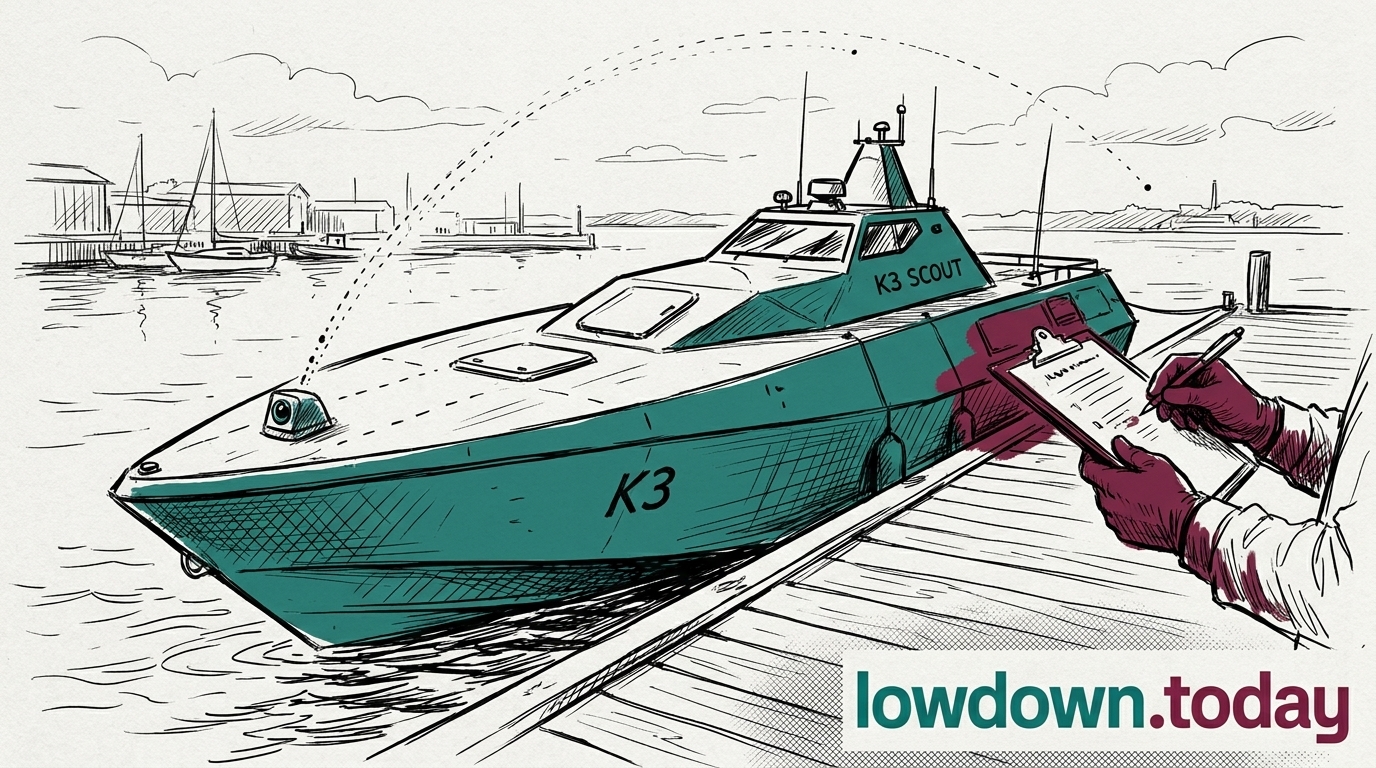
The Conservative opposition called on the Government on 9 August to 'urgently audit' equipment for hidden Chinese components, after the Telegraph's K3 SCOUT report. No named MP has been quoted on the record; the call came at party level, alongside the Ministry of Defence's own 10 August statement that no data had been compromised.
Netherlands Ministry of Defence
The Netherlands Ministry of Defence authorised Dutch Naval Design on 4 August to design 12-metre anti-submarine warfare uncrewed vessels for the Dutch-Belgian frigate programme, and to buy an adapted Compact FLASH dipping sonar from Thales Underwater Systems France. The order commits money and a named supplier while Britain's own certification body remains at the market-engagement stage.
Kraken Technology Group
Kraken Technology Group is a UK maritime-defence company based in Portsmouth that builds the K3 SCOUT, and crossed a $1bn valuation in July on a single-sourced $175m raise. The camera components reached the fleet under a third party's written security assurance, which the Platform Authority, which does not yet exist, was never positioned to check.
Navy Commercial
Navy Commercial
Navy Commercial at Whale Island published two notices on 5 August: 074032-2026, asking industry how to build a Platform Authority to certify uncrewed vessels, and 074351-2026, a GBP10m multi-role USV testbed for the Defence Chief Technology Officer. Responses on the Platform Authority close 19 August, ten days after the cameras were found transmitting to China.
Ministry of Defence
Ministry of Defence
The Ministry of Defence said on 10 August that a routine cyber vulnerability assessment found the camera fault, and a thorough investigation found no evidence that MoD data or systems had been accessed, compromised or transmitted externally. It stripped the cameras of internet connectivity but did not say whether it acted against the supplier.
Thales
Thales
Thales converted its 6 July engaging accord with Exail into a definitive combination agreement on 30-31 July, but the tender offer for Exail's remaining shares now closes by early 2028, later than July's timetable implied. Thales integrates its new undersea prime while still bidding against Kongsberg and DRASS's 2027 target for the AUKUS Pillar II contest.
