Skip to content
You can now search across every topic, entity and event.What's new
Autonomous Systems: Land & Sea
12AUG

Russia seizes Hryshyne near Pokrovsk

3 min read
14:17UTC

Russian forces take Hryshyne on what ISW calls the last defensible terrain before open steppe. Reserves are massing for a fresh offensive — even as Ukraine's Zaporizhzhia counteroffensive was meant to draw them south.

TechnologyDeveloping
Key takeaway

Pokrovsk's fall would breach the last defensible terrain before the Dnipro, risking operational-level collapse.

Russian forces seized Hryshyne, northwest of Pokrovsk, extending control over terrain that the Institute for the Study of War and the Center for European Policy Analysis have assessed as among the last defensible ground before the Donbas opens into flat steppe 1. Ukraine's Operation Task Force East reported Russia massing reserves near both Pokrovsk and Myrnohrad for a renewed push. The Pokrovsk-Dobropole corridor is now described as 'increasingly tense.'

Pokrovsk itself fell in December 2025 . Ukraine's southern counteroffensive in Zaporizhzhia — which reclaimed 460 sq km and eight settlements since late January — forced Russia to redeploy elite airborne and naval infantry away from the Donetsk axis. That redeployment was expected to ease pressure at Pokrovsk. It has not.

Russia's total force generation still exceeds what Ukraine can simultaneously contain on multiple axes. Even with a net monthly recruitment deficit of 9,000 , Russia retains enough MASS to concentrate forces at Pokrovsk while contesting the Zaporizhzhia gains further south. If the Pokrovsk-Dobropole line breaks, the terrain beyond offers few natural chokepoints — open agricultural land that favours the side with more artillery and air superiority over the contact zone. The Zaporizhzhia counteroffensive bought Ukraine strategic initiative in the south; it has not bought relief in the east.

Deep Analysis

In plain English

Pokrovsk is effectively a keystone in Ukraine's defensive wall in the Donbas. It is a major road and rail junction used to supply Ukrainian forces across the eastern front. Russian forces have just seized a nearby town called Hryshyne and are massing troops for a larger push. Military analysts say there are almost no natural obstacles — hills, rivers, forests — between Pokrovsk and the Dnipro River. If Russia breaks through here, its forces could advance rapidly across flat land without encountering a natural defensive barrier. That is why ISW and CEPA describe this as one of the most operationally dangerous sections of the entire front.

Deep Analysis
Synthesis

Read alongside Event 5, the Zaporizhzhia and Pokrovsk dual-axis geometry may represent the most dangerous operational configuration Ukraine has faced since the 2022 Kherson period. Russia may be using Zaporizhzhia as the publicly visible main effort precisely because doing so draws Ukrainian reserves away from the operationally decisive Pokrovsk axis.

Root Causes

Pokrovsk's exposure is structurally cumulative, not sudden. Each Russian gain since the fall of Lysychansk in 2022 has progressively stripped Ukrainian defensive depth in the Donbas. The town sits at the end of a chain of lost buffer zones — Avdiivka, Marinka, Vuhledar — that once absorbed exactly the pressure now directed at Pokrovsk itself.

Escalation

Events 5 and 6 together reveal a possible Russian sequential strategy: fix Ukrainian elite reserves in Zaporizhzhia with a declared primary axis, while fresh reserves pursue the Pokrovsk breakthrough on what appears a secondary axis. If that reading is correct, Ukraine faces a strategic trap where defending the declared threat exposes it to the operationally decisive one.

What could happen next?
2 risk1 consequence1 meaning1 opportunity
  • Risk

    Loss of Pokrovsk would sever Ukrainian supply lines across the Donetsk front, forcing a broad operational retreat across multiple sectors.

    Short term · Assessed
  • Risk

    Open steppe behind Pokrovsk offers no natural defensive fallback — a breakthrough could escalate to operational-level collapse across the Donbas.

    Short term · Assessed
  • Consequence

    A Russian Pokrovsk breakthrough would likely trigger mass civilian displacement and a new wave of Ukrainian refugees entering European countries.

    Medium term · Suggested
  • Meaning

    The Zaporizhzhia and Pokrovsk dual-axis geometry may represent the most dangerous operational configuration Ukraine has faced since 2022.

    Immediate · Suggested
  • Opportunity

    If Ukraine holds Pokrovsk while advancing in Zaporizhzhia, it may force Russia to redistribute reserves and relieve pressure on both axes simultaneously.

    Short term · Suggested
First Reported In

Update #5 · Trump frees 124m barrels; Russia earns €6bn

Ukrainian Ministry of Defence (mod.gov.ua)· 18 Mar 2026
Read original
Causes and effects
This Event
Russia seizes Hryshyne near Pokrovsk
Russia's seizure of Hryshyne and reserve concentration near Pokrovsk approaches what ISW and CEPA assess as the last defensible terrain before open Donbas steppe. If this line breaks, Ukraine loses the terrain advantage that has anchored its eastern defence since Pokrovsk fell in December 2025.
Different Perspectives
Conservative opposition
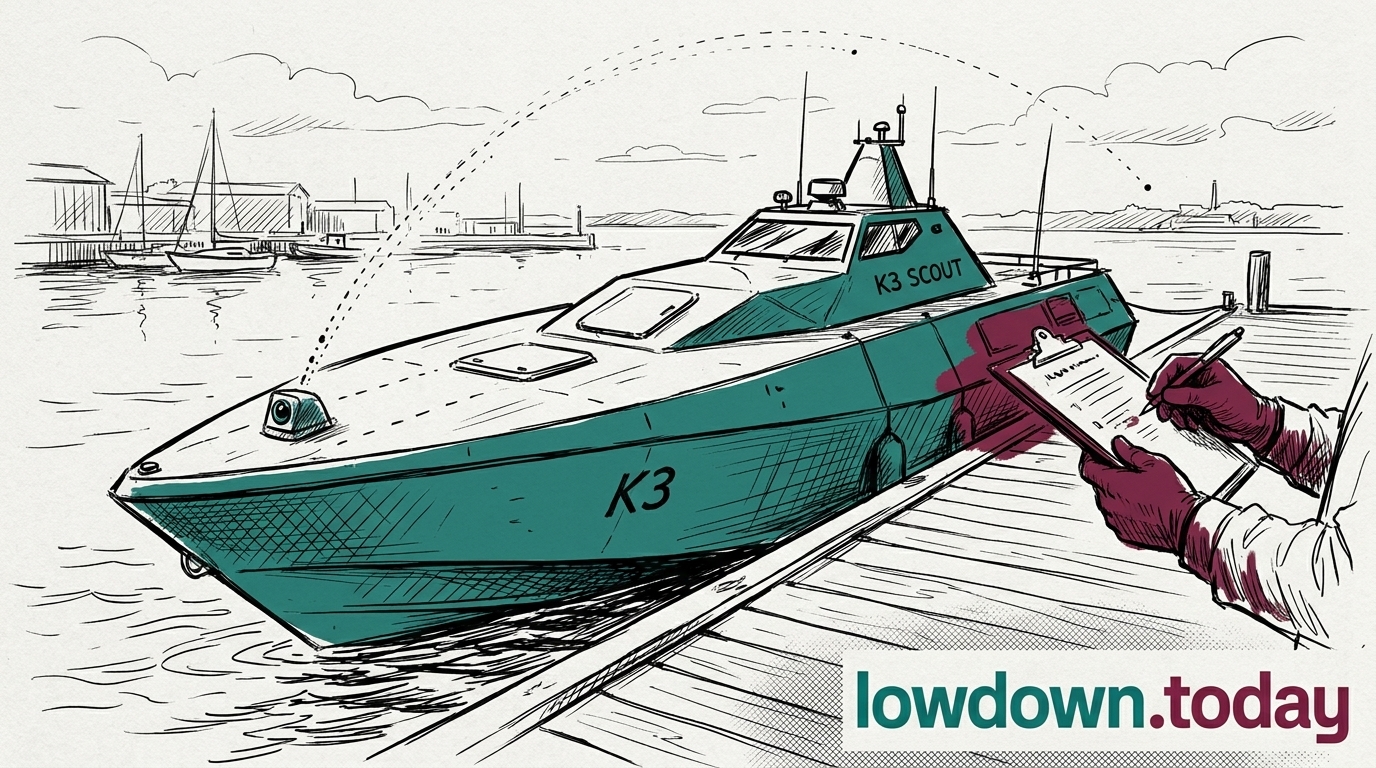
The Conservative opposition called on the Government on 9 August to 'urgently audit' equipment for hidden Chinese components, after the Telegraph's K3 SCOUT report. No named MP has been quoted on the record; the call came at party level, alongside the Ministry of Defence's own 10 August statement that no data had been compromised.
Netherlands Ministry of Defence
The Netherlands Ministry of Defence authorised Dutch Naval Design on 4 August to design 12-metre anti-submarine warfare uncrewed vessels for the Dutch-Belgian frigate programme, and to buy an adapted Compact FLASH dipping sonar from Thales Underwater Systems France. The order commits money and a named supplier while Britain's own certification body remains at the market-engagement stage.
Kraken Technology Group
Kraken Technology Group is a UK maritime-defence company based in Portsmouth that builds the K3 SCOUT, and crossed a $1bn valuation in July on a single-sourced $175m raise. The camera components reached the fleet under a third party's written security assurance, which the Platform Authority, which does not yet exist, was never positioned to check.
Navy Commercial
Navy Commercial
Navy Commercial at Whale Island published two notices on 5 August: 074032-2026, asking industry how to build a Platform Authority to certify uncrewed vessels, and 074351-2026, a GBP10m multi-role USV testbed for the Defence Chief Technology Officer. Responses on the Platform Authority close 19 August, ten days after the cameras were found transmitting to China.
Ministry of Defence
Ministry of Defence
The Ministry of Defence said on 10 August that a routine cyber vulnerability assessment found the camera fault, and a thorough investigation found no evidence that MoD data or systems had been accessed, compromised or transmitted externally. It stripped the cameras of internet connectivity but did not say whether it acted against the supplier.
Thales
Thales
Thales converted its 6 July engaging accord with Exail into a definitive combination agreement on 30-31 July, but the tender offer for Exail's remaining shares now closes by early 2028, later than July's timetable implied. Thales integrates its new undersea prime while still bidding against Kongsberg and DRASS's 2027 target for the AUKUS Pillar II contest.
