Skip to content
You can now search across every topic, entity and event.What's new
Autonomous Systems: Land & Sea
12AUG

Spring mud cuts engagements to 106

3 min read
14:17UTC

Combat engagements fell to 106 from 145 in two days — mud season, not restraint — as Russia presses three axes toward Kramatorsk and Sloviansk.

TechnologyDeveloping
Key takeaway

Spring thaw creates a reconstitution window; summer operations will reveal which side used it better.

106 combat engagements along the front line on 4 March, down from 145 on 2 March 1. The drop coincides with rasputitsa — the seasonal thaw that turns Ukraine's black earth into vehicle-swallowing mud. The pattern is consistent with reduced mechanised mobility, not reduced intent: infantry-led assaults continued across all active sectors.

The heaviest pressure fell on three axes. At Pokrovsk, which fell to Russian forces in December 2025 , attacks targeted Ukrainian positions west of Krasnoarmeysk — the next step in exploiting the city as a forward logistics platform. At Kostiantynivka, nine separate Russian assault actions hit Pleshchiivka, Sofiivka, and the approaches to Illinivka. These settlements sit on the routes to Kramatorsk and Sloviansk, the twin cities anchoring Ukraine's eastern defence; their encirclement has been Russia's stated operational objective for over a year. At Huliaipole, Russian forces pressed the Zaporizhzhia axis — the same sector where Commander-in-Chief Syrskyi reported Ukrainian forces recaptured 300–400 square kilometres during February .

Rasputitsa has constrained operations in this theatre for centuries; what changes is how armies compensate. The 8,828 Russian kamikaze drones launched in a single 24-hour period days earlier — roughly triple the 2025 daily average — suggest Moscow is substituting aerial volume for ground mobility. Drones are unaffected by mud, cheaper per sortie than artillery, and impose constant attrition on Ukrainian positions regardless of whether Russian armour can move. The operational tempo on 4 March was lower. The war of attrition was not.

Deep Analysis

In plain English

The 106 clashes on 4 March is down from 145 two days earlier — but this does not mean the war is cooling. Ukraine's terrain turns to deep mud in spring, making it physically impossible to move tanks and armoured vehicles cross-country. Both sides are still fighting; they simply cannot mass forces for large-scale pushes. The hardest fighting is concentrated on three fronts: near Pokrovsk (which Russia captured in December), near Kostiantynivka in central Donetsk, and at Huliaipole in the south. The Kostiantynivka axis is the most strategically consequential — Russian advances there would place direct pressure on Kramatorsk and Sloviansk, Ukraine's main administrative and logistics hub for the entire Donetsk front. Losing that urban complex would be more operationally damaging than Pokrovsk's fall.

Deep Analysis
Synthesis

Simultaneous Russian pressure on three geographically dispersed axes — Pokrovsk, Kostiantynivka, Huliaipole — reflects a classical economy-of-force attritional design rather than opportunistic advance. Maintaining pressure across all three vectors forces Ukraine to distribute reserves, preventing defensive concentration on any single threatened point. The operational goal is reserve depletion and positional degradation, not rapid breakthrough — consistent with Russian doctrinal preference for attrition over manoeuvre at this phase of the conflict.

Escalation

The engagement reduction is mechanistic, not political. Russian intent on all three axes is unchanged. The Kostiantynivka axis carries the highest strategic consequence: capture would position Russian forces for direct pressure on Kramatorsk-Sloviansk, Ukraine's primary Donetsk administrative and logistics hub. Loss of that complex would be operationally more severe than Pokrovsk's fall in December.

What could happen next?
  • Consequence

    Reduced spring engagement tempo creates a narrow reconstitution window for both sides before ground hardens and summer operational tempo resumes.

    Immediate · Assessed
  • Risk

    Russian success on the Kostiantynivka axis would bring direct pressure on Kramatorsk-Sloviansk, Ukraine's primary Donetsk logistics and administrative hub — operationally more consequential than Pokrovsk.

    Short term · Assessed
  • Meaning

    Three-axis simultaneous pressure indicates Russian force generation capacity remains sufficient for multi-vector attritional operations despite cumulative losses since 2022.

    Medium term · Assessed
First Reported In

Update #2 · Shadow fleet tanker sunk, talks seek venue

Russia Matters· 5 Mar 2026
Read original
Causes and effects
This Event
Spring mud cuts engagements to 106
Russia's offensive tempo toward Kramatorsk and Sloviansk continues across three axes despite seasonal constraints that have historically halted mechanised operations. The shift to infantry-led assault and intensified drone use suggests operational adaptation, not pause.
Different Perspectives
Conservative opposition
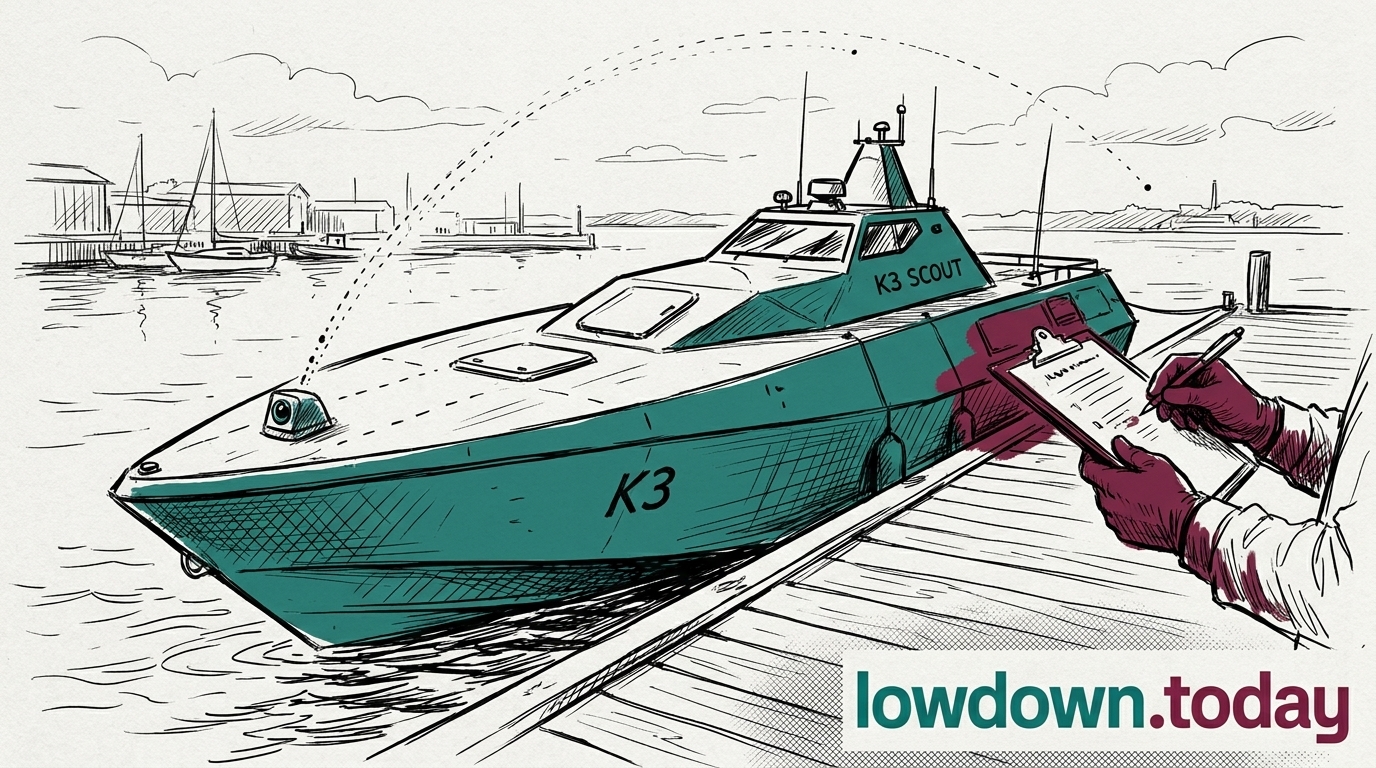
The Conservative opposition called on the Government on 9 August to 'urgently audit' equipment for hidden Chinese components, after the Telegraph's K3 SCOUT report. No named MP has been quoted on the record; the call came at party level, alongside the Ministry of Defence's own 10 August statement that no data had been compromised.
Netherlands Ministry of Defence
The Netherlands Ministry of Defence authorised Dutch Naval Design on 4 August to design 12-metre anti-submarine warfare uncrewed vessels for the Dutch-Belgian frigate programme, and to buy an adapted Compact FLASH dipping sonar from Thales Underwater Systems France. The order commits money and a named supplier while Britain's own certification body remains at the market-engagement stage.
Kraken Technology Group
Kraken Technology Group is a UK maritime-defence company based in Portsmouth that builds the K3 SCOUT, and crossed a $1bn valuation in July on a single-sourced $175m raise. The camera components reached the fleet under a third party's written security assurance, which the Platform Authority, which does not yet exist, was never positioned to check.
Navy Commercial
Navy Commercial
Navy Commercial at Whale Island published two notices on 5 August: 074032-2026, asking industry how to build a Platform Authority to certify uncrewed vessels, and 074351-2026, a GBP10m multi-role USV testbed for the Defence Chief Technology Officer. Responses on the Platform Authority close 19 August, ten days after the cameras were found transmitting to China.
Ministry of Defence
Ministry of Defence
The Ministry of Defence said on 10 August that a routine cyber vulnerability assessment found the camera fault, and a thorough investigation found no evidence that MoD data or systems had been accessed, compromised or transmitted externally. It stripped the cameras of internet connectivity but did not say whether it acted against the supplier.
Thales
Thales
Thales converted its 6 July engaging accord with Exail into a definitive combination agreement on 30-31 July, but the tender offer for Exail's remaining shares now closes by early 2028, later than July's timetable implied. Thales integrates its new undersea prime while still bidding against Kongsberg and DRASS's 2027 target for the AUKUS Pillar II contest.
