Skip to content
You can now search across every topic, entity and event.What's new
AI: Jobs, Power & Money
13JUN

Iran names Stargate AI centres as targets

4 min read
11:22UTC

The Islamic Revolutionary Guard Corps named Stargate UAE, the $500 billion OpenAI, SoftBank and Oracle joint venture, in a 1 April military targeting video. Amazon Web Services subsequently declared hard-down status for multiple zones after Iranian strikes on Bahrain and Dubai.

EconomicDeveloping
Key takeaway

Oracle-funded AI data centres are now in an active war zone; displaced workers carry the inflation and war risk.

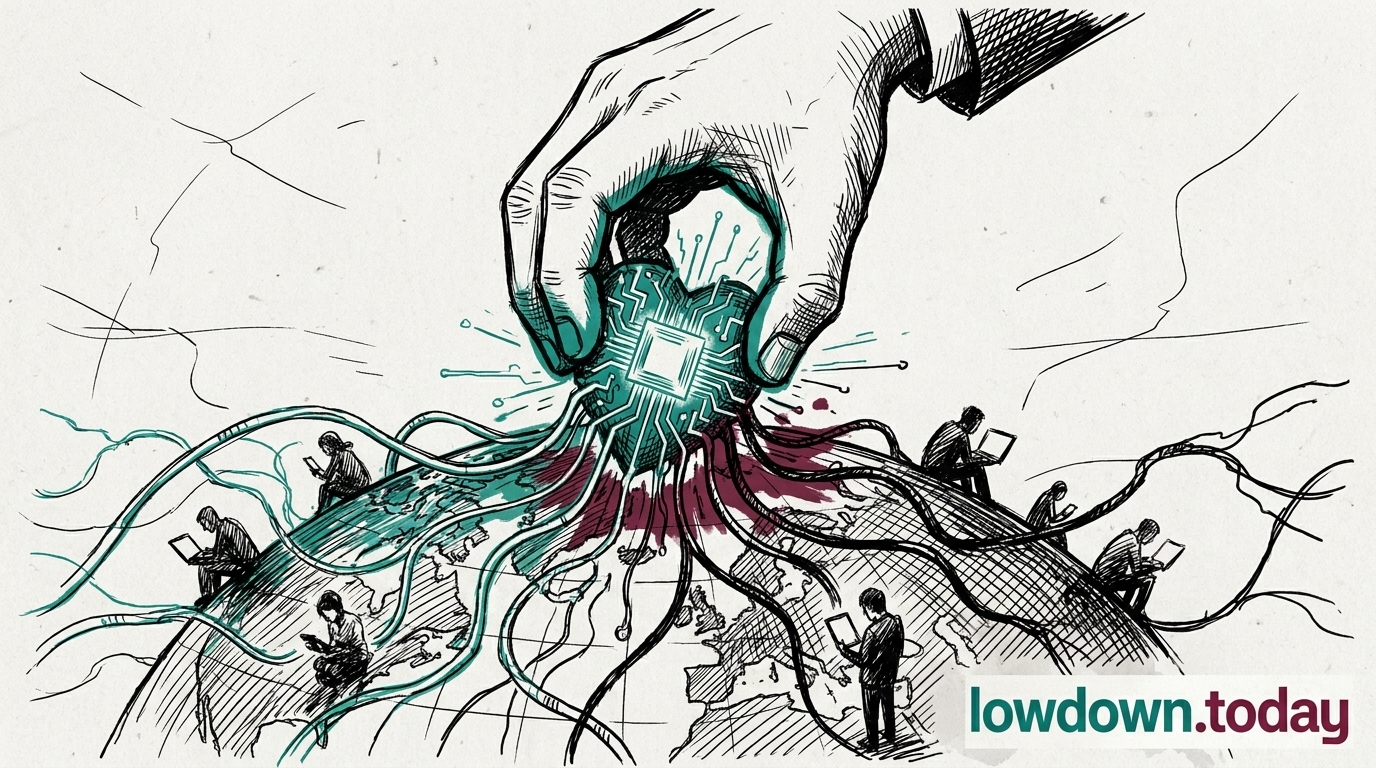
The Islamic Revolutionary Guard Corps (IRGC) named Stargate UAE, the $500 billion OpenAI, SoftBank and Oracle joint venture, in a 1 April 2026 military targeting video, the Iranian spokesperson adding the phrase "Nothing stays hidden to our sight". Amazon Web Services (AWS) subsequently declared "hard down status for multiple zones" after Iranian missile strikes on infrastructure in Bahrain and Dubai. Oracle's Dubai data centre had been struck in an earlier round. Nvidia and Apple were named in the same IRGC video.

The event sits inside the Iran-conflict-2026 story as a military and diplomatic matter; its relevance on this beat is that the capex displacing US workers now includes physical assets in an active war zone. Iran's earlier targeting video had named a broader group of US tech firms ; the IRGC's April escalation was the first to single out AI infrastructure specifically. For the workforce angle, the linkage is financial: Oracle funded its $156 billion data centre programme partly by terminating the bulk of its late-March workforce cuts , with a large Indian cohort notified by 6am email .

The capital that freed those jobs is now buying concrete and silicon that Iranian missiles are trying to hit. Goldman Sachs has calculated that data centre electricity demand adds roughly 0.1 percentage points to core US inflation in 2026 and 2027; a Strait of Hormuz closure with the associated gas-price spike would amplify the figure. The workers displaced to finance the capex absorb the inflation the capex generates, and now carry a physical war-risk exposure on the assets their severance helped build.

The Glasswing partner list includes Oracle alongside JPMorgan, Goldman Sachs and AWS ; the same institution therefore holds privileged access to the restricted frontier model that triggered the Bessent-Powell convening, and has physical assets under active IRGC threat funded by its own workforce cuts. That triple exposure, capital, capability and war risk, is the compressed version of the feedback loop this topic has been tracking. The precedent Iran has now set, that state militaries will treat AI capex as strategic infrastructure worth targeting, is likely to raise insurance and reinsurance pricing on Gulf data centre assets through 2026 and 2027, and to change the geographic distribution of future projects.


Deep Analysis

In plain English

Iran's military named specific US tech companies (including the joint OpenAI and Oracle project in the UAE called Stargate) as military targets in a video released in early April. Shortly after, Amazon's cloud service reported outages across several zones following missile strikes in the Gulf region. This matters beyond geopolitics: the same infrastructure that tech companies are building with money saved by laying off tens of thousands of workers is now physically at risk in an active conflict zone.

Deep Analysis
Root Causes

The IRGC's explicit naming of AI infrastructure as military targets reflects a structural condition in Iranian strategic doctrine: technology that multiplies adversarial military capability is categorised as a legitimate military target regardless of its primarily commercial use.

The $500 billion Stargate UAE venture's dual-use potential; AI models with confirmed autonomous attack-chaining capability (event index 4), deployed in a Gulf state that has signed the Abraham Accords; satisfies Iran's doctrinal threshold for targeting.

The Oracle data centre funding chain creates a second structural link: Oracle's $156 billion programme was funded in part by the 31 March 30,000-person layoff. Workers displaced to generate capex that builds infrastructure in an active conflict zone are absorbing a risk they did not consent to when their roles were eliminated.

The severance terms disclosed in Oracle's partial WARN filings (event index 10) do not reflect the physical risk premium embedded in the assets their displacement financed.

First Reported In

Update #6 · Three federal surveys, one 34-to-1 gap

Anthropic· 16 Apr 2026
Read original
Different Perspectives
India IT services and global capability centre workforce
India's in-house GCCs added roughly 200,000 net staff in fiscal 2026, nearly double the 110,000 added by the IT services firms feeding the same companies. The shift moves work toward captive centres while squeezing entry-level hiring at the outsourcing firms, reshaping where Indian tech careers begin as US clients cut staff at home.
EU workers and European labour institutions
The 93-4 committee vote locked the diluted Omnibus literacy clause before plenary: EU workers in AI-augmented but non-high-risk workplaces have no statutory right to demand an explanation until December 2027. The European Trade Union Confederation called the shift from 'ensure' to 'support' a legal threshold collapse, not a drafting compromise.
UK workforce and labour market
UK 16-to-24 unemployment reached 16.2% in the latest ONS reading, above the 15.2% pandemic peak and the highest since 2015. Britain is among the most AI-exposed labour markets this desk tracks, yet the Office for National Statistics still publishes no AI-attribution layer, so young workers face the displacement without official data naming its cause.
Anthropic and frontier AI labs subject to US jurisdiction
Anthropic complied with the directive but publicly disputed its application, citing that OpenAI's GPT-5.5 carried the identical jailbreak vulnerability and remained on sale. For any US-domiciled frontier lab, the action demonstrates that regulatory compliance and political alignment are now distinct variables: Anthropic backed the pro-regulation PAC and was the first lab Washington reached.
US national-security and export-control apparatus
The Lutnick directive treats runtime inference access by a foreign national as legally equivalent to exporting Claude Fable 5 and Mythos 5 to that person's home country. It established that a deployed consumer AI product can be withdrawn globally by regulatory letter, with no appeal period and no customer notice.
European workers and regulators
NBER working paper w34995 found European workers use generative AI at 32% versus 43% of US workers, a gap driven by management practice rather than regulation. The EU AI Act's high-risk employment deadline stays at December 2027, leaving European workers facing the same displacement curve two to four years behind the US.