
Skip to content
You can now search across every topic, entity and event.What's new
AI: Jobs, Power & Money
13JUN

Washington pulls a live AI model

2 min read
11:22UTC

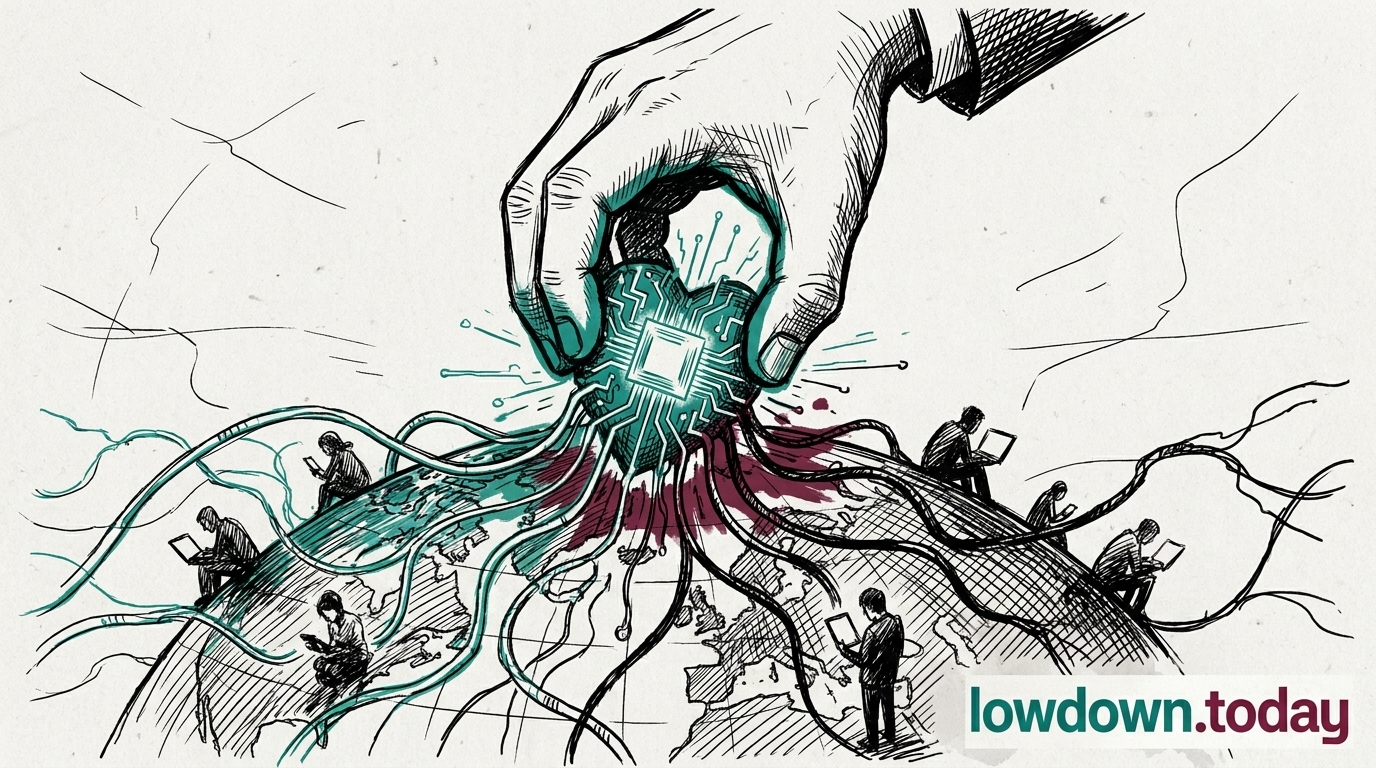
The US government ordered Anthropic to bar foreign nationals from its two newest Claude models, forcing the company to switch them off for every customer worldwide. Washington has moved from counting AI layoffs to seizing the models themselves, and the lab it hit first is the one that asked to be regulated. Hollywood's directors settle, US states write the disclosure law Congress will not, and OpenAI heads for an IPO while losing money on every dollar.

Key takeaway

Export law shut one AI lab while its rival stayed open; public capital is now asked to fund the gap.

This briefing mapped
Loading map…
Regulatory
Domestic
Economic

At 5:21pm Eastern on Friday 12 June, Commerce Secretary Howard Lutnick ordered Anthropic to bar foreign nationals from Claude Fable 5 and Mythos 5. The only way to comply was to switch both off for everyone on earth.

Sources profile:This story draws on mixed-leaning sources from United States
United States

On 12 June 2026, Commerce Secretary Howard Lutnick ordered Anthropic to bar all foreign nationals from Claude Fable 5 and Mythos 5. Those models cannot check nationality mid-conversation, so Anthropic switched both off for every customer on earth.

Lutnick used the deemed-export doctrine, a law built for chips, to reach a deployed consumer AI product. OpenAI's rival model carried the same jailbreak and stayed on sale. 

New York's A9581 passed both chambers on the strength of a Senate vote and now awaits Governor Hochul's signature. California cleared SB 951 through its labour committee 5-0 on Wednesday 10 June. Washington's own federal bill has not moved.

Sources profile:This story draws on neutral-leaning sources from United States
United States

New York's A9581 passed both chambers and awaits Governor Kathy Hochul's signature. The bill requires firms with 50 or more employees to file an annual report on how AI affects their hiring. California's SB 951 cleared a Senate committee 5-0 on 10 June.

Both bills answer a specific failure: New York's existing AI layoff-disclosure clause produced zero attributions from 162 companies covering 28,300 workers in its first year. States are filling the gap Congress has not. 

The Directors Guild reached a four-year AMPTP deal on Tuesday 9 June. Directors won the right to treat AI footage like a camera shot, but secured no training ban and no residual, with a 24.4% health-plan rise as their largest concrete gain.

Sources profile:This story draws on neutral-leaning sources

The Directors Guild of America reached a four-year deal with the studios' body on 9 June 2026. Directors won the right to treat AI-generated footage like camera footage, but secured no training ban and no royalty. Their main concrete gain was a 24.4% health-plan rise.

The guild closed in 29 days, fastest of three. Studios hold a settled template through 2030: AI permitted, workers keep nominal credit, no guild secured payment for AI-generated work. 

EU Parliament committees backed the Digital Omnibus 93-4 on Tuesday 2 June, sending it toward adoption before 2 August. The binding duty on employers to ensure staff understand AI is downgraded to an unenforceable promise to support it.

Sources profile:This story draws on neutral-leaning sources

EU Parliament committees approved the Digital Omnibus 93-4 on 2 June 2026, sending it toward adoption before 2 August. The package swaps the binding employer duty to ensure staff understand AI for an unenforceable promise to support that understanding.

For EU workers in AI-augmented jobs, the change removes the one statutory tool to demand an explanation from their employer. Binding AI employment rules under the AI Act arrive only in December 2027. 

OpenAI confirmed its IPO filing on 9 June, targeting a September listing above $1 trillion. Reported figures show roughly $2bn a month in revenue against a projected $14bn operating loss for 2026, with no positive cash flow expected until about 2030.

Sources profile:This story draws on centre-leaning sources from United States
United States
LeftRight

OpenAI confirmed on 9 June 2026 that it filed a draft prospectus targeting a September listing above $1 trillion. Reported figures show roughly $2bn a month in revenue against a projected $14bn operating loss for 2026, with no positive cash flow until about 2030.

Goldman Sachs, Morgan Stanley, and JPMorgan took the underwriting mandate. OpenAI's March 2026 round valued it at $852bn on roughly $122bn from Amazon, Nvidia, and SoftBank, bridging losses to a projected 2030 breakeven. 

Sources:Fortune
Closing comments

Up. The Lutnick directive raises the ceiling for US government intervention in AI deployment from study-and-report to runtime withdrawal without notice. The next escalatory step is a second lab facing a BIS action, which would confirm the channel as a repeatable policy tool. The competitive-reporting mechanism, if it becomes known as a viable route to imposing costs on rivals, creates an incentive for further filings. On the capital side, OpenAI's S-1 disclosure will, for the first time, submit the displacement thesis to public-market due diligence: if analysts at Goldman Sachs, Morgan Stanley and JPMorgan conclude the 2030 breakeven is not credible, a valuation correction cascades to every private AI company that took funding at 2025-26 prices. The EU has no near-term escalation path on worker rights before December 2027.

Different Perspectives
US national-security and export-control apparatus
The Lutnick directive treats runtime inference access by a foreign national as legally equivalent to exporting Claude Fable 5 and Mythos 5 to that person's home country. It established that a deployed consumer AI product can be withdrawn globally by regulatory letter, with no appeal period and no customer notice.
Anthropic and frontier AI labs subject to US jurisdiction
Anthropic complied with the directive but publicly disputed its application, citing that OpenAI's GPT-5.5 carried the identical jailbreak vulnerability and remained on sale. For any US-domiciled frontier lab, the action demonstrates that regulatory compliance and political alignment are now distinct variables: Anthropic backed the pro-regulation PAC and was the first lab Washington reached.
UK workforce and labour market
UK 16-to-24 unemployment reached 16.2% in the latest ONS reading, above the 15.2% pandemic peak and the highest since 2015. Britain is among the most AI-exposed labour markets this desk tracks, yet the Office for National Statistics still publishes no AI-attribution layer, so young workers face the displacement without official data naming its cause.
EU workers and European labour institutions
The 93-4 committee vote locked the diluted Omnibus literacy clause before plenary: EU workers in AI-augmented but non-high-risk workplaces have no statutory right to demand an explanation until December 2027. The European Trade Union Confederation called the shift from 'ensure' to 'support' a legal threshold collapse, not a drafting compromise.
India IT services and global capability centre workforce
India's in-house GCCs added roughly 200,000 net staff in fiscal 2026, nearly double the 110,000 added by the IT services firms feeding the same companies. The shift moves work toward captive centres while squeezing entry-level hiring at the outsourcing firms, reshaping where Indian tech careers begin as US clients cut staff at home.


