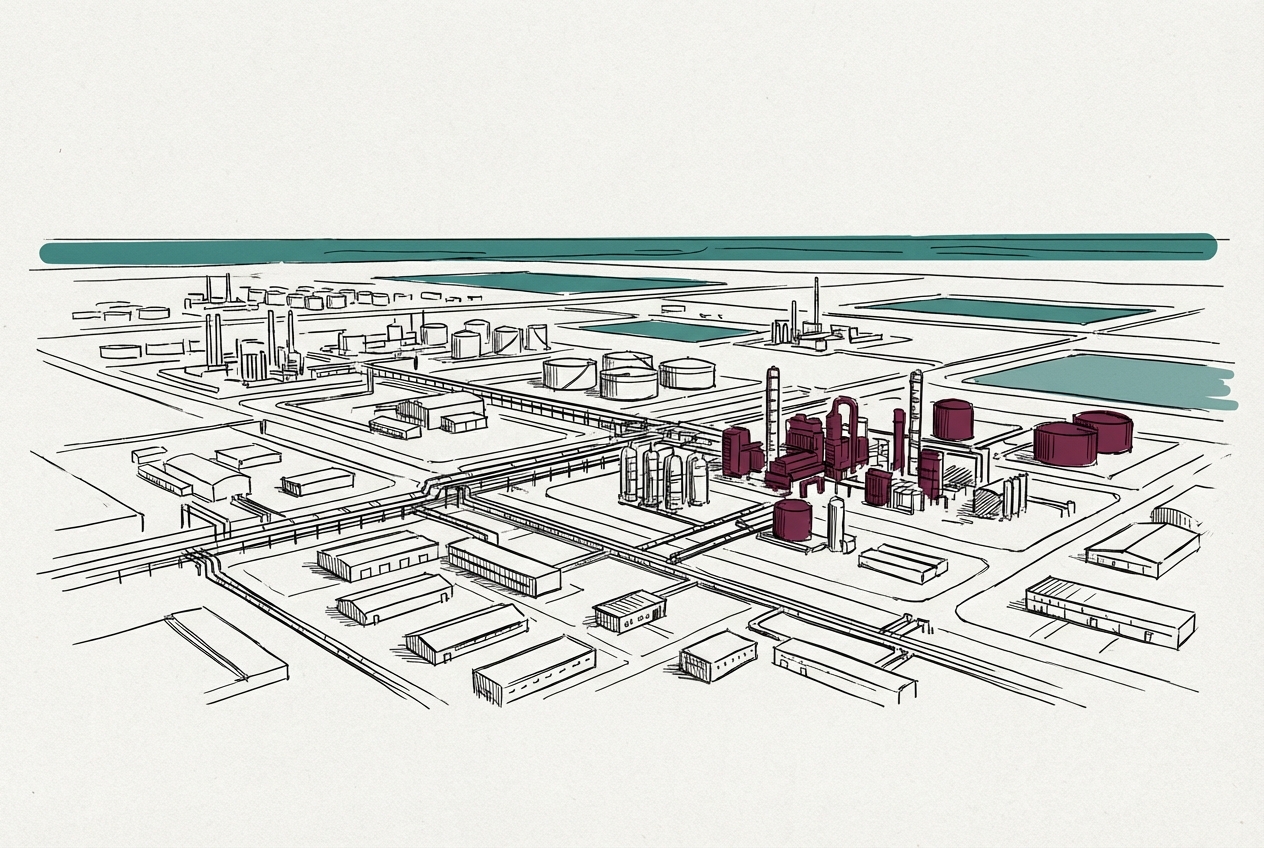
Habshan
UAE sour gas processing hub that bypasses the strait of Hormuz; struck during Iran conflict.
As of 19 August, Habshan remained UAE sour gas processing hub that bypasses the strait of Hormuz; struck during Iran conflict.
Last refreshed: 20 August 2026 · Appears in 1 active topic
If Habshan is approaching capacity, does the UAE's Hormuz bypass hit its ceiling in the next few weeks?
Timeline for Habshan
Mentioned in: DP World builds around the strait
Iran Conflict 2026Mentioned in: Gulf producers build around the strait
Iran Conflict 2026Mentioned in: Fujairah hits 1.62 mbpd; ADCOP nears cap
Iran Conflict 2026Mentioned in: Iran strikes five Gulf states on ceasefire day
Iran Conflict 2026Mentioned in: Habshan shut; UAE records first dead
Iran Conflict 2026Background
Habshan is a major onshore sour gas processing complex operated by ADNOC, located roughly 250 km southwest of Abu Dhabi city. Five processing trains handle combined throughput exceeding 4 bcf/day. The complex is also the origin point for the Habshan-Fujairah pipeline, a 750,000 bpd crude export line designed to route Gulf of Oman shipments and bypass the strait of Hormuz.
Habshan's relevance in Update 91 is as the upstream source terminal for the ADCOP pipeline feeding Fujairah on The Gulf of Oman. Crude flows through Fujairah reached 1.62 million bpd approaching the ADCOP 2 million bpd ceiling, and Khor Fakkan handling rose to 50,000 vessels per week, a 25-fold increase. If Habshan's throughput is at or near its processing ceiling, ADCOP's capacity ceiling is effectively fixed by the source terminal's output rather than the pipeline's design limit.
The IRGC's declared maritime control zones over UAE's eastern coastline represent a second layer of pressure on the Habshan-Fujairah system: Iran cannot easily strike Habshan directly without a major escalation against UAE territory, but maritime zone claims over Fujairah's offshore loading area achieve some of the same pressure at lower diplomatic cost. The infrastructure paradox from March 2026 has not resolved: the system was designed to bypass Hormuz, but its vulnerability to both physical damage (missile debris) and maritime interdiction (Gulf of Oman zone claims) is higher than the original bypass logic assumed.
What is the Habshan gas facility?
Was Habshan attacked by Iran?
Why did the UAE shut down Habshan?
What is the Habshan-Fujairah pipeline and why does it bypass Hormuz?
How does Habshan compare to Shah Gas Field?
What is the Habshan-Fujairah pipeline and why is it important?
Has Iran attacked UAE energy infrastructure?

