Skip to content
You can now search across every topic, entity and event.What's new
US Midterms 2026
7SEP

White House signs nothing on elections

3 min read
13:32UTC

Between Tuesday 28 April and Thursday 7 May, the Presidential Actions portal recorded three executive orders, none of them on voting, redistricting, the SAVE Act, or judicial nominations.

PoliticsDeveloping
Key takeaway

Two fortnights of zero election-related signings, with maximum institutional effect routed elsewhere.

The White House signed no executive order, proclamation, or pardon touching elections, voting, redistricting, the SAVE Act (Safeguard American Voter Eligibility Act), or judicial nominations between Tuesday 28 April and Thursday 7 May 2026. 1 The Presidential Actions portal records three executive orders in the window: a Cuba sanctions order on Friday 1 May, the TrumpIRA.gov retirement-savings order on Thursday 30 April, and a federal contracting efficiency order the same day.

The pattern compounds. This is the second consecutive fortnight in which the institutional architecture of the midterm map advances without an election-related instrument leaving the Resolute Desk. Louisiana v. Callais was decided by a Court three of whose justices President Donald Trump appointed; Pam Bondi's DOJ pressed the voter-data suits dismissed by five district courts; the Senate Republican majority confirmed Justin D. Smith to the 8th Circuit by unanimous consent on 20 April ; state legislatures in Texas and Florida moved on the executive's tempo.

Operational silence at the Resolute Desk has paired with maximum effect through aligned actors. Senator John Kennedy's SAVE Act reconciliation motion failed 48-50 on Monday 27 April when Susan Collins, Lisa Murkowski, Thom Tillis and Mitch McConnell voted against . The legislative route remains closed; SCOTUS, DOJ, and the state legislatures continue to deliver.

Deep Analysis

In plain English

Presidents often sign executive orders to signal their priorities and direct government agencies. But in the nearly two-week window from 28 April to 7 May, President Trump signed nothing related to elections, voting, or redistricting, even as his political allies were using courts and state governments to reshape electoral maps. The administration's electoral objectives are being achieved through institutions the executive has already shaped: the Supreme Court through judicial appointments, the Justice Department through the attorney general, and state governors through political alignment. Direct orders on voting rules would be blocked by the same courts that enjoined seven of the eight 31 March voting executive order provisions in early April. The result is that the most consequential changes to how Americans elect their representatives are happening without a single presidential signature.

Deep Analysis
Root Causes

The White House signed its last election-related executive order on 31 March 2026, which was blocked within 72 hours by three federal courts. That injunction pattern removed direct executive action on voting rules from the available toolkit for this window.

The structural alternative is already in place: three Trump judicial appointees sit on SCOTUS, Pam Bondi runs the Justice Department, and Republican governors in Florida, Tennessee, South Carolina, and Mississippi were ready to act on SCOTUS clearance. The alignment between the executive branch and aligned institutions is dense enough that presidential signature is not the bottleneck.

What could happen next?
  • Consequence

    With the legislative route to the SAVE Act closed and direct executive orders on voting blocked by courts, the redistricting and Justice Department voter-data tracks are the only active federal election-infrastructure tools through at least October 2026.

  • Risk

    The DOJ voter-data programme has now lost in five consecutive district court rulings; if the 9th Circuit affirms on 19 May, the programme effectively collapses without a legislative fix or a Supreme Court intervention.

First Reported In

Update #5 · Callais lands; maps move

The White House· 7 May 2026
Read original
Causes and effects
This Event
White House signs nothing on elections
The desk is quiet on election machinery while aligned institutions, courts, DOJ, state legislatures, deliver the same outcomes through their own instruments.
Different Perspectives
New Hampshire student voters
Students who hold no accepted photo ID under HB 323 cannot vote in the 8 September primary after Judge Laplante declined to block the law on timing grounds. Whether the same rule applies on 3 November is still open.
Alaska Democratic Party
The Alaska Democratic Party moved $884,835 in coordinated spending to Mary Peltola between 17 and 30 July, more than the DCCC spent nationally in the same fortnight.
National Republican Senatorial Committee
The NRSC, which sued to remove coordinated-spending caps in NRSC v. FEC, put $2,230,472 behind candidates in the first complete month after winning that case, more than double the total for the prior six months combined.
Supreme Court of Missouri
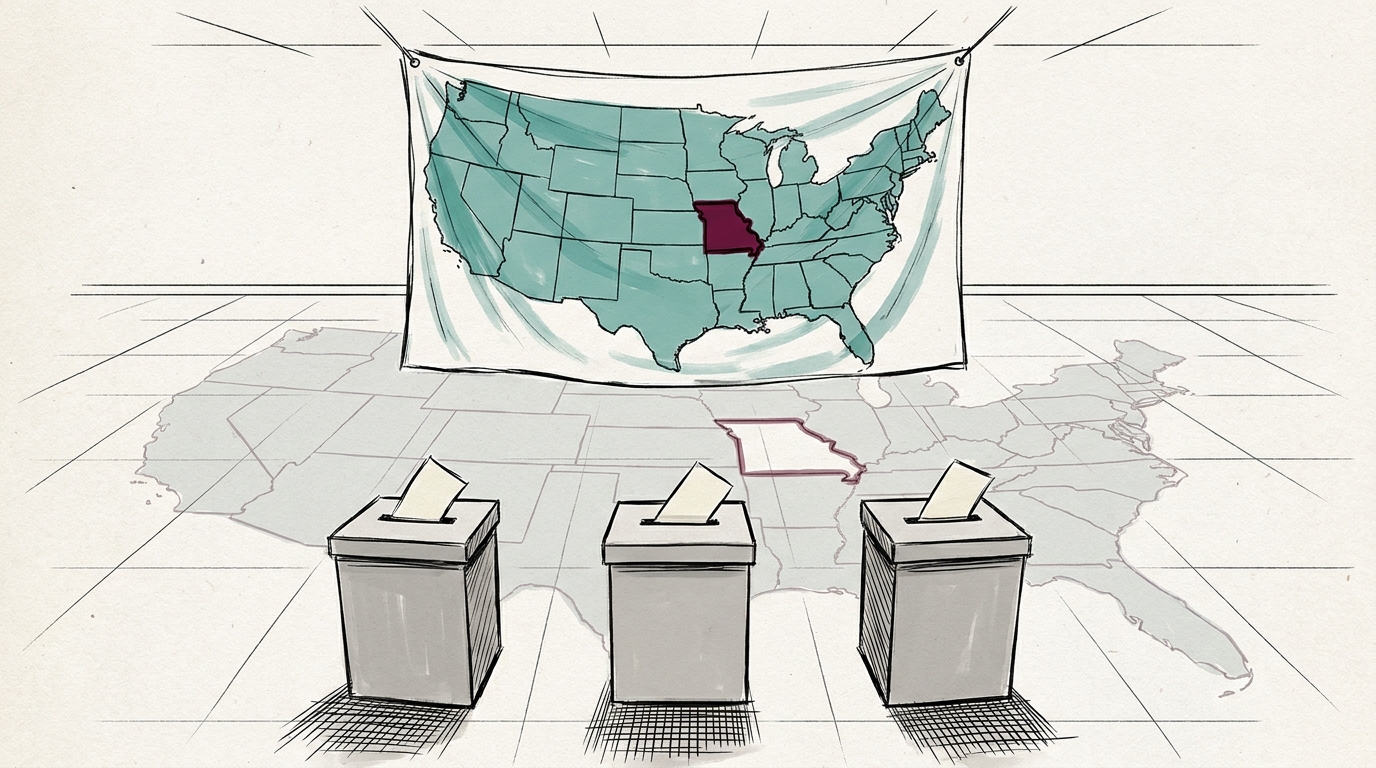
The unanimous court held that Article III, section 49 carries no redistricting exception, so a referendum petition against a congressional map is as valid as against any other law. It ordered the 2022 map to govern unless voters approve HB 1 on 3 November.
Denny Hoskins, Missouri Secretary of State
Hoskins told the Supreme Court that changing the congressional map after 1.2 million primary votes and ahead of the 19 September overseas-ballot deadline violates Purcell and the Elections Clause. He wants HB 1 reinstated before ballots print for November.
Senate Republican leadership
Floor time is finite at 51-47 with a bipartisan funding negotiation running, and a contested procedural fight over grant conditions is not the best use of it this month. Nothing has been abandoned; the resolution keeps its place on the calendar.
