Skip to content
Briefings are running a touch slower this week while we rebuild the foundations.See roadmap
Russia-Ukraine War 2026
27MAR

IRGC's 48th wave: three per day

3 min read
20:48UTC

Iran's 48th attack wave in 16 days hit Qatar and Saudi Arabia while Foreign Minister Araghchi demanded Gulf states expel US forces — a tempo that contradicts American claims of 90-95% degradation.

ConflictDeveloping
Key takeaway

Three waves per day across six states signals interceptor-depletion strategy, not symbolic retaliation.

The IRGC announced its 48th wave of Operation True Promise 4 on Saturday — roughly three attack waves per day since the war began on 28 February. Qatar absorbed 4 ballistic missiles and several drones, all intercepted. Saudi Arabia intercepted and destroyed 6 drones 1. Iranian Foreign Minister Araghchi called on neighbouring states to "expel foreign aggressors" 2.

The wave count is itself a measure of operational capacity. Defence Secretary Hegseth claimed on 12 March that Iran's missile volume was down 90% and drone launches down 95% . The IRGC's ability to sustain three waves daily across multiple countries sits uneasily with those figures — unless the pre-war baseline was far larger than US intelligence estimated, or the remaining inventory is being allocated with greater discipline than before.

Araghchi's demand follows a chain of command that bypasses Iran's civilian government entirely. Parliament Speaker Ghalibaf publicly reversed President Pezeshkian's 7 March order to halt Gulf strikes, declaring nations hosting US bases remained legitimate targets 3. The IRGC has treated that position as operational doctrine since. Qatar, which hosts Al Udeid Air Base — the forward headquarters of US Central Command and the nerve centre of the air campaign — absorbs Iranian missiles while simultaneously housing the command structure directing strikes on Iran.

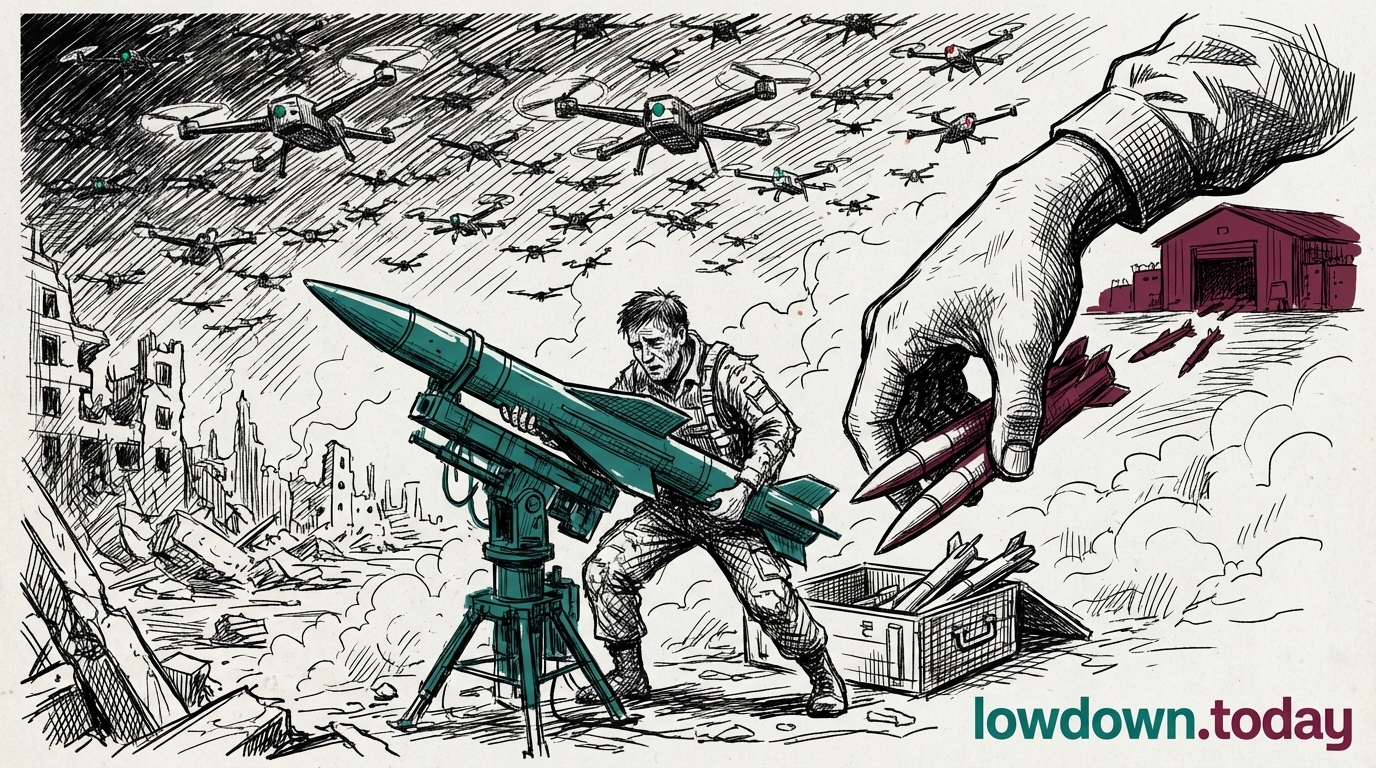
That contradiction has grown sharp enough for Hamas to publicly ask Tehran to stop hitting Gulf neighbours (Event 6). Saudi Arabia's interception of all six drones adds to a cumulative Gulf air defence tally exceeding 3,100 Iranian missiles and drones intercepted since 28 February . Interception rates have held. But the interceptor supply chain — Patriots, THAADs, and now 10,000 Merops drones diverted from Ukraine (Event 7) — is being consumed at rates no Gulf military has publicly disclosed.


Deep Analysis

In plain English

Iran has now launched 48 separate attack waves — averaging three per day — across the Gulf region under the name 'Operation True Promise 4,' continuing a series that began in April 2024. Each wave forces neighbouring countries to fire expensive interceptor missiles to shoot down cheaper Iranian drones and missiles. Iran's logic appears to be exhausting these defences faster than they can be restocked, rather than maximising immediate damage. Iran's Foreign Minister is simultaneously calling on Gulf governments to expel US forces — applying political pressure at the same time their militaries face physical attrition. The two tracks are designed to work together: military strain gives the political argument urgency.

Deep Analysis
Synthesis

FM Araghchi's 'expel foreign aggressors' call is a doctrine borrowed from Iran's Lebanon playbook: generate sufficient political pressure on host governments that they become the agents of US base removal, rather than Iran having to destroy those bases directly. Each Iranian strike on Kuwaiti or Qatari territory becomes Iran's argument that hosting US forces is the cause — shifting moral and legal responsibility onto the host nation.

The sequential wave numbering also normalises the campaign's continuation. By framing each wave as part of an explicit series, the IRGC signals that halting is a deliberate choice requiring political concessions — not a natural end-state — raising the cost of any ceasefire negotiation.

Root Causes

The 'True Promise' naming series is an IRGC institutional brand, not Foreign Ministry language. The IRGC's demonstrated operational autonomy from civilian command means wave count and target selection reflect IRGC strategic doctrine exclusively. The 48-wave public accounting also serves a domestic Iranian function: it provides the IRGC a public ledger justifying the campaign's scale to an Iranian population absorbing its own casualties — framing continued strikes as measured response rather than open-ended war.

Escalation

The 48-wave count combined with FM Araghchi's 'expel aggressors' statement reveals a two-track campaign: military attrition of interceptor stocks plus political pressure on host-nation governments. If either track succeeds — a country requests US forces depart, or a major air defence system is saturated — the strategic picture shifts rapidly. Direction: sustained escalatory pressure aimed at fracturing the US basing network politically rather than defeating it militarily. No deescalatory signal is present in either track.

What could happen next?
  • Risk

    Gulf air defence interceptor stocks may reach critical thresholds within 30–60 days at current wave frequency, creating coverage windows over oil infrastructure.

    Short term · Suggested
  • Consequence

    FM Araghchi's 'expel aggressors' framing creates domestic political pressure in Kuwait and Qatar that could constrain those governments' public support for US basing arrangements.

    Short term · Suggested
  • Precedent

    Operation True Promise 4 establishes that a non-nuclear state can sustain multi-front ballistic missile campaigns against six nations simultaneously, permanently reshaping regional deterrence calculations.

    Long term · Assessed
  • Risk

    The IRGC's operational independence from civilian command means no diplomatic signal from Tehran's elected government can reliably halt the wave campaign.

    Immediate · Assessed
First Reported In

Update #36 · Israel plans full Litani seizure

Al Jazeera· 15 Mar 2026
Read original
Causes and effects
This Event
IRGC's 48th wave: three per day
The IRGC's sustained three-wave-per-day tempo across multiple countries demonstrates operational capacity that contradicts US degradation claims. Araghchi's demand that Gulf states expel American forces formalises Iran's treatment of host nations as co-belligerents, raising the political cost of basing agreements across the region.
Different Perspectives
North Korea / DPRK
North Korea / DPRK
ISW confirmed the first mounting of DPRK Type-75 MLRS on Russian autonomous UGVs near Kharkiv on 7 June, the latest step in a supply axis that escalated from shells in 2023 to troops in 2024. Pyongyang gains live battlefield data on its ordnance and on Russia's uncrewed-systems programme.
IAEA / Rafael Grossi
Grossi confirmed Chornobyl structural damage with nuclear material metres away and could not attribute the ZNPP 15-hour blackout during the agreed repair window. Six ceasefires brokered and broken at ZNPP, compounded by Rosatom's May attack on IAEA neutrality, have eroded his ability to enforce the windows he negotiates.
Emmanuel Macron / France
Macron co-signed the E3 framework whose line-of-contact baseline marks Europe's first formal acceptance that 1991 borders are not the opening position. France's role carries weight because Macron had previously proposed a European force for Ukraine, and the framework's multinational force point is the vehicle for that.
Keir Starmer / E3
Keir Starmer / E3
Starmer, Macron and Merz met Zelenskyy on 7 June and backed a five-point framework taking the line of contact as the talks baseline, conceding roughly one fifth of Ukraine in exchange for a multinational force and frozen assets. With US mediation ended, the NATO Ankara summit on 7-8 July is the next test.
Vladimir Putin / Kremlin
Putin used SPIEF to reject Zelenskyy's summit letter, citing 'elements of rudeness', and repeated the pre-agreed treaty precondition that has frozen every diplomatic round since May. The SPIEF platform's message of investor confidence was punctured by naval fires visible from St Petersburg, which Moscow declined to dispute in scale.
Ukraine / Unmanned Systems Forces
Commander Brovdi confirmed USF units tracked and set fire to Boikyi at Kronstadt, while Code 9.2 struck the Chonhar Bridge the following day. Ukraine is sequencing strikes for rear-area interdiction and political timing rather than ground gains, trading the Baltic Fleet's home base for the logistics squeeze Russia cannot absorb without rationing its own occupied territory.



