Skip to content
You can now search across every topic, entity and event.What's new
Russia-Ukraine War 2026
23JUL

Trump orders blockade on a tweet

3 min read
20:33UTC

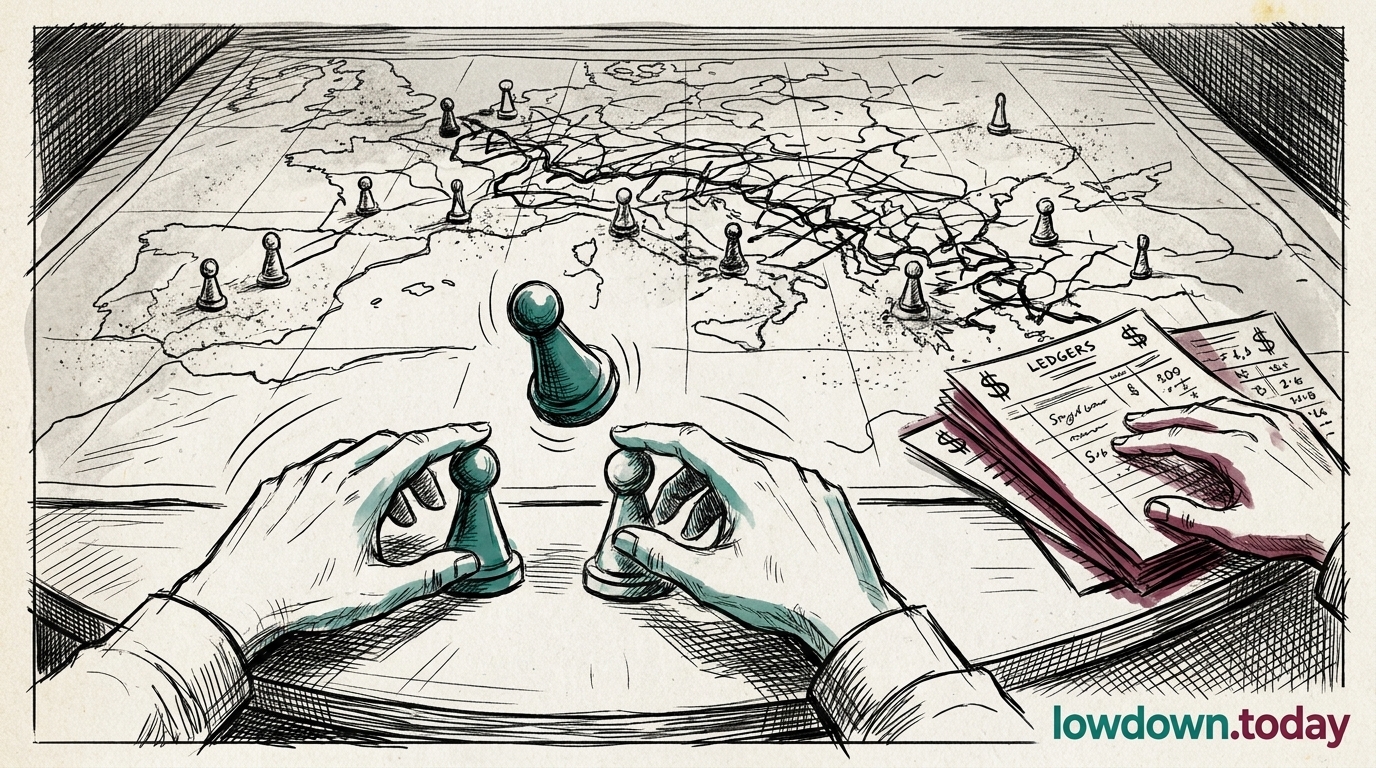
The US president announced a naval blockade of Iranian ports via Truth Social with no executive order, proclamation, or legal instrument of any kind.

ConflictDeveloping
Key takeaway

A naval blockade announced by social media post has no presidential instrument behind it.

Donald Trump posted on Truth Social on Saturday ordering the US Navy to "begin the process of BLOCKADING any and all Ships trying to enter, or leave, the Strait of Hormuz." He told reporters separately that the ceasefire was "holding well" and that Iran's "whole navy is under water." The two statements, issued hours apart, describe different wars.

After 45 days of conflict, The White House presidential-actions page shows zero Iran-related executive instruments . The pattern has repeated across five Hormuz ultimatums, the ceasefire declaration, and now the blockade . Each action was announced by social media rather than signed instrument. The legal gap is not accidental; it avoids congressional oversight triggers, allied consultation requirements, and judicial review.

Under international law, a blockade of a sovereign state's ports without formal legal authority exposes every interdicted vessel to UNCLOS (United Nations Convention on the Law of the Sea) arbitration. Flag states whose ships are stopped have grounds to file immediately. The legal void extends to every approaching deadline. GL-U (General License U) lapses 19 April , the ceasefire window closes around 22 April, and the WPR (War Powers Resolution) clock approaches its statutory limit near the end of the month. No signed presidential instrument backs any of them.


Deep Analysis

In plain English

On Sunday evening, President Trump posted on Truth Social , his social media platform , that the US Navy would blockade Iranian ports. A blockade means naval ships physically stop other vessels from reaching their destination. Here is the unusual part: normally when a US president orders a naval blockade, they sign a formal legal document called a proclamation or executive order. This creates a paper trail, informs Congress, and tells allied governments what the legal basis is. Trump did not do that. The blockade exists only as a social media post. When the US military (called CENTCOM) went to enforce it, they quietly narrowed the scope , because blockading an entire international waterway used by every nation's ships would have been diplomatically catastrophic. None of this narrowing was published either. The result: one of the most consequential naval actions in decades is operating without any written legal basis that courts, Congress, or allied governments can examine.

Deep Analysis
Root Causes

The zero-instrument pattern across 45 days of war reflects three structural conditions simultaneously.

First, congressional authorisation for military force was never sought. A formal AUMF or presidential proclamation triggers the 48-hour notification clock under the War Powers Resolution and opens the blockade to congressional challenge. The tweet format avoids that trigger while preserving presidential deniability if CENTCOM narrowed the order.

Second, IEEPA , the primary peacetime legal mechanism for economic warfare , requires a formal declaration of national emergency specific to Iran. The administration has been operating on a pre-existing Iran national emergency renewed in March 2026, but has not issued new Iran-specific emergency declarations. This constrains OFAC's ability to issue fresh sanctions and leaves the blockade without a civilian economic enforcement architecture.

Third, allied consultation requirements built into NATO Article 4 and bilateral Status of Forces Agreements are bypassed when no instrument is published. The UK, Germany, Australia, France, and Japan were all informed after the fact, which is why the UK coalition assembled as a counter-response rather than a parallel one.

What could happen next?
  • Risk

    Any country whose flag vessel is stopped under the tweet order has grounds to file UNCLOS arbitration immediately, since no sovereign legal instrument exists to contest , creating a cascade of international legal challenges.

    Short term · 0.82
  • Consequence

    The absence of a congressional notification means the 48-hour WPR clock may not have started, potentially extending the president's unilateral authority window , but also meaning no legal mechanism exists to wind the blockade down without a new tweet.

    Immediate · 0.75
  • Precedent

    If the blockade sustains without legal challenge succeeding, it normalises social-media executive action for future naval operations, eliminating the procedural safeguards that allied consultation and congressional notification were designed to provide.

    Long term · 0.7
First Reported In

Update #67 · Trump blockades Iran on a tweet

CENTCOM / Al Jazeera· 13 Apr 2026
Read original
Different Perspectives
IAEA (Rafael Grossi)
IAEA inspectors logged Zaporizhzhia's 22nd loss of off-site power, ten of them in the last three months, after a thunderstorm knocked out the plant's sole surviving backup line. Grossi reads the accelerating frequency, not any single outage, as the safety signal now that the plant's redundancy is exhausted.
United States (Treasury/OFAC)
Washington has let general licence 134C, its Russian crude waiver, lapse for 36 days with no successor, the longest gap of the war. Treasury has not said whether the non-renewal reflects deliberate policy or administrative delay, leaving buyers to price in compliance risk rather than wait for clarity.
Slovakia
Slovakia
Slovakia dropped its hold-out on the EU's 21st sanctions package only after winning a 2028 guarantee phasing out Russian gas, the exact pipeline dependency, roughly 80% of its crude supply, that gave it leverage. Bratislava's climbdown clears the package but leaves the same single-veto mechanism intact for the next round.
Russia (Kremlin and general staff)
General staff chief Gerasimov claimed Donetsk captures on 18 July that ISW says it cannot corroborate, extending a pattern ISW clocked at a 5:1 exaggeration ratio earlier this year. Moscow is conditioning its public for a possible autumn mobilisation after September's Duma elections rather than acknowledging the front has stalled.
Ukraine (Zelenskyy government)
Zelenskyy dismissed his commander-in-chief, defence minister and chief of general staff within eight days, replacing Syrskyi with Drapatyi and Hnatov with Skybiuk as protesters demanded Syrskyi go and Fedorov return. Kyiv frames the sweep as a bet on manoeuvre capacity ahead of a feared Russian autumn surge, not the disarray critics read into three changes in a week.
The United Kingdom
The United Kingdom
Starmer pledged £300 million in Kyiv on 16 July toward Ukraine's Gripen E squadron, adding to the PURL expansion Trump and Rutte had announced two days earlier. London is paying into a scheme built around a shortfall NATO's own published $4bn-plus pledge does not close against Zelenskyy's roughly $15bn stated need.



