Skip to content
You can now search across every topic, entity and event.What's new
Russia-Ukraine War 2026
16JUN

Carnegie: Iran war masks Kyiv's oil strike cost

3 min read
10:25UTC

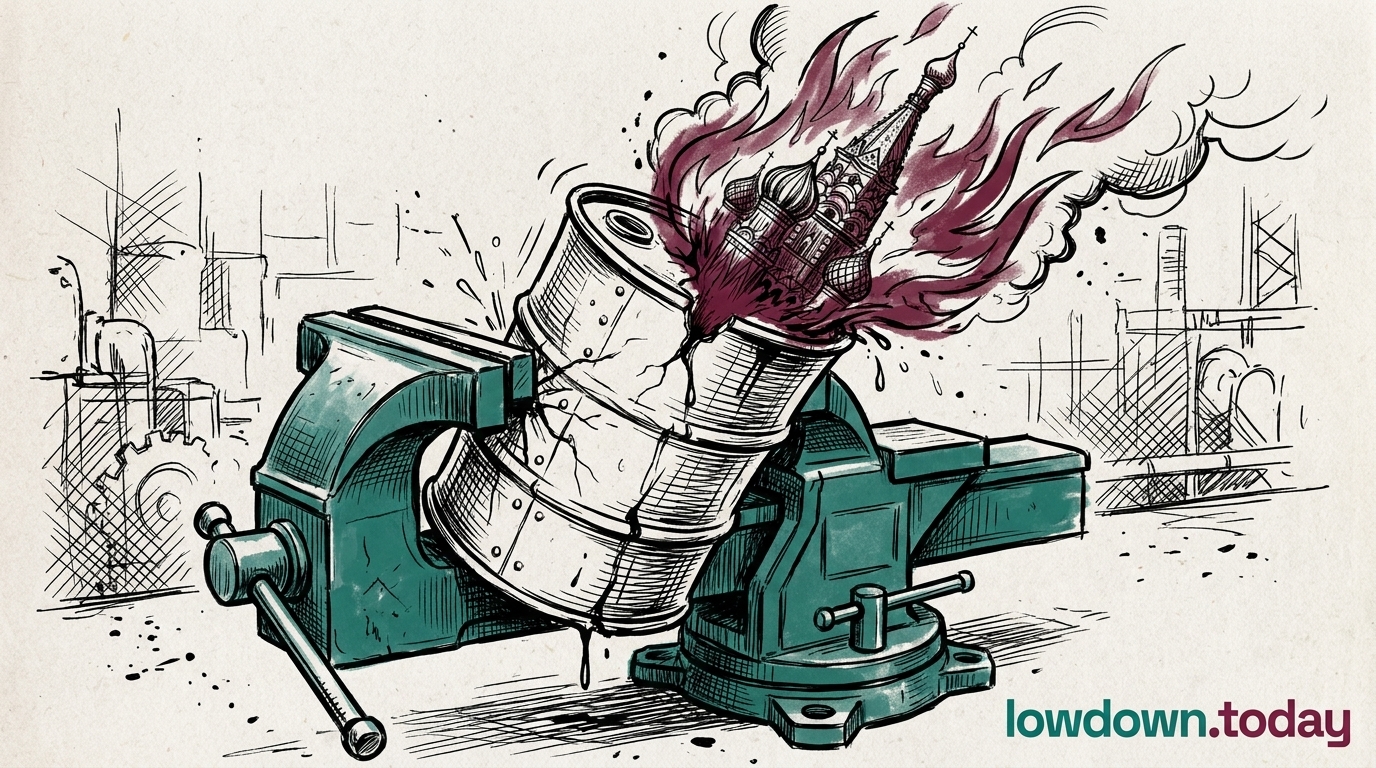
Carnegie put numbers on a paradox this week: Ukrainian strikes cut Russian crude exports by 33% between 25 March and 11 April, yet post-attack weekly revenues ran 62% above late February because the Iran conflict drove global prices higher.

ConflictAssessed
Key takeaway

Tehran's war is currently subsidising two thirds of Moscow's export revenue loss.

Analysts at the Carnegie Endowment for International Peace, a Washington-based non-partisan think tank, published a quantification in April showing that Ukrainian strikes cut Russian crude exports from 5.2 million to 3.5 million barrels per day between 25 March and 11 April, a 33% volume cut 1. Over the same period the Iran conflict drove global prices higher. Post-attack weekly revenues ran 17% below the preceding two weeks but 62% above late February. Carnegie's figures place the price offset above the volume loss on a common ledger for the first time.

Ukraine's oil strike campaign has been scaling since the Baltic terminal hits in late March, and Urals crude spiked through the Iran war's early-April phase . With Russian barrels displaced from the market and global demand elevated by Hormuz risk, the residual barrels Moscow sells clear at a premium that covers most of the shortfall. Tehran's war is functioning as Moscow's revenue insurance.

That subsidy is contingent. If the strait of Hormuz reopens and global prices fall, the fiscal squeeze Reshetnikov named in the same fortnight tightens directly. The UK-France planning conference at Northwood on 22 April is aimed at exactly that reopening, which means the same week's institutional calendar contains both the lever that keeps Russia's revenue high and the lever that would pull it down. Carnegie's quantification is the first analytical frame to price the link between the two theatres on a common ledger, and it positions Moscow's fiscal stability on an axis Moscow does not control at either end.


Deep Analysis

In plain English

Ukraine has been attacking Russia's oil export facilities: the ports, pipelines and tanks that Russia uses to sell oil abroad. That campaign cut Russia's oil exports by about a third between late March and mid-April. Normally that would hit Russia's income hard. But at the same time, a separate war between the US, Israel, and Iran drove global oil prices sharply higher, because Iran's threat to block the Strait of Hormuz: the narrow waterway through which 20% of global oil passes: made buyers nervous. Higher prices partially compensated Russia for selling less oil. It is an accidental subsidy from the Iran conflict to Russia's war chest.

What could happen next?
  • Risk

    A successful Hormuz reopening from the Northwood conference would depress Brent and Urals prices, removing the Iran-war price floor that currently offsets Ukraine's volume cut: tightening Russia's revenue position significantly without any new Ukrainian strike action required.

    Short term · 0.7
  • Opportunity

    Ukraine's energy strike campaign remains economically effective even when price offsets the volume impact: each destroyed refinery or dispatch station degrades domestic refined-product supply chains that cannot be offset by higher export prices, creating internal fuel shortages distinct from export revenue calculations.

    Medium term · 0.65
  • Risk

    Shadow fleet concentration on Russian National Reinsurance Company cover, driven by cumulative EU designations reaching 632 vessels, creates an unquantified tail risk: a single catastrophic tanker casualty could expose RNRC's capital inadequacy and trigger a fleet-wide insurance crisis.

    Medium term · 0.5
First Reported In

Update #14 · Kyiv's Druzhba gambit unlocks €90bn loan

Carnegie Endowment for International Peace· 24 Apr 2026
Read original
Different Perspectives
Turkey
Turkey
Ankara hosts the NATO summit on 7-8 July, the next Western diplomatic convergence that Russia may target with a mass barrage based on the documented pattern of timing strikes to allied events; Turkey's role as the indispensable logistical intermediary between Kyiv and Moscow gives it standing to broker any ceasefire repair at Zaporizhzhia.
IAEA
IAEA
The IAEA's sixth brokered repair ceasefire at ZNPP collapsed within days of enabling initial work on the 750 kV Dniprovska line, leaving Europe's largest nuclear plant on a single 330 kV backup with 19 total blackouts recorded since the Russian occupation began.
European Union
European Union
The EU delayed the €9.1bn first tranche of its €90bn Ukraine loan on unmet technical conditions, while disbursing a separate €2.8bn Facility payment on 8 June; the G7 sanctions-to-talks linkage now runs parallel to EU enforcement.
United Kingdom
United Kingdom
Britain conducted its first maritime interdiction of the Russian shadow fleet, with Royal Marines seizing the Smyrtos in the English Channel on 14 June, and simultaneously announced a £210m Urenco uranium deal to break Ukraine's dependence on Russian nuclear fuel.
United States
United States
Trump called both Putin and Zelenskyy separately on 14 June, pledged to re-engage on Ukraine now the Iran deal is done, and the G7 tied future Russia sanctions to peace-talk progress, giving Washington leverage over both parties' negotiating posture.
Ukraine
Ukraine
Zelenskyy attended the G7 at Evian and proposed a direct Putin summit while 140,000 households in Kyiv lost power and the Lavra's Dormition Cathedral burned; Metropolitan Epiphanius called it an attack "against history, against Christianity." Kyiv's immediate priority is closing the PAC-3 export gap that left 19 of 34 Iskander-M ballistic missiles unintercepted.


