Skip to content
Briefings are running a touch slower this week while we rebuild the foundations.See roadmap
Russia-Ukraine War 2026
5MAR

Fujairah hits 1.62 mbpd; ADCOP nears cap

4 min read
04:57UTC

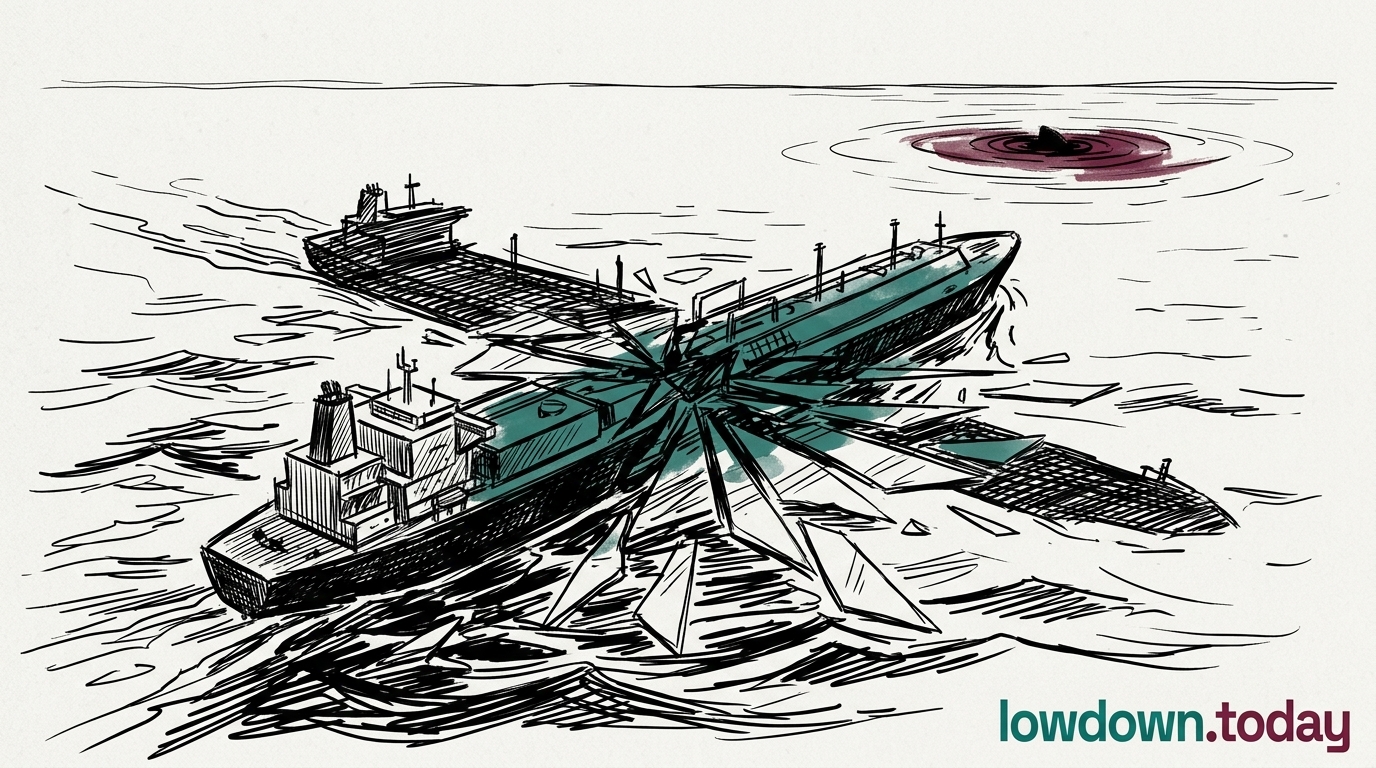
Crude flow through Fujairah reached 1.62 million bpd by late March, a 38% rise within reach of the ADCOP pipeline's 2 million bpd design ceiling, while Khor Fakkan container handling rose 25-fold to 50,000 vessels per week.

ConflictDeveloping
Key takeaway

The Hormuz bypass route is approaching its ceiling as the IRGC claims the water above it.

Crude flow through Fujairah rose from 1.17 mbpd in February to 1.62 mbpd by late March 1, a 38% increase that puts the port within reach of the Abu Dhabi Crude Oil Pipeline (ADCOP) design ceiling of 2 mbpd. Khor Fakkan container handling went from 2,000 to 50,000 vessels per week, a 25-fold rise; six container ships were berthed and ten waiting on the day of the report.

Fujairah and Khor Fakkan sit on the United Arab Emirates' eastern coast, on The Gulf of Oman side of the Strait of Hormuz. ADCOP runs 370 km from Habshan, a terminal in Abu Dhabi's interior, to Fujairah, bypassing the strait entirely. When Hormuz is closed or contested, every barrel that previously sailed out of the Persian Gulf has to find another route, and the two UAE eastern ports are the alternative.

That alternative is running out of room. ADCOP's 2 mbpd design ceiling has never been tested at sustained throughput. Pipeline infrastructure operating near design capacity under conflict-zone threat generates compressor and metering stress that maintenance schedules cannot absorb on a normal cycle; real-world ceiling likely sits 200,000 to 300,000 bpd below the published figure. The 1.62 mbpd reading leaves perhaps 80,000 to 180,000 bpd of usable headroom before the pipeline starts forcing maintenance trade-offs. Khor Fakkan's congestion is sharper still: a 25-fold rise in a year cannot be absorbed by adding berths on a weeks-to-months timeline.

The United Arab Emirates (UAE) foreign ministry has not commented directly on the legal pressure. The Islamic Revolutionary Guard Corps (IRGC) published a map on 5 May claiming maritime control zones along the UAE's eastern coastline, the legal escalation that followed the 4 May physical drone strike on the Fujairah Oil Industry Zone . The pattern is kinetic-then-legal: strike a target, then claim sovereignty over the water above it. International maritime law gives the IRGC's coastline claim no recognised standing, yet the 4 May drone strike demonstrated kinetic reach over the same water. If insurance markets price the legal claim, the bypass route's effective capacity falls before its physical capacity does.

A signed MOU would reopen Hormuz and end the toll system, taking the kinetic-then-legal pattern off the board. If Tehran's reply collapses against the 9 May expiry, the 380,000 bpd nominal headroom at Fujairah becomes the constraint that matters: the next significant Hormuz incident exhausts the surface alternative, and crude that cannot move by pipeline or by Khor Fakkan stays unloaded.

Deep Analysis

In plain English

The Strait of Hormuz is blocked, so oil that used to flow through it is going around the long way, through a pipeline in the UAE called ADCOP that runs from inland Abu Dhabi to the port of Fujairah on the UAE's eastern coast. By late March, that bypass route was handling 1.62 million barrels of oil per day. The problem: the pipeline was designed for 2 million barrels per day, and it is within about 380,000 barrels of that limit. Meanwhile, Iran's military struck the Fujairah oil terminal in a drone attack on 4 May and is now claiming legal authority over the sea in front of Fujairah. At current throughput growth rates, the bypass headroom runs out in roughly seven to nine weeks.

What could happen next?
  • Risk

    If the IRGC's 4 May drone strike on Fujairah Oil Industry Zone is followed by further kinetic action at the ADCOP terminal, the physical bypass capacity could drop below 1 million bpd within days, removing the only surface alternative to a blocked Hormuz.

  • Consequence

    Khor Fakkan's 25-fold rise to 50,000 vessels per week cannot be absorbed by berth expansion on any timeline shorter than 18 months; the congestion is a structural constraint, not a transient queue.

First Reported In

Update #91 · MOU in Tehran, missiles in the strait

AGBI· 8 May 2026
Read original
Causes and effects
This Event
Fujairah hits 1.62 mbpd; ADCOP nears cap
The only surface route around a blocked Hormuz is approaching its design ceiling at exactly the moment the IRGC is claiming legal authority over the water above it.
Different Perspectives
North Korea / DPRK
North Korea / DPRK
ISW confirmed the first mounting of DPRK Type-75 MLRS on Russian autonomous UGVs near Kharkiv on 7 June, the latest step in a supply axis that escalated from shells in 2023 to troops in 2024. Pyongyang gains live battlefield data on its ordnance and on Russia's uncrewed-systems programme.
IAEA / Rafael Grossi
Grossi confirmed Chornobyl structural damage with nuclear material metres away and could not attribute the ZNPP 15-hour blackout during the agreed repair window. Six ceasefires brokered and broken at ZNPP, compounded by Rosatom's May attack on IAEA neutrality, have eroded his ability to enforce the windows he negotiates.
Emmanuel Macron / France
Macron co-signed the E3 framework whose line-of-contact baseline marks Europe's first formal acceptance that 1991 borders are not the opening position. France's role carries weight because Macron had previously proposed a European force for Ukraine, and the framework's multinational force point is the vehicle for that.
Keir Starmer / E3
Keir Starmer / E3
Starmer, Macron and Merz met Zelenskyy on 7 June and backed a five-point framework taking the line of contact as the talks baseline, conceding roughly one fifth of Ukraine in exchange for a multinational force and frozen assets. With US mediation ended, the NATO Ankara summit on 7-8 July is the next test.
Vladimir Putin / Kremlin
Putin used SPIEF to reject Zelenskyy's summit letter, citing 'elements of rudeness', and repeated the pre-agreed treaty precondition that has frozen every diplomatic round since May. The SPIEF platform's message of investor confidence was punctured by naval fires visible from St Petersburg, which Moscow declined to dispute in scale.
Ukraine / Unmanned Systems Forces
Commander Brovdi confirmed USF units tracked and set fire to Boikyi at Kronstadt, while Code 9.2 struck the Chonhar Bridge the following day. Ukraine is sequencing strikes for rear-area interdiction and political timing rather than ground gains, trading the Baltic Fleet's home base for the logistics squeeze Russia cannot absorb without rationing its own occupied territory.