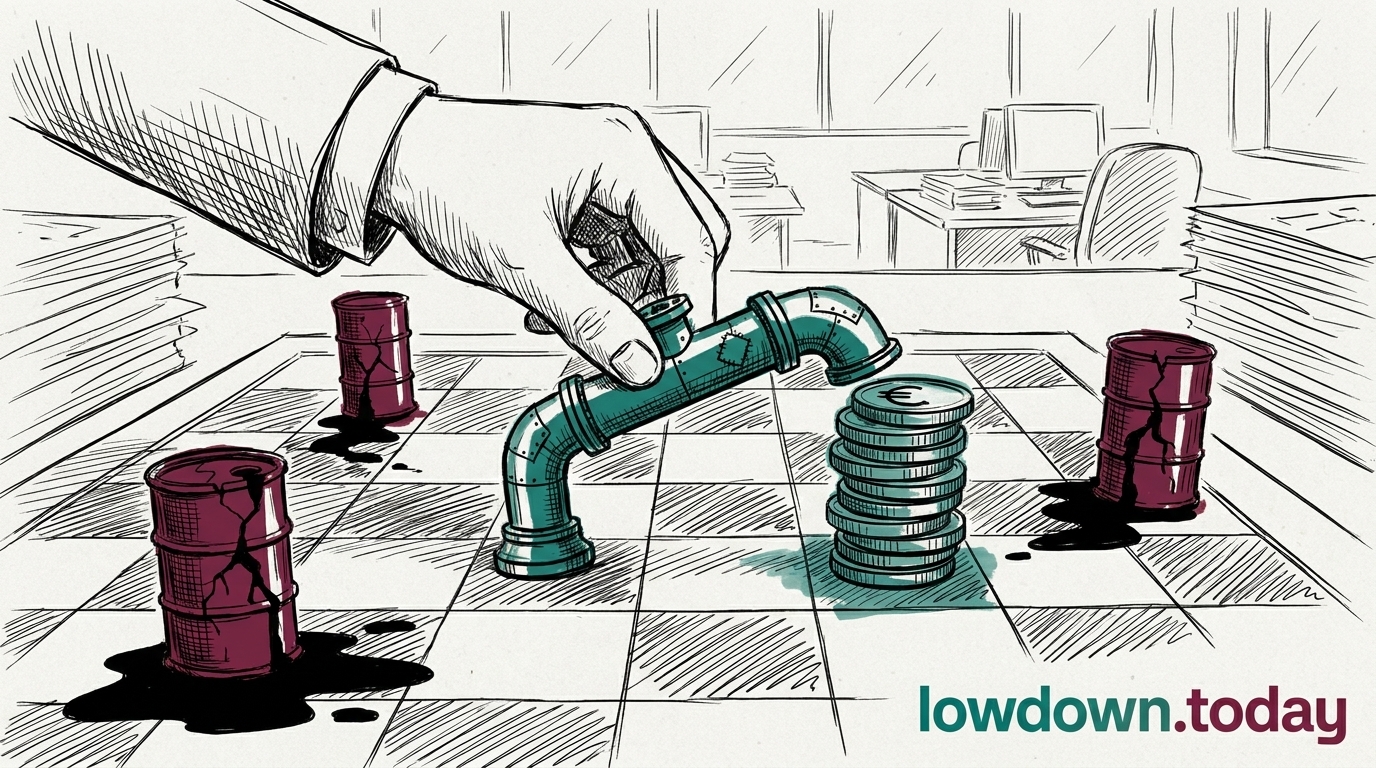
Brent crude settled at $105.30 on 25 April with intraday prints above $106 and a weekly gain of roughly 18% per The National1. This is the second consecutive session above $105, 57% above the $67.41 pre-war baseline and a continuation from the $105.73 close on 24 April. No new IRGC seizure occurred on 25 April, and the dark-shipping picture from the Larak-Qeshm carve-out was unchanged.
The price moved on the absence of a diplomatic resolution rather than on a fresh provocation. That is a structural shift: the market has stopped treating each diplomatic failure as a temporary setback and is pricing the absence of a resolution track as the default scenario. The repricing matters because future seizures will now push the price from $105 rather than from $67, amplifying the economic shock of any tactical escalation. UK and European pump prices follow Brent with a one-to-two-week lag.
The options curve confirms the shift. With the baseline reset, any de-escalation announcement becomes disproportionately bearish rather than merely corrective, which makes the political incentive structure for Tehran and Washington asymmetric: Iran loses revenue floor on a deal, and US consumer pump prices ease only after a deal is concrete enough to clear forwards. Brent at $105 is the new floor, not a ceiling.




