Skip to content
Briefings are running a touch slower this week while we rebuild the foundations.See roadmap
Russia-Ukraine War 2026
24APR

Analysts warn of $100-120 oil

4 min read
11:21UTC

Expired war risk insurance — not Iranian missiles — is now the binding constraint on oil through the Strait of Hormuz. Even a ceasefire cannot reset the clock, and analysts warn of $100–120 per barrel within weeks.

ConflictDeveloping
Key takeaway

The insurance market's independent reassessment clock means economic damage from the Hormuz closure will outlast any ceasefire by weeks, making the $100–120/bbl scenario dependent on insurer timelines rather than military outcomes alone.

Brent Crude held above $85 per barrel on Day 7, with analysts warning of $100–120 per barrel if the strait of Hormuz remains effectively closed beyond two to three weeks. Shipping consultancy Simpson Spence Young assessed US Navy convoys as "unlikely in the near-term," given simultaneous combat demands on American naval assets. Trump's promised DFC insurance programme and Navy escort system remain non-operational; no escorted commercial passage has been attempted.

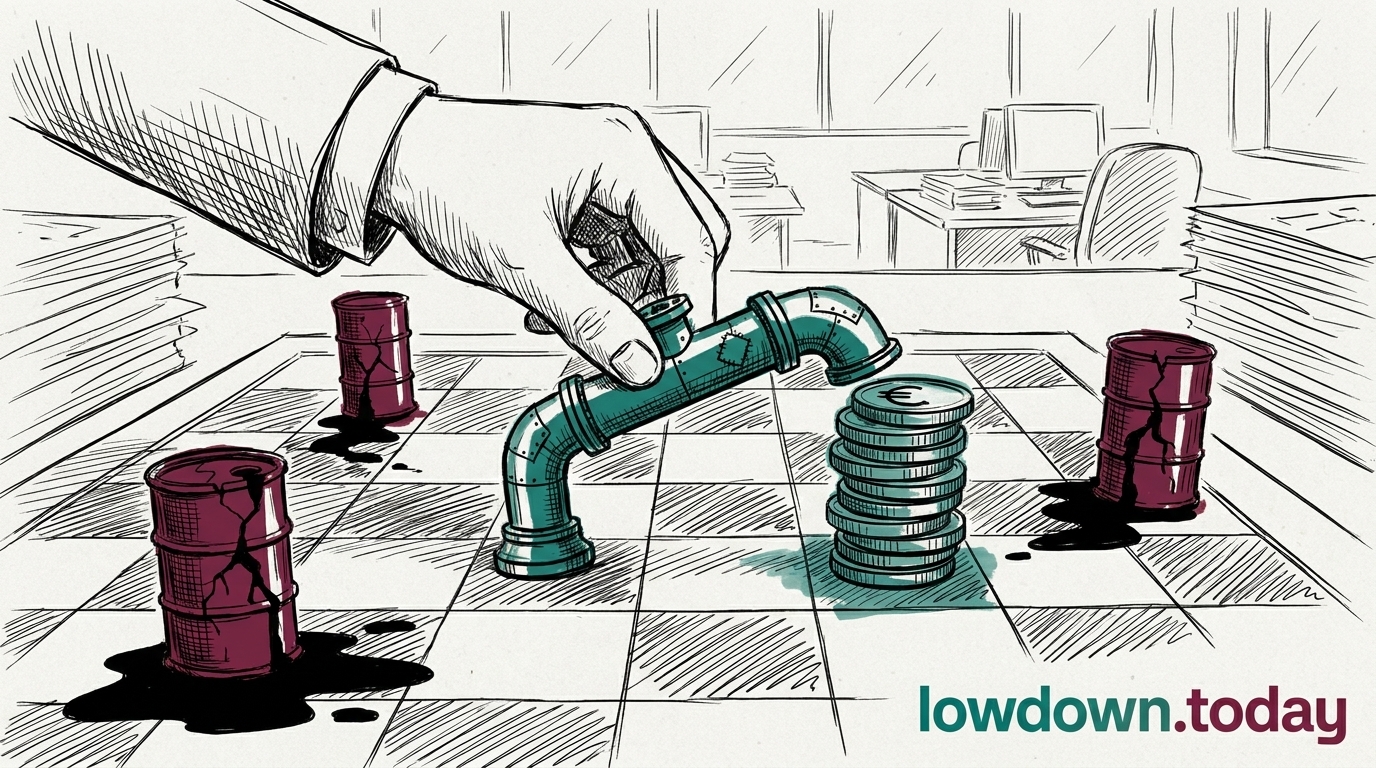
The binding constraint is now contractual, not military. Every major Protection and Indemnity club's war risk cover expired at midnight on Thursday . Without P&I insurance, no commercial vessel can legally transit the strait — cargo cannot be discharged at destination ports, charterers will not accept the liability, port authorities will not grant entry. Even an immediate ceasefire would not restore shipping: P&I clubs conduct independent reassessments that typically require weeks, and their timelines respond to actuarial models, not diplomatic announcements. More than 150 vessels sit at anchor in The Gulf of Oman and Arabian Sea, unable to move in either direction.

Iraq's exports have fallen by 1.5 million barrels per day as tanker availability drops, compounding supply losses across The Gulf. China's separate safe-passage arrangement with Iran for Chinese-flagged vessels may allow some oil to move — but at terms Beijing sets, creating a two-tier Hormuz where roughly 60 per cent of Gulf crude bound for Asia could resume while Western-bound cargoes remain blocked. Goldman Sachs's Q2 forecast of $76 per barrel, issued earlier this week , assumed partial Hormuz restoration before June — an assumption that now depends on an insurance industry with no commercial incentive to rush.

The 1980s Tanker War offers limited precedent. Between 1984 and 1988, Iran and Iraq attacked more than 400 commercial vessels in The Gulf, but shipping continued because the attacks were selective, insurance remained available at higher premiums, and the US Navy eventually provided escorts under Operation Earnest Will. The current situation is different in kind: a functional blockade enforced not by mines or patrol boats but by the withdrawal of the commercial infrastructure — insurance, classification, port-state acceptance — without which tankers cannot operate. The bottleneck is self-reinforcing: combat operations prevent Navy escorts, absent escorts prevent insurance renewal, absent insurance prevents transit. Twenty thousand seafarers and 15,000 cruise passengers remain stranded in Gulf and Arabian Sea waters with no repatriation route.

Deep Analysis

In plain English

About one-fifth of the world's daily oil supply passes through the Strait of Hormuz — a narrow channel between Iran and Oman. Right now it is effectively closed: active combat makes the passage dangerous, and the companies that insure ships against war damage have all cancelled their policies. Even if fighting stopped tomorrow, those insurers must formally reassess the risk before they will cover ships again — a process that historically takes four to eight weeks minimum. Tankers won't sail without cover, so oil stays blocked regardless of whether guns fall silent. The longer this lasts, the more expensive petrol, heating fuel, and air travel become, because oil underpins the cost of transporting almost everything.

Deep Analysis
Synthesis

China's separate safe-passage arrangement with Iran effectively makes Beijing the sole arbiter of which oil clears Hormuz while Western carriers are locked out. This gives China simultaneous leverage over Gulf producers (who need a buyer) and Western consumers (who need supply) — an asymmetric economic position that will persist even after hostilities end, because restoring Western insurance cover does not undo any preferential pricing or currency-denomination terms Beijing has secured during the window of exclusivity.

Root Causes

Approximately 21 million barrels per day transit Hormuz with no full alternative. Saudi Arabia's East-West pipeline (capacity ~5 million bpd) and the UAE's Habshan-Fujairah pipeline (~1.5 million bpd) together cover roughly 30% of normal Hormuz flow — the remainder has no bypass. These pipelines were not expanded during the stable 2010s because cheaper Hormuz transit removed the commercial incentive, leaving Gulf producers structurally exposed to exactly this scenario.

Escalation

The compounding of two independent lock-ins — combat closure and insurance expiry — means the economic escalation path is now partially decoupled from military decisions. Each additional day of closure deepens the actuarial case for extended reassessment periods, making the $100–120 scenario more probable as a function of elapsed time rather than discrete military escalation steps.

What could happen next?
2 consequence1 risk1 opportunity1 precedent
  • Consequence

    Insurance paralysis extends shipping disruption four to eight weeks beyond any ceasefire, locking in elevated prices regardless of military outcome.

    Immediate · Assessed
  • Risk

    Iraq faces acute fiscal crisis if Basra export revenues remain blocked for 45–60 days, given its ~90% budget dependence on oil receipts and lack of alternative export routes.

    Short term · Assessed
  • Consequence

    China's exclusive Hormuz passage arrangement will translate into discounted crude acquisition and yuan-denominated pricing terms that persist structurally beyond the conflict.

    Medium term · Suggested
  • Opportunity

    The investment case for expanding Saudi and UAE bypass pipeline capacity — currently covering only ~30% of normal Hormuz throughput — becomes commercially viable for the first time in a decade.

    Long term · Suggested
  • Precedent

    The insurance market's independent operational timeline, decoupled from military and political decisions, establishes that future Hormuz disruptions carry an automatic weeks-long economic tail regardless of conflict duration.

    Long term · Assessed
First Reported In

Update #24 · Trump demands unconditional surrender

Al Jazeera· 6 Mar 2026
Read original
Different Perspectives
EU Council / European Commission
With Orban's veto lifted and Magyar's Tisza government not placing a replacement block, the European Commission is signalling the first 90 billion euro Ukraine loan tranche for late May or early June 2026. Disbursement depends on Magyar's 5 May government formation proceeding to schedule.
Germany
Germany
Russia's Druzhba northern branch transit halt from 1 May removes one of Germany's residual non-Russian crude supply options. The timing compounds Berlin's exposure in the same week Ukrainian strikes drive Russian refinery throughput to its lowest since December 2009.
IAEA / Rafael Grossi
Grossi confirmed the Zaporizhzhia Nuclear Power Plant lost external power for its 14th and 15th times within a single week in late April, with the Ferosplavna-1 backup feeder damaged 1.8 km from the switchyard. He was negotiating a further local ceasefire; the previous IAEA-brokered repair lasted less than a week.
Japan
Japan
Japan authorised direct PAC-3 exports to the United States on 30 April, breaking its post-1945 arms export restrictions to replenish Iran-war-depleted US stockpiles. The White House global Patriot export freeze remains in place; Japan's historic policy shift benefits US readiness without reaching Ukraine.
Kazakhstan
Kazakhstan
Russia's Druzhba northern branch transit halt from 1 May cuts Kazakhstan's access to the German crude market. Astana routes most of its export crude through Russian infrastructure, meaning Moscow's unilateral decision directly constrains Kazakh export diversification despite Kazakhstan's stated neutrality on the war.
Péter Magyar / Tisza Party / Hungary
Magyar targets 5 May for government formation ahead of the 12 May constitutional deadline. Orbán lifted the EU loan veto before leaving office; Magyar supports Hungary's opt-out but has not placed a new veto, leaving the first 90 billion euro tranche on track for late May disbursement.
