Skip to content
Welcome, thoughtbot's Giant Robots listeners!Start here
Pandemics and Biosecurity
3OCT

DRC Ebola tops 1,000 confirmed cases

4 min read
13:42UTC

The DRC Bundibugyo outbreak crossed 1,094 confirmed cases by 24 June as patient isolation fell to about 35%, far below the 70% the CDC model says is needed to break the worst trajectory.

ScienceDeveloping
Key takeaway

Isolation at 35% against a 70% threshold puts the outbreak inside the modelled range where the worst trajectories apply.

The Bundibugyo outbreak in DR Congo reached 1,094 confirmed cases and 277 deaths by Wednesday 24 June, the European Centre for Disease Prevention and Control (ECDC) reported, with Uganda at 20 cases and two deaths⁠1. It is the largest outbreak of this Ebola species on record, more than seven times the roughly 149 cases of the 2007 Uganda outbreak in which the species was first identified⁠2. Africa CDC Director-General Jean Kaseya told an African Union heads-of-state meeting the toll "will be worse than what we had in West Africa", invoking the 2014-16 epidemic that killed more than 11,000 people⁠3.

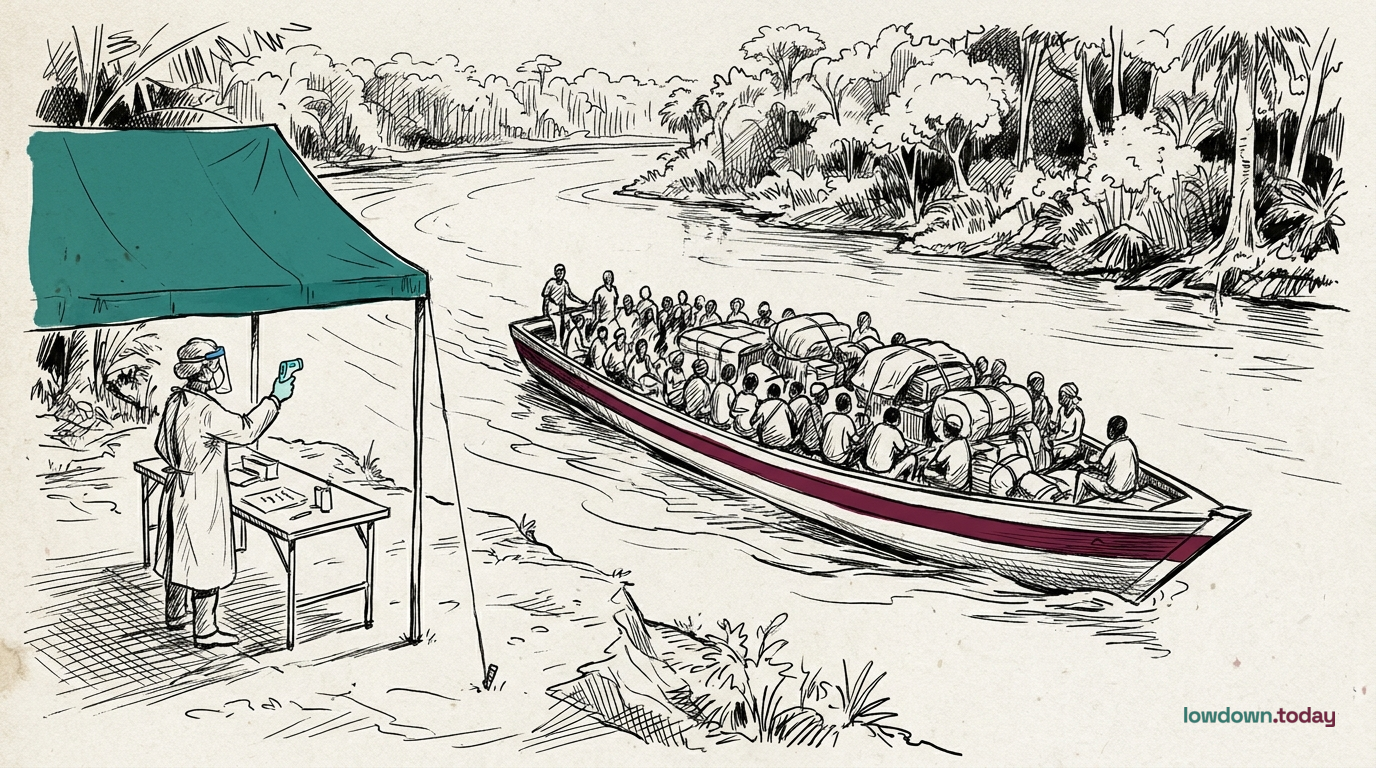
The number that decides the outbreak's direction is not the case count but the share of patients in isolation. On Tuesday 23 June, 387 of 1,094 patients were isolated, about 35%, down from 45.9% on 14 June⁠4. CDC modelling puts the outbreak's reproduction number, the average number of people each case infects, at 2.51 and identifies a 70% isolation rate as the threshold needed to collapse worst-case trajectories. At 35% and falling, the response sits well inside the range where the model's grimmest curves, not its containment runs, apply.

That fork is mechanical, not rhetorical. Every confirmed patient left in the community is a node from which the virus can branch at a rate above two; pulling isolation toward 70% severs those branches faster than they form, while letting it drift toward a third widens them. The crossing past 1,000 cases is the headline, but the isolation figure is the lever, and it is the one slipping. No treatment has yet reached a single patient, leaving case management and isolation as the only tools currently in play.

Deep Analysis

In plain English

When someone has Ebola, the single most important thing is making sure they are kept separate from other people until they either recover or die. This stops them passing the virus on. Scientists have calculated that if around 70% of Ebola patients are safely isolated, the outbreak shrinks. Below that level, the virus spreads faster than the response can contain it. Right now, only 35 out of every 100 confirmed Ebola patients in DR Congo are in a safe isolation facility. On 14 June it was 46 out of 100, so things are moving in the wrong direction. The number of new cases grew faster than the number of beds. Some patients or their families are refusing to go to treatment centres, partly because there is still no proven Ebola drug for this particular strain of the virus. The Ebola strain in this outbreak is called Bundibugyo, and it has caused more cases than any previous Bundibugyo outbreak in history.

Deep Analysis
Root Causes

The declining isolation rate from 45.9% to 35% in nine days reflects two converging structural pressures. First, the case count grew faster than isolation capacity: 179 new confirmed cases in five days pushed the denominator while the numerator (beds available for safe isolation) grew more slowly. Bunia's treatment centres have a fixed physical footprint; construction of additional capacity takes weeks.

Second, active Islamic State-ADF (Allied Democratic Forces) presence in Ituri Province has constrained response movement in Mambasa health zone since early June, where IS blocked access entirely. Responders cannot isolate patients they cannot reach.

The 150+ patient escapes documented since late May reflect a parallel problem: community members removing sick relatives from treatment centres, believing that home care is no worse than facility isolation when no licensed treatment exists for this Ebola species.

The structural root behind both is the multi-year degradation of state authority in eastern DRC. The DRC national government's fiscal capacity to deploy isolation capacity in Ituri is limited; it relies on multilateral partners whose access is constrained by the same security conditions.

Escalation

The trend is adverse. Isolation fell from 45.9% on 14 June to 35% on 23 June, moving further from the CDC model's 70% threshold during a period when case counts accelerated from 695 to 1,094 confirmed. Unless isolation capacity expands significantly faster than case accumulation, requiring rapid physical construction and a reversal of community-trust dynamics in IS-affected zones, the CDC model's 65%-of-runs worst case continues to dominate.

What could happen next?
  • Risk

    At current trajectory (isolation declining while case counts accelerate), CDC simulation models project 65% probability of reaching 20,000 cases by 22 August 2026.

    Short term · Assessed
  • Consequence

    The 1,094 confirmed case count makes this the largest Bundibugyo outbreak in recorded history by a factor of more than seven, rewriting the pathogen's known risk profile.

    Immediate · Reported
  • Opportunity

    The $910m AU pledge mobilised on 18 June, if rapidly deployed to physical isolation beds and community-trust programming, could shift the isolation trajectory before the CDC model's August threshold is reached.

    Short term · Suggested
First Reported In

Update #8 · Ebola reaches France through a screening blind spot

World Health Organization· 25 Jun 2026
Read original →
Different Perspectives
IGWG co-chair Tovar da Silva Nunes
The Brazilian co-chair closed the eighth pathogen-sharing session on 18 September without an agreed annex text, the second session in a row to end that way. He presented the outcome as continued commitment, with adoption due at the World Health Assembly in May 2027.
Fraport
Fraport
The Frankfurt Airport operator has told staff to watch for fever, hessenschau reported, after six airport workers caught malaria. Germany does not require insecticide spraying of arriving aircraft cabins, and parasite genotyping to trace the source is due at the end of October.
European Centre for Disease Prevention and Control
ECDC reported the eight Frankfurt Airport malaria cases on 18 September and considers repeated arrivals of infected mosquitoes on aircraft likely. It has not ruled out local mosquitoes, and awaits genotyping due at the end of October.
Pan American Health Organization
PAHO counted 53,957 measles cases in the Americas by 19 September and is supporting Peru's response in Puno and Arequipa. It warns that October's Señor de los Milagros festivities and Pope Leo XIV's November visit could increase transmission.
Bangladesh Directorate General of Health Services
The DGHS recorded 1,030 measles-related deaths and 172,720 suspected cases by 14 September, after a campaign that reached 19.75 million children. Its disease-control director, Halimur Rashid, said further vaccination rounds were expected within two weeks.
Minapharm
Minapharm
The Egyptian drugmaker and its Berlin subsidiary ProBioGen were awarded up to US$16.5m by CEPI on 27 August to take a Bundibugyo vaccine into a Phase 1 trial in Africa. Final manufacture is planned for Cairo, making it CEPI's first Bundibugyo candidate with an African producer.
