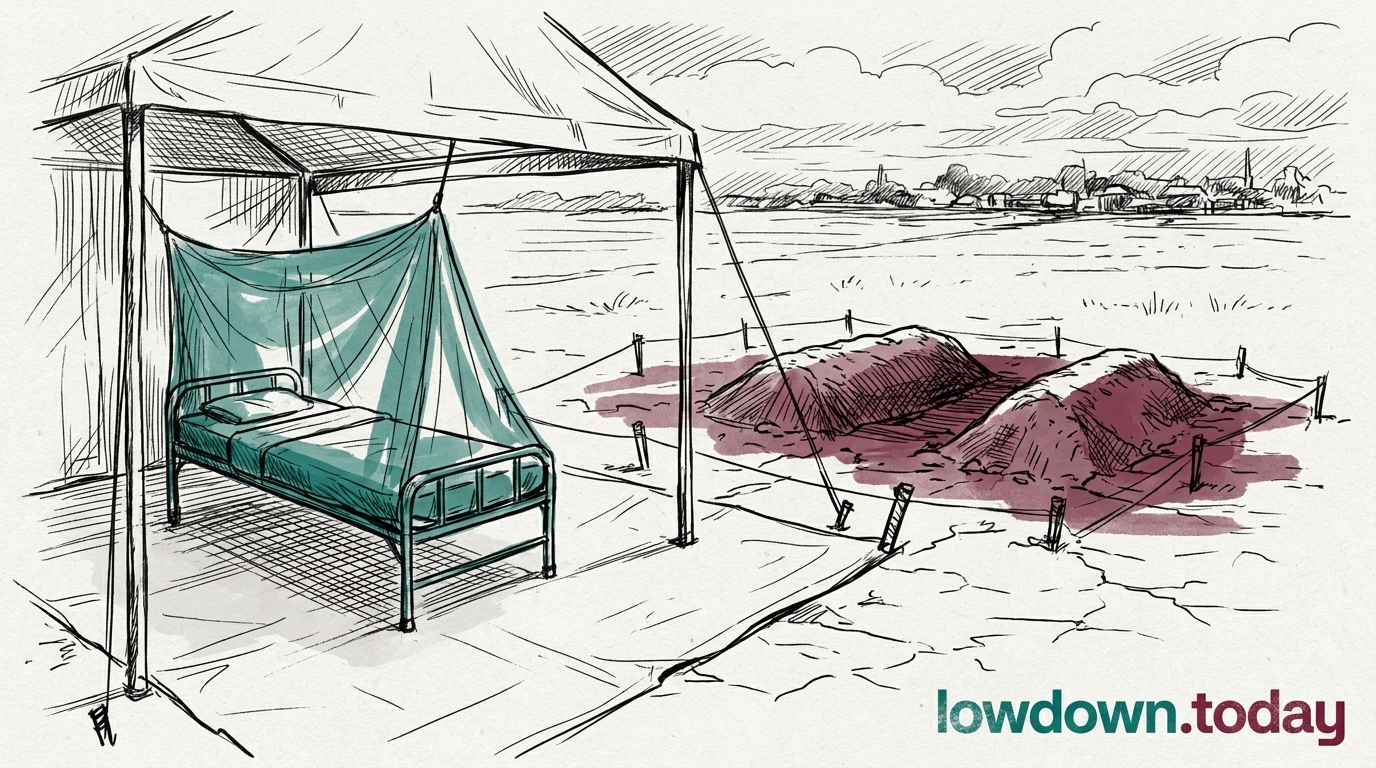
Uganda and DR Congo closed their shared border to non-essential travel for four weeks, screening 4,772 travellers at 32 points of entry, Africa CDC recorded 1. Under a cross-border agreement, Uganda also helped establish two mobile laboratories and an 80-bed treatment unit at Aru and Kasenyi, both on the Congolese side of the line.
The frontier runs for roughly 800km through Ituri and the Kivus, crossed daily by traders, farmers and families with relatives on both sides, and it has never been sealable in any literal sense. Formal closure moves traffic to informal paths rather than stopping it, which is why the screening posts and the laboratories are the operative part of the announcement. Kasenyi and Aru sit where the crossings concentrate, and a mobile laboratory there returns a result in hours rather than after a day's drive to a provincial machine.
Uganda has spent money and staff building diagnostic and treatment capacity inside a neighbouring country's territory, which is cheaper than treating imported cases at home and far cheaper than a second Ugandan outbreak. Uganda's own cluster, whose last patient was discharged in mid-July , began with infections that crossed this frontier, and most of the people it reached were Congolese nationals. An 80-bed unit at Aru follows the same logic as testing travellers before they move rather than after.