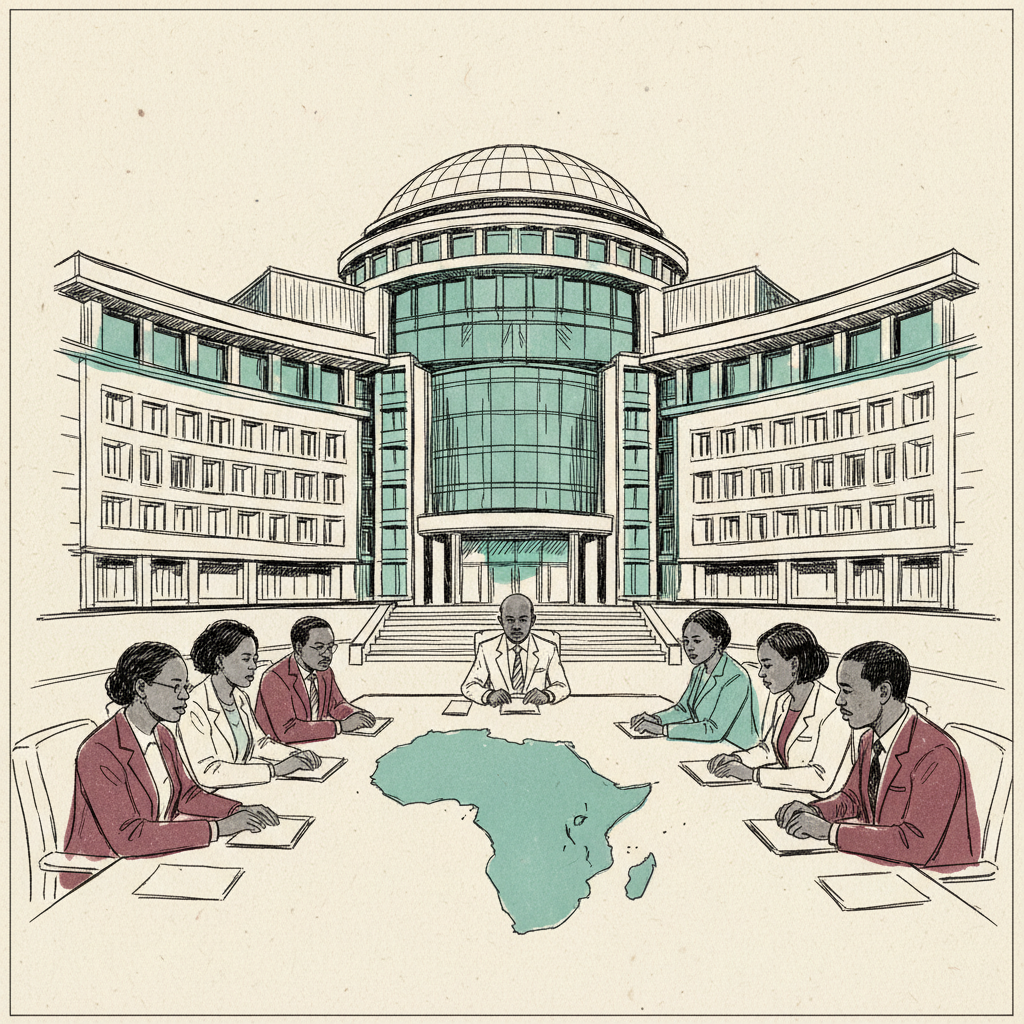
Africa CDC
Africa's continental disease surveillance body; declared Ebola emergency 24 hours before WHO PHEIC.
On 16 May, Africa CDC declared a continental Ebola emergency 24 hours before WHO, setting the response pace for the Bundibugyo outbreak.
Last refreshed: 22 September 2026 · Appears in 1 active topic
Can Africa CDC's $500m war chest outpace a 1,000-case outbreak with no vaccine?
Timeline for Africa CDC
Published the US$2.997bn pledge total
Pandemics and Biosecurity: G20 talks take Ebola pledges to US$3bnMentioned in: Madagascar logs half July's mpox cases
Pandemics and BiosecurityListed ten countries at risk
Pandemics and Biosecurity: Ebola reaches Sud-Ubangi by river boatMentioned in: CEPI awards Minapharm US$16.5m for Ebola
Pandemics and BiosecurityMentioned in: DR Congo's 19 Ebola labs still trail the outbreak
Pandemics and BiosecurityBackground
Africa CDC is the African Union's public health agency. Established in 2016 and headquartered in Addis Ababa, it coordinates disease surveillance, outbreak preparedness and laboratory capacity across the African Union's 55 member states.
Its role is to turn continental alerts into shared action across national health systems. On 16 May 2026, its Ebola emergency declaration preceded WHO's by 24 hours, showing that the agency can set a regional response timetable rather than wait for a global process.
Africa CDC also carries operational responsibility beyond emergency declarations. Its direct Pandemic Fund accreditation, announced on 17 June 2026, allows it to apply for grants without an intermediary, while ARILAC extends its laboratory work into antimicrobial resistance.
Africa CDC sets the response pace
On 16 May 2026, Africa CDC declared a continental public health emergency for Bundibugyo Ebola, 24 hours before WHO issued its own emergency declaration. The move also came before DR Congo's health ministry made a formal public statement.
On 17 June, the Pandemic Fund accredited Africa CDC as an Implementing Entity. The status let the agency seek grants directly instead of routing transfers through the World Bank or WHO. For Africa CDC, that made its continental coordination role a funding channel as well as an emergency-warning role.
Africa CDC expands resistance testing
On 6 May 2026, Africa CDC launched ARILAC in Addis Ababa with the African Society for Laboratory Medicine and the EU. The four-year programme aims to build antimicrobial-resistance testing capacity across eight African states, where routine testing reached only 1.3% of more than 50,000 assessed laboratories in 14 countries.
On 23 May, the World Health Assembly adopted its 2026-2036 antimicrobial-resistance plan. ARILAC gives Africa CDC a practical laboratory network alongside that global policy framework, centred on producing local resistance data rather than setting targets alone.
Africa CDC sets the response pace
What is the Africa CDC Advisory and Technical Council?
Why did Africa CDC declare an Ebola emergency before the WHO?
What is Africa CDC and how is it different from the US CDC?
Why did Africa CDC oppose the US Ebola travel ban?
Africa CDC expands resistance testing
What is ARILAC and why did Africa CDC launch it?
Reference
What does Africa CDC do and who funds it?
Recently resolved
Why does Africa CDC oppose Ebola travel bans?
How does Africa CDC's hantavirus statement differ from the WHO's?
Why does Africa CDC's Ebola situation report 71 carry two different dates?
How many Bundibugyo Ebola deaths happened outside a treatment centre?
How much money has been raised for the Bundibugyo Ebola response?
Why does AMR surveillance matter so much in Africa?
Why did Africa CDC appeal for health-worker protection in July 2026?
