Skip to content
Welcome, thoughtbot's Giant Robots listeners!Start here
Pandemics and Biosecurity
3OCT

Ebola reaches France past exit checks

4 min read
13:42UTC

A French doctor cleared DR Congo's airport exit checks on 19 June while still incubating Bundibugyo Ebola, then tested positive in France on 24 June, the first case outside Africa in this outbreak.

ScienceDeveloping
Key takeaway

Exit screening cannot see a virus still incubating, so a pre-symptomatic departure is invisible by design.

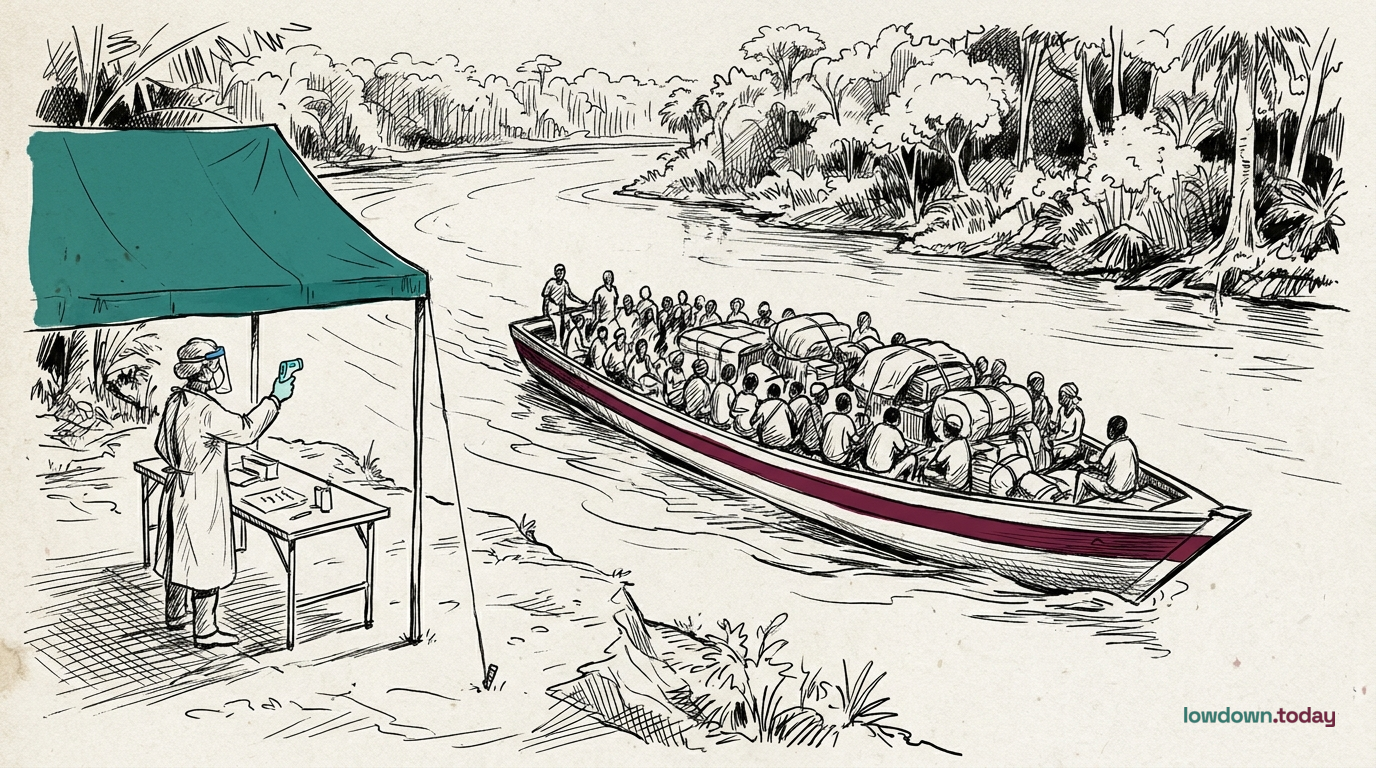
A French humanitarian doctor WHO spent 31 days treating Ebola patients in Ituri Province, eastern DR Congo, left the country in good health on Friday 19 June and tested positive for Bundibugyo ebolavirus in France on Wednesday 24 June⁠1. It is the first confirmed Ebola case outside Africa in this outbreak. Africa CDC Director-General Jean Kaseya confirmed the worker "left DRC in good health"⁠2, which is precisely the problem: there was nothing for a screener to find.

Exit screening reads temperatures and symptoms at the airport gate. It cannot detect a pathogen still in its incubation period, the gap between infection and first symptoms, which for Bundibugyo runs up to three weeks. The doctor departed inside that gap. Bundibugyo ebolavirus is a rare Ebola species first identified in Uganda in 2007, with no approved vaccine or treatment, and the European Centre for Disease Prevention and Control (ECDC) rates the risk to the wider EU population as very low because the patient is in full isolation.

The control that closes the incubation gap is active monitoring of returning responders after they land, not a check at departure. France is now running exactly that, tracing the patient's flight co-passengers and hospital contacts through the full three-week window. The case arrived three days after the United States renewed its border restriction on nationals of three Ebola-affected states, an order that would never have stopped a French citizen. For European responder cohorts deployed to Ituri Province, the lesson is that returnee surveillance, not border screening, is the layer that catches this class of importation.

Deep Analysis

In plain English

Ebola spreads through direct contact with the body fluids of a sick person, not through the air like flu. The French doctor WHO tested positive on 24 June had been working in the part of DR Congo where the Ebola outbreak is worst. They left on 19 June feeling completely well, with no fever and no symptoms. Airport medical staff checked them and found nothing wrong. The catch is that Ebola can incubate for up to 21 days before a person gets sick. During those 21 days, viral load in the bloodstream stays too low for standard airport temperature checks to catch. Standard airport screening cannot find a virus that has not yet caused symptoms. By the time the doctor fell ill in France, they had already passed through DRC's exit checks. This case does not mean the doctor did anything wrong, or that French airports failed: exit screening cannot, by design, catch someone WHO is not yet symptomatic.

Deep Analysis
Root Causes

Exit screening's structural ceiling rests on a biological fact: Bundibugyo ebolavirus has an incubation period of up to 21 days, and viral load in blood is too low to detect by rapid antigen test until the patient develops fever and symptoms.

DRC's exit screening protocol checks temperature and symptom self-declaration, two measures that are valid only when the infection has progressed to clinical illness. A health worker WHO deployed for 31 days in Ituri Province, completed their tour, and departed 19 June was within the incubation window but pre-symptomatic; the protocol had no mechanism to catch them.

The secondary structural cause is the absence of a mandatory post-departure monitoring regime for healthcare workers deployed in active PHEIC zones. France has had the capacity for 21-day active surveillance since the 2014-16 outbreak, but deployment remained voluntary rather than required under French public health law. The gap between voluntary and mandatory was closed in the UK (UKHSA issued mandatory 21-day monitoring notices for Ebola returnees) but persists across much of the EU.

Escalation

The France importation is a qualitative escalation: the first confirmed Ebola case outside Africa in this PHEIC. It does not alter the outbreak's fundamental trajectory inside DRC. ECDC's maintained 'very low' EU/EEA risk assessment reflects Bundibugyo's limited secondary transmission potential outside a healthcare setting.

The more significant escalation signal remains the declining isolation rate inside DRC (from 45.9% on 14 June to 35% on 23 June), which drives CDC model projections toward worst-case outcomes. The France case is a demonstration of the importation risk documented by prior WHO risk assessments, not a new threat vector.

What could happen next?
  • Consequence

    EU member states face pressure to legislate mandatory 21-day active monitoring for aid workers returning from active PHEIC zones, replacing current voluntary frameworks.

    Short term · Assessed
  • Risk

    If the French index case had contacts in a healthcare setting before isolation, secondary nosocomial transmission in a European hospital becomes the scenario WHO risk models have assigned a very-low but non-zero probability.

    Immediate · Suggested
  • Precedent

    The France importation will be cited in future IHR revision negotiations as evidence that Temporary Recommendation frameworks need a specific returnee-monitoring clause for Ebola PHEIC contexts.

    Medium term · Assessed
First Reported In

Update #8 · Ebola reaches France through a screening blind spot

Al Jazeera· 25 Jun 2026
Read original →
Different Perspectives
IGWG co-chair Tovar da Silva Nunes
The Brazilian co-chair closed the eighth pathogen-sharing session on 18 September without an agreed annex text, the second session in a row to end that way. He presented the outcome as continued commitment, with adoption due at the World Health Assembly in May 2027.
Fraport
Fraport
The Frankfurt Airport operator has told staff to watch for fever, hessenschau reported, after six airport workers caught malaria. Germany does not require insecticide spraying of arriving aircraft cabins, and parasite genotyping to trace the source is due at the end of October.
European Centre for Disease Prevention and Control
ECDC reported the eight Frankfurt Airport malaria cases on 18 September and considers repeated arrivals of infected mosquitoes on aircraft likely. It has not ruled out local mosquitoes, and awaits genotyping due at the end of October.
Pan American Health Organization
PAHO counted 53,957 measles cases in the Americas by 19 September and is supporting Peru's response in Puno and Arequipa. It warns that October's Señor de los Milagros festivities and Pope Leo XIV's November visit could increase transmission.
Bangladesh Directorate General of Health Services
The DGHS recorded 1,030 measles-related deaths and 172,720 suspected cases by 14 September, after a campaign that reached 19.75 million children. Its disease-control director, Halimur Rashid, said further vaccination rounds were expected within two weeks.
Minapharm
Minapharm
The Egyptian drugmaker and its Berlin subsidiary ProBioGen were awarded up to US$16.5m by CEPI on 27 August to take a Bundibugyo vaccine into a Phase 1 trial in Africa. Final manufacture is planned for Cairo, making it CEPI's first Bundibugyo candidate with an African producer.
