Skip to content
You can now search across every topic, entity and event.What's new
Pandemics and Biosecurity
25JUN

Ebola reaches France through a screening blind spot

4 min read
15:53UTC

A French doctor returning from Ituri tested positive for Bundibugyo Ebola, the first case outside Africa in this outbreak, after passing DRC exit checks while still incubating. Scientists explained why H5N1 hid in dairy udders for two years, WHO found one in six infections now beats first-line antibiotics, and Africa CDC won the right to spend pandemic money without WHO.

Key takeaway

Every surveillance system failed at the boundary it was not designed to see; Africa CDC is the exception, building authority faster than the crisis it is responding to.

This briefing mapped
Humanitarian
Regulatory
Infrastructure
Legal

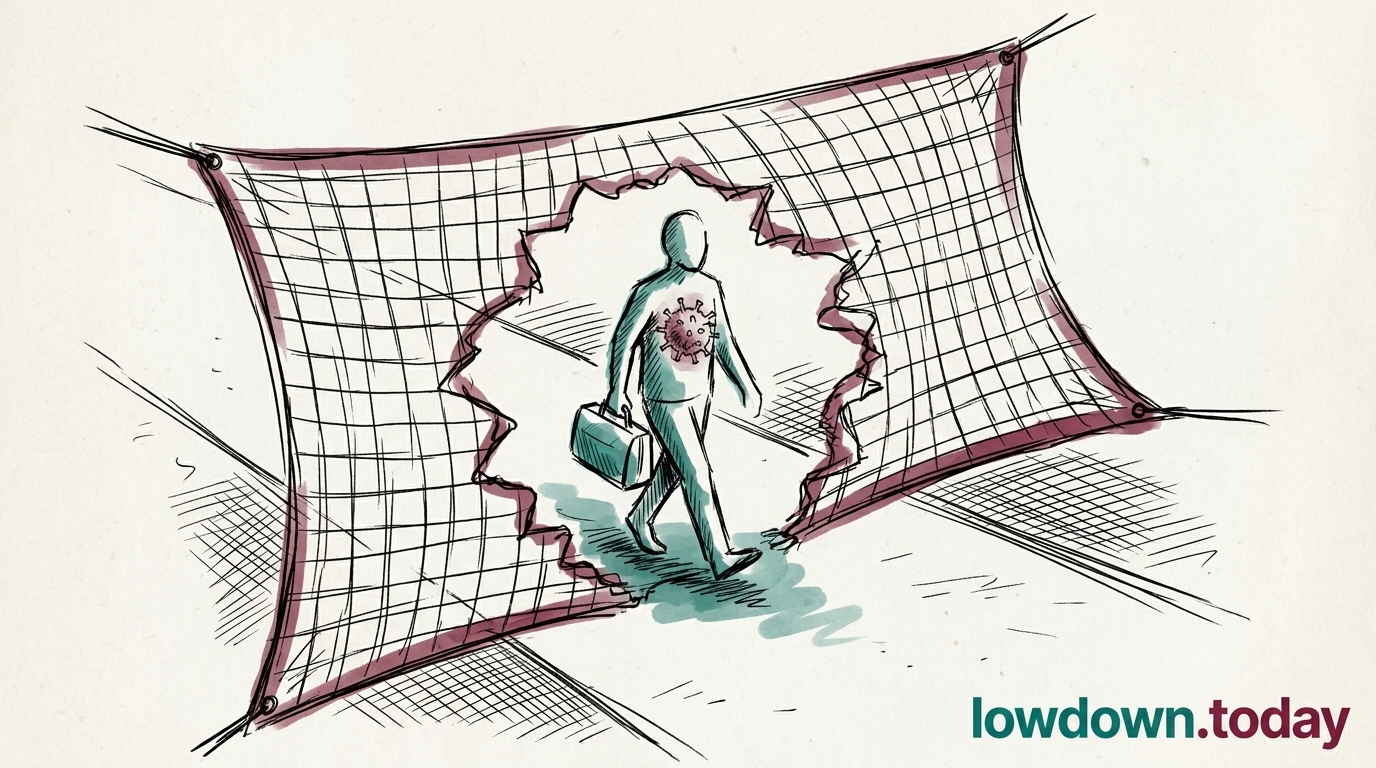
A French doctor cleared DR Congo's airport exit checks on 19 June while still incubating Bundibugyo Ebola, then tested positive in France on 24 June, the first case outside Africa in this outbreak.

Sources profile:This story draws on neutral-leaning sources from Qatar
Qatar

A French humanitarian doctor spent 31 days treating Ebola patients in eastern DR Congo, returned home on 19 June without symptoms, and tested positive on 24 June. Airport staff found nothing wrong, because the virus had not yet caused illness.

Exit screening catches fewer than 30% of Ebola importations during an active emergency, according to London School of Hygiene and Tropical Medicine modelling. The case does not change the outbreak's trajectory inside DR Congo

The DRC Bundibugyo outbreak crossed 1,094 confirmed cases by 24 June as patient isolation fell to about 35%, far below the 70% the CDC model says is needed to break the worst trajectory.

Sources profile:This story draws on neutral-leaning sources

The Bundibugyo Ebola outbreak in DR Congo reached 1,094 confirmed cases and 277 deaths by 24 June. That makes it the largest Bundibugyo outbreak on record, more than seven times bigger than the 2007 event. Only 35% of patients are safely isolated, down from 46% nine days earlier.

US modelling puts 70% isolation as the threshold that collapses the worst case. Jean Kaseya, head of Africa's continental health agency, warned the toll could exceed 11,000 deaths, matching the 2014-16 epidemic. 

US renews 30-day Ebola entry ban

The US CDC issued a fresh 30-day entry ban on DRC, Uganda and South Sudan nationals on 21 June, renewing a lapsed restriction that the WHO emergency committee still opposes.

Sources profile:This story draws on centre-left-leaning sources from Qatar
Qatar

The US Centers for Disease Control renewed its 30-day Ebola entry ban on 21 June, barring nationals of DR Congo, Uganda, and South Sudan. The WHO has consistently advised against such restrictions, saying they don't stop the virus.

Three days later, a French doctor, not a national of any of the three banned countries, became the first confirmed Ebola case outside Africa. The ban would not have stopped them. South Sudan has no confirmed cases at all. 

Sources:Al Jazeera

The Pandemic Fund accredited Africa CDC as an Implementing Entity on 17 June, the first continental health agency anywhere to spend pandemic money without routing it through WHO or the World Bank.

Sources profile:This story draws on neutral-leaning sources

On 17 June, the Pandemic Fund gave Africa's Centres for Disease Control direct access to its grants for the first time. Set up by G20 countries in 2022, the Fund had previously required all transfers to pass through the World Bank or WHO, adding weeks.

The next day, African heads of state pledged another $910 million for the Ebola response. Whether that money reaches Ituri Province fast enough to improve patient isolation rates is the key question. 

Sources:Africa CDC

University of Pittsburgh scientists found H5N1 binds receptors abundant in udder tissue but scarce in airways, explaining why bird flu hid in US dairy herds for two years.

Sources profile:This story draws on neutral-leaning sources

University of Pittsburgh scientists found why H5N1 bird flu spread through more than 1,000 US dairy herds undetected for two years. The virus targets receptors in cow udder tissue, not the lungs, so it appeared as mastitis rather than respiratory illness. Respiratory surveillance was checking the wrong organ.

Pasteurisation destroys the virus; commercial dairy products carry no risk. The US Department of Agriculture ended mandatory herd testing in May, leaving the next udder-tropic strain with the same blind spot. 

Two weeks after a Nipah case was confirmed in Kozhikode, no secondary infection has appeared among the roughly 100 contacts ICMR is tracing, with the surveillance window closing around 2 July.

Sources profile:This story draws on neutral-leaning sources

Two weeks after Nipah was confirmed in Kozhikode, Kerala on 11 June, none of the roughly 100 traced contacts have developed symptoms. Eleven low-risk contacts have been formally discharged. The index patient remains on a ventilator at Kozhikode Medical College Hospital.

Nipah's case-fatality rate runs 40-75%, with no licensed vaccine. Kerala has contained four previous outbreaks using rapid tracing and isolation. The full monitoring window closes around 2 July. 

Sources:New Kerala

WHO's GLASS 2025 report found one in six of 23 million bacterial infections across 104 countries no longer responds to first-line antibiotics, with resistance highest where labs are scarcest.

Sources profile:This story draws on neutral-leaning sources

WHO's Global Antimicrobial Resistance Surveillance report (2025, covering 104 countries) found one in six bacterial infections no longer responds to standard first-line antibiotics. Resistance rose in 40% of tracked pathogen-drug combinations between 2018 and 2023. South-East Asia and the Middle East already sit at one in three.

The findings land just after the World Health Assembly adopted a plan to cut antimicrobial resistance deaths by 10% by 2030. Some experts call that target modest given the new data's trajectory. 

Sources:CIDRAP / WHO

ECDC launched a monthly clade I mpox bulletin after confirming 336 cases across 15 EU and EEA countries, with local transmission now established in Spain, the Netherlands, Italy and Portugal.

Sources profile:This story draws on neutral-leaning sources

The European Centre for Disease Prevention and Control (ECDC) launched a monthly mpox clade I bulletin on 17 June. It confirmed 336 cases across 15 EU and European Economic Area countries over 12 months. Four countries have confirmed local spread, with no link to Africa travel.

ECDC rates the risk as moderate for gay and bisexual men and low for the general population. Clade I is now a sustained European transmission chain, not a one-off import. 

Sixty-nine technology and security figures urged the US Congress to mandate screening of synthetic DNA orders under S.3741, a check no country anywhere currently requires.

Sources profile:This story draws on neutral-leaning sources

In June 2026, 69 technology and security figures wrote to the US Congress urging passage of S.3741. The bill would require gene synthesis companies to screen DNA (deoxyribonucleic acid) orders against dangerous sequences. No country currently has such a law.

The signatories included AI leaders because today's AI tools can help people design around existing voluntary screening systems. Experts note the screening methods can still be circumvented by anyone with moderate technical knowledge. 

PAHO logged 20,521 measles cases across the Americas in 2026, about four times the 2025 total, and issued surveillance guidance as the FIFA World Cup opened across three host countries.

Sources profile:This story draws on neutral-leaning sources

The Pan American Health Organization recorded 20,521 measles cases across the Americas in 2026, roughly four times the 2025 total. Mexico accounts for 10,920 cases and Guatemala for 6,209. The World Cup opened across the United States, Mexico and Canada in June, raising concerns about transmission near venues.

Children WHO missed measles-mumps-rubella vaccinations during the 2020-21 coronavirus pandemic are the vulnerable cohort, not vaccinated visitors. Two doses provide near-complete protection. 

ECDC's 17 June risk assessment confirmed 97 cases of Dermatophilus congolensis across six European countries and judged human-to-human spread the most likely route, though the disease stays mild.

Sources profile:This story draws on neutral-leaning sources

The European Centre for Disease Prevention and Control (ECDC) confirmed 97 cases of Dermatophilus congolensis, a bacterial skin infection, across six countries on 17 June. The bacterium normally infects horses and cattle; this cluster spread person-to-person through close skin contact in saunas and martial arts venues.

Standard antibiotics clear the infection; ECDC rates public risk as very low. The significance is that a normally animal-only bacterium has established new human-to-human spread in Europe. 

Closing comments

The Ebola trajectory is the binding variable. The CDC model (R0 = 2.51, estimated spillover 19 February) puts 65% of simulation runs above 20,000 cases by 22 August if isolation holds at 20%; the current 35% is below that but above the early-June floor. The direction matters more than the level: isolation fell from 45.9% on 14 June to 35% on 23 June, a ten-point drop in nine days. If the trend continues downward, the model's worst-case simulations become the operative ones. The France importation adds a second escalation pathway: if any secondary case emerges among traced contacts, European public health agencies face immediate decisions about healthcare-worker screening protocols and Ebola Treatment Unit readiness that have not been stress-tested at scale outside Africa. The most likely scenario is sideways-to-up: the outbreak continues to grow, containment remains partial, and the governance institutions (Africa CDC, WHO) continue to operate ahead of the crisis without closing it.

AI-assisted, human-edited under the editorial responsibility of Bannermedia Ltd. Reviewed by Ed Woodcock on 25 June 2026. Editorial standards.

Different Perspectives
DRC Ministry of Health
Regulatory authority for the MBP134 and remdesivir trial applications pending since 20 May, the ministry has not authorised dosing of any patient while the outbreak has crossed 1,094 cases. The delay has drawn no public explanation, leaving frontline clinicians operating on supportive care alone in a conflict-affected province.
Africa CDC
Africa CDC
Jean Kaseya confirmed the French doctor departed DRC in good health, then joined the AU High-Level Meeting that mobilised $910m in Ebola pledges on 18 June, the day after Africa CDC became the first AU institution to win direct Pandemic Fund access. The agency has now moved ahead of Geneva on every major institutional step since 16 May.
France
France
France confirmed the first imported Bundibugyo case on 24 June and immediately began tracing co-passengers and hospital contacts, the playbook for post-landing monitoring that exit screening cannot provide. ECDC rated EU/EEA risk as very low, but the contact-tracing window will run for at least three weeks.
WHO
WHO
WHO's emergency committee continues to advise against travel restrictions, a position the France importation reinforces rather than undermines: the importer was a French citizen the US entry ban would not have stopped. The GLASS 2025 report, published under WHO's GLASS programme, adds the AMR burden as a parallel governance challenge.
Ituri Province communities and health workers
Communities and health workers in Ituri Province are carrying the outbreak's primary burden: 1,094 confirmed cases, 277 deaths, a patient isolation rate that has fallen to 35%, and 34 healthcare worker infections as of 10 June. No approved treatment is available; the state authority to authorise a trial drug has not acted.
India (ICMR)
India (ICMR)
The Indian Council of Medical Research deployed its rapid-response machinery within hours of the 11 June Kozhikode Nipah confirmation, tracing roughly 100 contacts and discharging 11 low-risk contacts after 21 symptom-free days. Two weeks of silence among contacts represents the outcome India's system was built to produce.


