Skip to content
Welcome, thoughtbot's Giant Robots listeners!Start here
Pandemics and Biosecurity
3OCT

DRC isolates 46% of confirmed outbreak cases

3 min read
13:42UTC

DRC's health ministry counted 782 confirmed cases on 14 June with 359 patients isolated, a 45.9 percent rate. The CDC model says 70 percent isolation collapses the worst case; 46 percent leaves it open.

ScienceDeveloping
Key takeaway

At 46 percent patient isolation, the DRC outbreak sits between the CDC model's safe and worst-case thresholds.

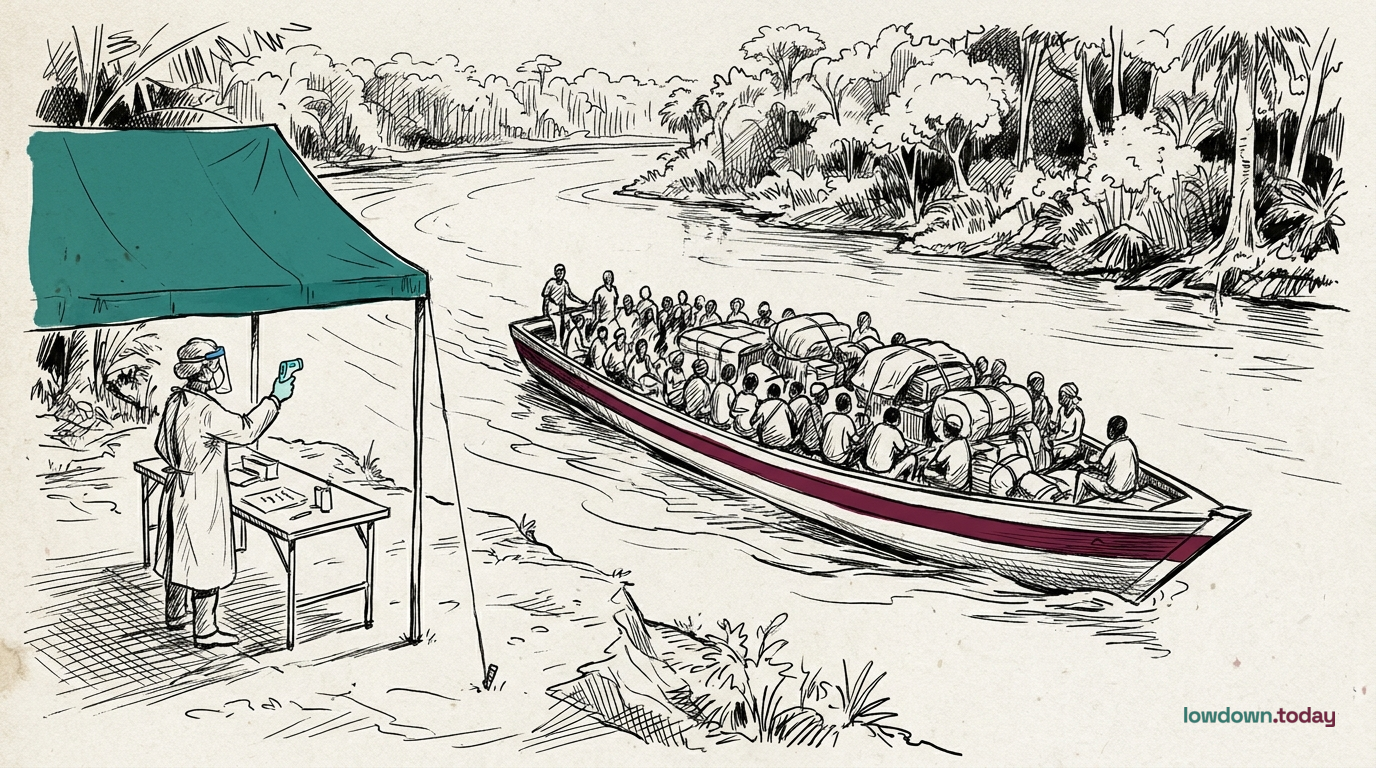
DRC's Ministry of Health, reporting a day after the WHO log on 14 June, counted 782 confirmed cases and 181 deaths, with 359 patients in isolation, meaning 45.9 percent of confirmed cases were isolated in a treatment unit⁠1. The ministry is the national surveillance authority for the outbreak, and its count runs a day later and slightly higher than WHO's confirmed reference total.

The CDC, the United States federal public health agency, published a reproduction-number model on 5 June that named patient isolation, not contact follow-up, as the variable that decides this outbreak. At the model's R0 of 2.51, every infected person passes the virus to roughly two and a half others if nothing intervenes. The model measured one thing: how many confirmed cases reach a treatment bed where they cannot infect anyone else. At 20 percent isolation, its worst case of 20,000 cases by August occurs in 65 percent of simulation runs. At 70 percent isolation, that worst case collapses to a one-in-a-hundred tail.

DRC's 45.9 percent sits between those two poles, above the baseline that drives the model toward catastrophe but well below the threshold that breaks the chain. The Africa CDC's science advisors point to continuing attacks on health facilities as the reason a traced contact often cannot be moved into a bed. A contact found by phone but unable to reach a treatment unit still transmits. That is the gap the isolation number measures and the tracing number hides.

Deep Analysis

In plain English

The CDC (US Centers for Disease Control and Prevention) published a mathematical model that calculates how many people each Ebola patient infects on average. For this outbreak the number is 2.51. To stop the outbreak growing, you need to get most of those patients into an isolation unit before they infect others. The model says you need roughly 70 percent of confirmed patients isolated to prevent a worst-case explosion. Right now, 46 percent are isolated. That gap, between 46 and 70 percent, is what the outbreak's short-term trajectory depends on. Contact tracing is working better, but tracing someone and then getting them safely to a treatment unit are two different problems in a conflict zone.

Deep Analysis
Root Causes

Patient isolation in Ituri depends on treatment unit capacity, community trust, and physical access to those units, none of which are fully within the response's control. Treatment units require security escorts in at least eight of the 29 affected health zones, meaning the bottleneck is not patient willingness but route safety. Where patients cannot safely travel, isolation cannot happen regardless of tracing coverage.

A structural asymmetry compounds this: the CDC model was derived from early-outbreak data from relatively accessible health zones. The model's 70 percent threshold likely understates what is needed in zones with partial access, because the accessible zones are better-connected to isolation capacity and the inaccessible zones systematically depress the aggregate rate while contributing disproportionately to community spread.

Escalation

The 45.9 percent isolation rate sitting between the model's floor (20 percent) and its collapse threshold (70 percent) means the outbreak is in an indeterminate zone. Three to four percentage points of isolation improvement shifts probability distributions materially; three to four percentage points of decline risks pushing simulation medians toward the 20,000-case scenario. Current trajectory is upward in case count and indeterminate on isolation.

What could happen next?
  • Meaning

    The CDC model makes a specific, testable claim: reaching 70 percent isolation reduces the August worst-case from a 65 percent probability to 1 percent. Every isolation unit opened is a measurable intervention on this probability.

  • Risk

    Ituri's security-constrained zones prevent isolation regardless of contact-tracing investment, setting a practical ceiling on the isolation rate achievable under current conditions.

First Reported In

Update #7 · Bundibugyo's fork stays open

DRC Ministry of Health / UN News· 16 Jun 2026
Read original →
Different Perspectives
IGWG co-chair Tovar da Silva Nunes
The Brazilian co-chair closed the eighth pathogen-sharing session on 18 September without an agreed annex text, the second session in a row to end that way. He presented the outcome as continued commitment, with adoption due at the World Health Assembly in May 2027.
Fraport
Fraport
The Frankfurt Airport operator has told staff to watch for fever, hessenschau reported, after six airport workers caught malaria. Germany does not require insecticide spraying of arriving aircraft cabins, and parasite genotyping to trace the source is due at the end of October.
European Centre for Disease Prevention and Control
ECDC reported the eight Frankfurt Airport malaria cases on 18 September and considers repeated arrivals of infected mosquitoes on aircraft likely. It has not ruled out local mosquitoes, and awaits genotyping due at the end of October.
Pan American Health Organization
PAHO counted 53,957 measles cases in the Americas by 19 September and is supporting Peru's response in Puno and Arequipa. It warns that October's Señor de los Milagros festivities and Pope Leo XIV's November visit could increase transmission.
Bangladesh Directorate General of Health Services
The DGHS recorded 1,030 measles-related deaths and 172,720 suspected cases by 14 September, after a campaign that reached 19.75 million children. Its disease-control director, Halimur Rashid, said further vaccination rounds were expected within two weeks.
Minapharm
Minapharm
The Egyptian drugmaker and its Berlin subsidiary ProBioGen were awarded up to US$16.5m by CEPI on 27 August to take a Bundibugyo vaccine into a Phase 1 trial in Africa. Final manufacture is planned for Cairo, making it CEPI's first Bundibugyo candidate with an African producer.
