Skip to content
Briefings are running a touch slower this week while we rebuild the foundations.See roadmap
Iran Conflict 2026
16MAY

US warship seizes Iranian cargo ship Touska

4 min read
12:41UTC

The USS Spruance fired into the Touska's engine room in the Gulf of Oman, the first kinetic seizure of an Iranian vessel since 1988.

ConflictDeveloping
Key takeaway

The US took an Iranian ship into custody for the first time since 1988 on a tweet's authority.

On 19 April the USS Spruance, an Arleigh Burke-class guided missile destroyer, intercepted the Iranian-flagged cargo ship Touska in The Gulf of Oman after a six-hour standoff. The warship fired several rounds from its 5-inch MK 45 naval gun into the Touska's engine room, put Marines aboard, and took the vessel into US custody. CENTCOM (US Central Command) confirmed 25 commercial vessels have been turned back since the blockade began 1.

The action crossed a threshold the previous 24 turn-backs had not. A US warship took an Iranian vessel into custody for the first time since the 1988 Tanker War, still operating under verbal authority alone. The direct antecedent was a Trump Truth Social post on 12 April , , narrowed by a CENTCOM operational order that pointed the blockade at Iranian ports . The Touska seizure also followed the IRGC firing on the Indian-flagged Sanmar Herald and Jag Arnav despite radio clearances , which is the Iranian escalation the Spruance was answering.

For shipping underwriters the risk picture changed in one afternoon. A turn-back is an insurable inconvenience; a hull taken into a foreign navy's custody is a constructive total loss claim. War-risk premiums on Hormuz hulls were already elevated; the Spruance action is the first underwritten data point on kinetic US interdiction. Khatam al-Anbiya (the IRGC's construction and engineering conglomerate) issued a written retaliation warning calling the seizure a ceasefire breach, which means the next Iranian response to a tanker stop is on a clock Tehran has now publicly started.

A counter-view from Trump's legal advisers holds that a commander-in-chief can act without signed instruments to defend US-flagged commerce. The Touska was Iranian-flagged, bound for a foreign port, still in international waters. That is a separable legal question no court has yet tested, and the signed-paper record an admiralty court would review remains empty of Iran instruments .

Deep Analysis

In plain English

The US Navy's USS Spruance stopped an Iranian cargo ship in the Gulf of Oman and, after a six-hour standoff, fired shots into the engine room to disable it. American Marines then boarded the ship and took it into custody. This is the first time a US warship has physically seized an Iranian vessel since a naval battle in the same waters in 1988. What makes this legally unusual is that President Trump signed no executive order authorising it. The Navy was operating under a chain of command that traces back to a 12 April Truth Social post. Courts in other countries asked to rule on the seizure will look for a proper presidential document and find nothing. Iran's IRGC construction arm immediately threatened to retaliate.

Deep Analysis
Root Causes

CENTCOM's operational order narrowed Trump's full-strait blockade directive to vessels entering or departing Iranian ports, creating a written enforcement framework that authorised turn-backs but said nothing about custody.

The Touska seizure exceeded that written authority and was retrospectively covered only by a verbal chain of command running to a Truth Social post. No prior US administration running declared hostilities past Day 48 had failed to produce a signed congressional notification; the White House has consciously used verbal authority as a policy instrument across all 52 days.

The Khatam al-Anbiya retaliation warning emerged from a separate command chain: the IRGC construction conglomerate that provides engineering and logistics to the Guard Corps Navy. Its written retaliation warning is a Guard Corps institutional response, not a government one, mirroring the Tabnak transit order's relationship to Araghchi's civilian corridor.

What could happen next?
  • Precedent

    Custodial seizure of a foreign vessel under social-media authority, if unchallenged in admiralty courts, normalises the practice for future blockades.

    Long term · 0.65
  • Risk

    Khatam al-Anbiya's written retaliation warning raises the probability of a symmetric IRGC kinetic response before the 22 April ceasefire expires.

    Immediate · 0.7
  • Consequence

    P&I clubs repricing Hormuz hulls from delay-risk to total-loss will increase insurance costs for all non-sanctioned vessels attempting transit.

    Short term · 0.8
First Reported In

Update #74 · Two unsigned rulebooks collide at Hormuz

Al Jazeera· 20 Apr 2026
Read original
Causes and effects
This Event
US warship seizes Iranian cargo ship Touska
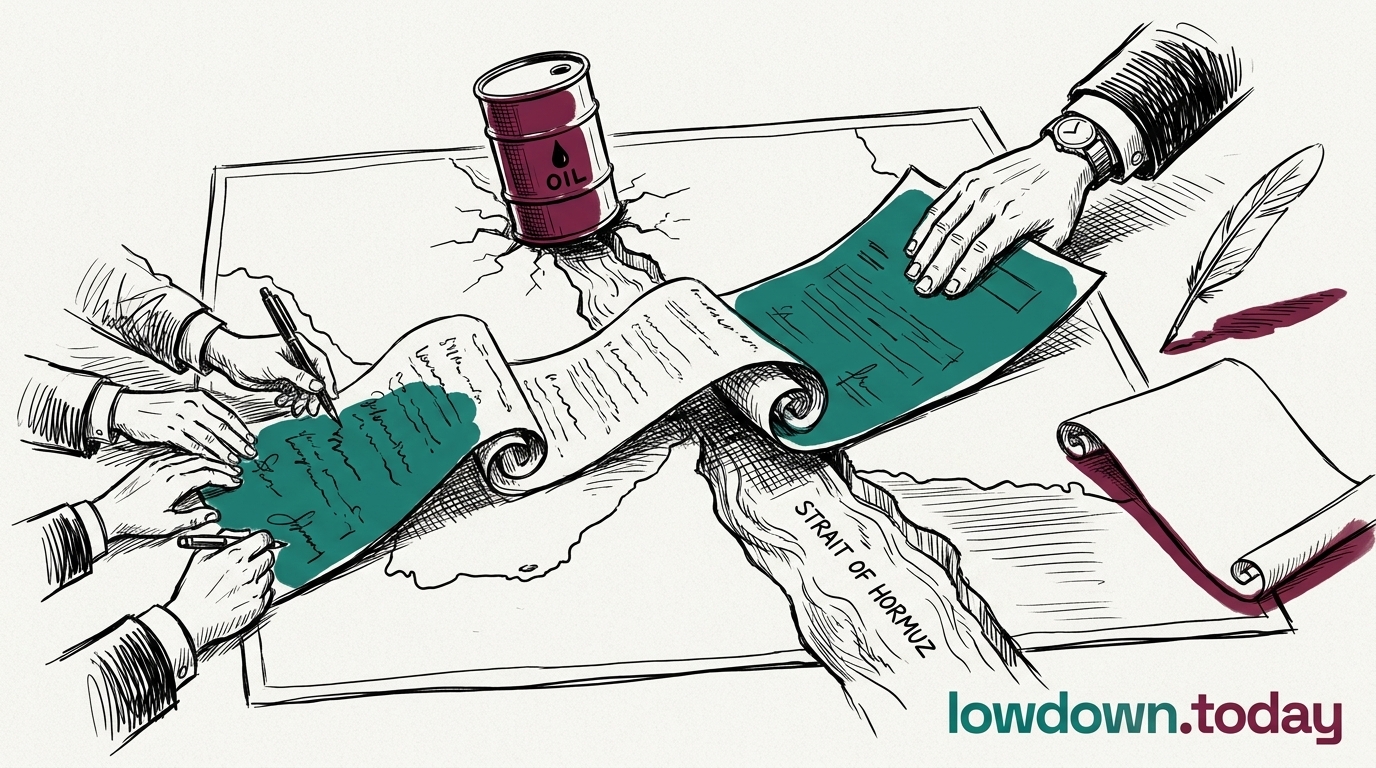
The blockade crossed from turn-back orders to vessel-taking under the same verbal authority a Truth Social post provides. For shipping underwriters, the threshold of risk moved overnight. For any court that later reviews the capture, the legal file is a tweet.
Different Perspectives
India (BRICS meeting host, grey-market beneficiary)
New Delhi hosted the BRICS foreign ministers' meeting on 14 May that Araghchi attended under the Minab168 designation, giving India a front-row seat to Iran's diplomatic positioning. India's state refiners have been absorbing discounted Iranian crude through grey-market routing since April; Brent at $109.30 means every barrel sourced outside the formal market generates a structural saving.
Hengaw / Kurdish human rights monitors
Hengaw's daily reports from Iran's Kurdish provinces remain the sole independent cross-check on Iran's judicial activity during the conflict. Two executions across Qom and Karaj Central prisons on 15 May and five Kurdish detentions on 15-16 May indicate the wartime judicial pipeline is operating independently of military tempo.
Pakistan (mediator and bilateral partner)
Islamabad spent its diplomatic capital as the US-Iran MOU carrier to secure LNG passage for two Qatari vessels through a bilateral Pakistan-Iran agreement, spending its mediation credit for direct economic gain. China's public endorsement of Pakistan's mediatory role on 13 May is the structural reward.
China and BRICS bloc
Beijing endorsed Pakistan's mediatory role on 13 May, one day after the BRICS foreign ministers' meeting in New Delhi. Chinese state banks are processing PGSA yuan toll payments; China has not commented on its vessels' continued Hormuz passage, but benefits structurally from a non-dollar toll system it did not design.
Iraq (bilateral passage partner)
Baghdad negotiated a 2-million-barrel VLCC transit without paying PGSA yuan tolls, offering political alignment in lieu of cash. Iraq's position inside Iran's adjacent bloc makes it the natural first bilateral partner and a template for how Tehran structures passage deals with states that cannot afford Western coalition membership.
Bahrain and Qatar (Gulf signatories)
Both signed the Western coalition paper while hosting US Fifth Fleet and CENTCOM's Al Udeid base, respectively. Qatar occupies the sharpest contradiction: it is on coalition paper while simultaneously receiving LNG passage through the bilateral Iran-Pakistan track, a position Doha has tacitly accepted from both sides.