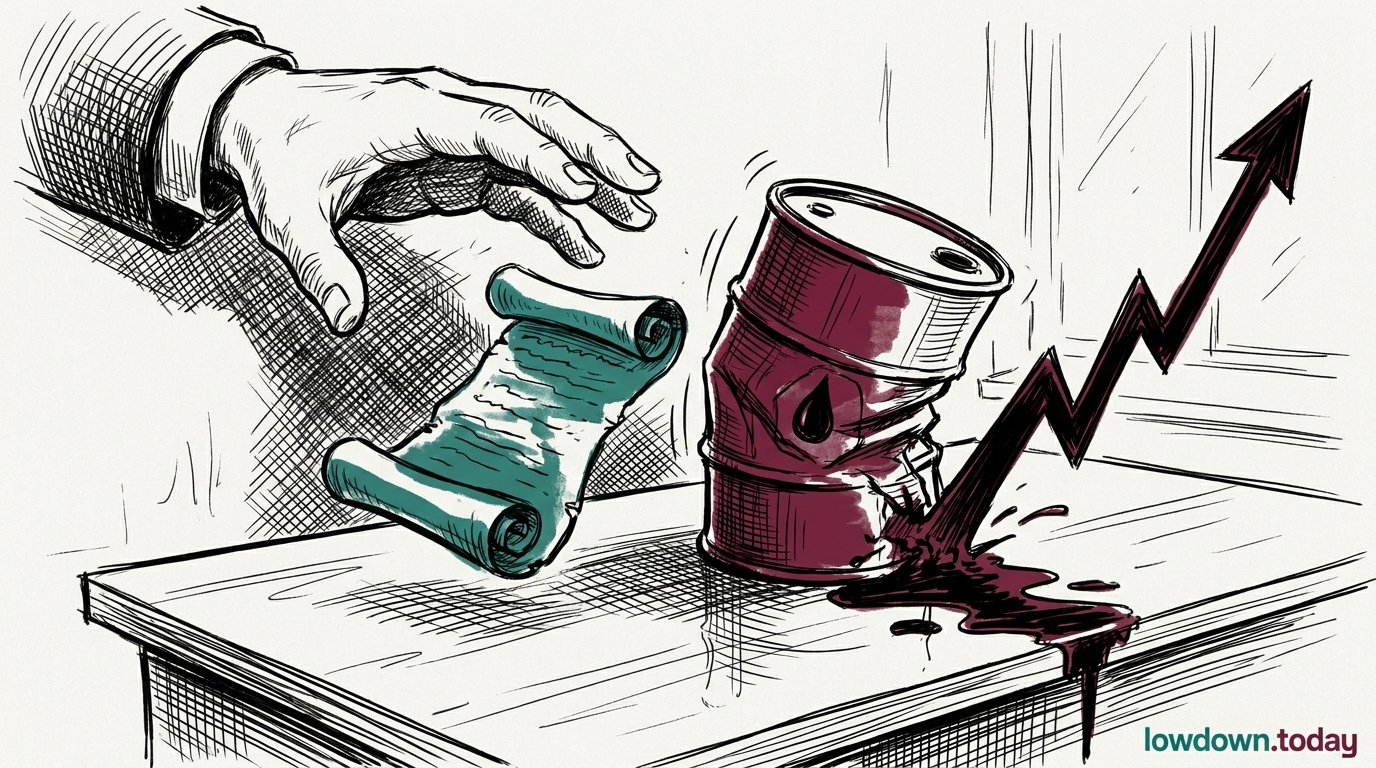
Brent Crude settled at $111.16/bbl on 28 April 2026 in London, up 2.71% in a single session from $108.11 on 27 April. The contract printed a new post-war high inside the same trading session that produced the United Arab Emirates OPEC exit announcement and the third Truth Social post from Donald Trump asserting Iran had told him it was collapsing. Axios found no Iranian confirmation and no accompanying State Department readout.
Brent Crude is the North Sea benchmark used to price roughly two-thirds of the world's oil contracts. The 28 April rally bundled two catalysts: the UAE exit removed a moderating voice on bloc production cuts at the moment CENTCOM's blockade was logging 37 vessels redirected, and the Pakistan-brokered ceasefire text arrived in Washington with no signed US response. Fortune reported the Brent settlement and confirmed US average gasoline at $4.18/gallon, the highest since the war began on 28 February. The year-on-year gain on Brent stands at 75.67%, a war premium that translates to roughly $1.80 more per US gallon than American drivers paid a year ago, or an extra $25 to $30 per fill on a typical 50-litre tank.
Markets priced the policy vacuum, not the diplomatic activity. Day 60 closes against an unbroken zero-instrument record; the price arc since Day 17, which closed at $100.21 Brent and $3.79 US gasoline, has run alongside that empty signing column. The barrels that would normally cap a war-driven price rally remain trapped behind a closed Hormuz, while Abu Dhabi's stranded barrels sit outside the bloc's quota framework after Friday. Even a ceasefire text signed before the War Powers Resolution clock expires this Friday would not by itself unlock the barrels: the structural premium needs Hormuz transits restored and an OPEC+ quota framework that, after Friday, no longer includes Abu Dhabi.
European drivers face a similar premium; airlines are repricing fuel-surcharge bands across the Atlantic and The Gulf. The London close at $111.16 will set every Asian opening through 1 May.


