Skip to content
Briefings are running a touch slower this week while we rebuild the foundations.See roadmap
Iran Conflict 2026
11MAY

Brent at $92.69, biggest week since 1983

3 min read
14:01UTC

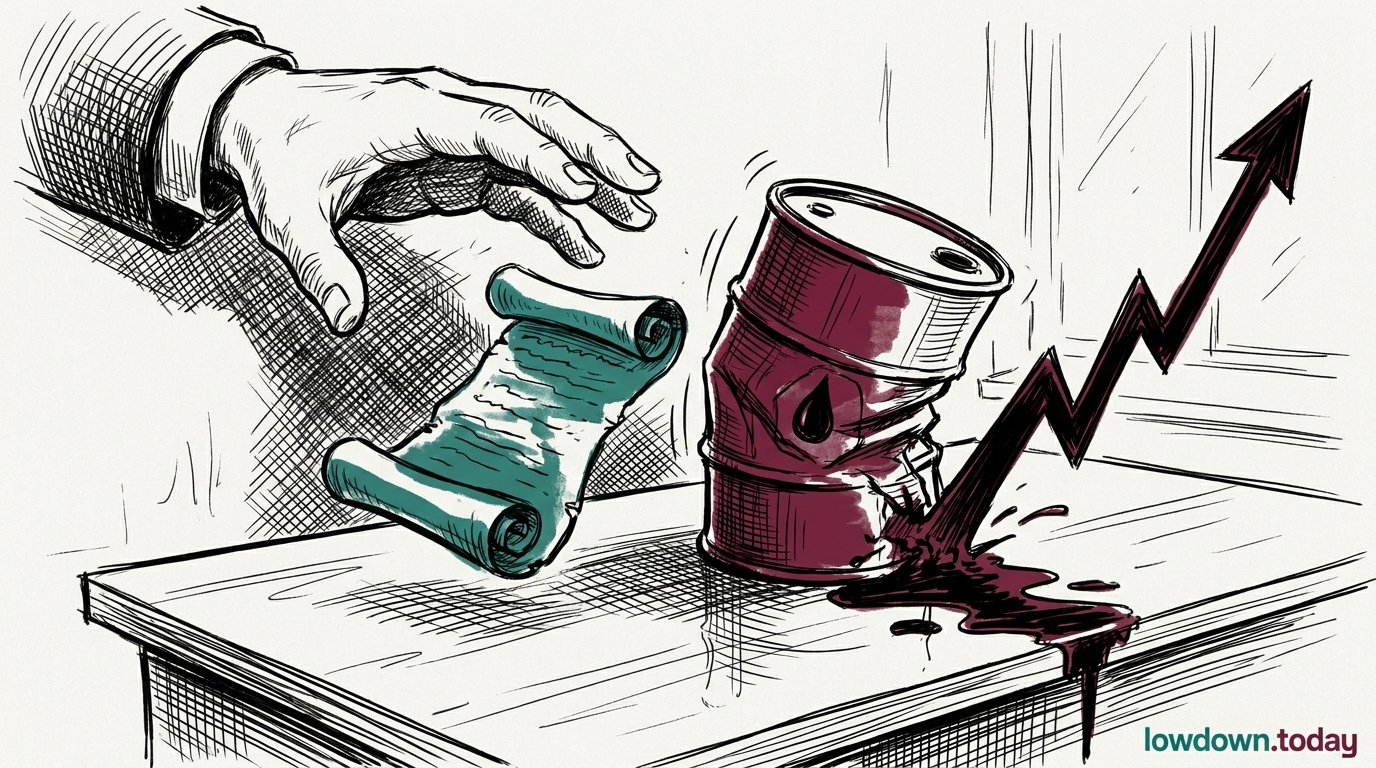
Brent crude hit $92.69 — up 27% since Day 1 — as the war's energy disruption split into two crises that a ceasefire alone cannot resolve.

ConflictDeveloping
Key takeaway

The insurance collapse imposes a minimum duration floor on economic disruption that is structurally independent of the conflict's military outcome — price rises and supply constraints are already locked in for weeks regardless of when hostilities end.

Brent Crude reached $92.69 on Friday, briefly touching $94, in the largest weekly gain in US crude futures history since trading began in 1983. Oil has risen roughly 27% since strikes opened on 28 February. Kuwait is cutting output. Brent crossed $85 on Day 7 and gained another $8 in 24 hours.

The energy disruption has split into two independent crises. The military crisis is visible: Iranian strikes on energy infrastructure have escalated from Bahrain's BAPCO refinery through Fujairah port to Saudi Arabia's Shaybah mega-field. The structural crisis is less visible and will outlast the fighting.

Every major Protection and Indemnity club cancelled war risk coverage at midnight on 5 March . More than 150 commercial vessels sit at anchor in The Gulf of Oman and Arabian Sea. The CSIS estimated the first 100 hours of the conflict at $3.7 billion ; the daily cost of stranded shipping runs in addition. Trump's Development Finance Corporation insurance programme and Navy convoy escorts remain non-operational .

Previous Gulf crises — the 1973 embargo, the 1979 revolution, the 1990 invasion of Kuwait — each drove oil higher over weeks or months. This shock has compressed a comparable move into eight days because it combines a chokepoint closure — the strait of Hormuz handles roughly 21% of daily global oil consumption — with the failure of the commercial insurance infrastructure that makes tanker transit possible.

Deep Analysis

In plain English

Shipping companies operating in war zones normally buy 'war risk insurance' to cover their vessels if damaged. Every major insurer in this market has cancelled that coverage. Without insurance, ships cannot legally dock at most major ports worldwide — port regulations in the vast majority of countries require valid cover as a condition of entry — and banks will not finance cargo without it. This is effectively a maritime blockade imposed by the insurance market, not by any military force. Critically, even if a ceasefire happened tomorrow, the insurers would require weeks of actuarial reassessment, internal committee approvals, and reinsurance treaty renegotiations before coverage could resume — meaning the economic disruption has a built-in delay that no political decision can shortcut.

Deep Analysis
Synthesis

The body identifies the two-timeline structure but does not surface the critical asymmetry: military operations can be halted by political decision within hours, but insurance market re-entry requires actuarial reassessment, committee approval, reinsurance treaty renegotiation, and port state control regulatory sign-off across multiple jurisdictions in sequence. The floor on economic disruption duration is therefore a structural property of insurance market governance, not a function of the conflict's length — a ceasefire does not start the clock; it merely removes the primary obstacle to an independently slow process.

Root Causes

The simultaneous cancellation by all major P&I clubs — rather than sharp premium increases — reflects a structural shift in marine insurance governance that post-dates 2020: clubs adopted concentration-risk protocols treating fleet-wide war zone exposure as systemic rather than individual-vessel risk. This means reinstatement is a governance decision requiring formal committee votes and reinsurance treaty renegotiation across multiple jurisdictions, not a market-clearing event that resolves automatically when risk falls. The withdrawal is policy-driven rather than purely actuarial.

What could happen next?
2 consequence2 risk1 precedent
  • Consequence

    Commercial shipping cannot resume immediately upon ceasefire; insurance reassessment governance cycles impose a structural minimum delay of four to six weeks, locking in supply disruptions independent of the military outcome.

    Short term · Assessed
  • Risk

    Oil-importing emerging market central banks face a policy trap: defending currencies requires rate rises that suppress growth, while accepting depreciation imports further inflation — sovereign debt stress in high-import-dependency economies is a plausible near-term consequence.

    Short term · Assessed
  • Risk

    Kuwait's output cuts coincide with the Shaybah targeting, simultaneously removing two sources of Gulf spare capacity that OPEC-plus normally deploys to cap price spikes — the buffer against the $150 scenario is structurally smaller than aggregate OPEC spare capacity figures suggest.

    Immediate · Assessed
  • Consequence

    Airlines, fertiliser producers, and petrochemical manufacturers with forward hedges priced below $80 per barrel face unhedged exposure on above-contract consumption volumes, compressing margins across energy-intensive industrial sectors through at least mid-2026.

    Short term · Suggested
  • Precedent

    Simultaneous market-wide P&I cancellation — rather than premium escalation — establishes a new industry norm for conflict-zone exit that will accelerate future insurance withdrawals in comparable scenarios, amplifying the economic disruption multiplier in future Gulf or Strait crises.

    Long term · Suggested
First Reported In

Update #25 · Russia shares targeting data on US forces

Bloomberg· 7 Mar 2026
Read original
Different Perspectives
International human rights monitors (NetBlocks, IHR, Hengaw)
NetBlocks recorded 1,704 cumulative hours of near-total internet blackout for roughly 90 million Iranians on Day 74, while IHR documented ongoing executions under emergency provisions. These organisations are the only active monitoring windows into a civilian population cut off from the global internet for 71 consecutive days.
UK / France coalition
The Royal Navy confirmed HMS Dragon's Hormuz deployment on its own website on 11 May, converting a press-reported presence into declared force posture; UK and French defence ministers hosted a coalition meeting the same day. Britain and France are now the only named contributors to a Hormuz escort mission all five allies Trump originally asked had declined.
Saudi Aramco / Gulf producers
Saudi Aramco CEO Amin Nasser warned on 11 May that a Hormuz closure could remove 100 million barrels of weekly supply from global markets (roughly 15 million barrels per day for a week), a figure that dwarfs any OPEC+ swing capacity. The warning functions as both a price-floor signal and a public pressure on Washington to protect transit.
Beijing / Chinese Government
China has not publicly acknowledged the four Hong Kong-registered entities designated on 11 May or extended MOFCOM's Blocking Rules cover to HK-domiciled firms. Xi Jinping hosts Trump on 14–15 May having already de-risked state-bank balance sheets via NFRA's quiet loan halt, entering the summit partially compliant before any negotiation.
Tehran / Iranian Government
Foreign Minister Araghchi described Iran's 10-point counter-proposal as 'reasonable and responsible' via spokesman Baqaei on 11 May, and widened the mediator pool by meeting Turkish, Egyptian, and Dutch counterparts in a single day. Tehran is buying procedural runway while Trump's verbal rejection went unmatched by any written US counter.
Trump White House
Trump White House
Trump called the ceasefire 'on massive life support' and dismissed Iran's 10-point counter-proposal as 'a piece of garbage' on 11 May, while departing for Beijing two days later with no signed Iran instrument to show Congress. The verbal maximum and the paper void coexist: the administration is running a legal pressure campaign through Treasury while the president free-lances the rhetoric.