Skip to content
Briefings are running a touch slower this week while we rebuild the foundations.See roadmap
Iran Conflict 2026
2MAR

Day 3: IRGC HQ destroyed; Britain quits coalition

7 min read
19:00UTC

The US destroyed the IRGC's Sarallah headquarters in Tehran, completing the systematic decapitation of Iran's military command. Prime Minister Starmer told Parliament that Britain would not join offensive operations — the sharpest UK-US military split since 2003. Oil rose past $85 with the Strait of Hormuz still effectively closed, China confirmed its first casualty, and Israel signalled a ground invasion of Lebanon.

Key takeaway

The campaign has destroyed Iran's command architecture but created a governance vacuum that no actor — including the US — has a plan to fill, while the coalition prosecuting the war has narrowed to two states.

This briefing mapped
Loading map…
Military
Diplomatic

Israel mobilised reservists and launched an 'offensive campaign' in Lebanon after Netanyahu reportedly told his cabinet Trump had approved the operation — opening a third front the IDF has not managed since 1973.

Sources profile:This story draws on centre-left-leaning sources from Israel
Israel

Israel mobilised reservists and the IDF launched what it called an 'offensive campaign' in Lebanon. The Times of Israel reported that Netanyahu told his cabinet Trump had given the green light for a new offensive against Hezbollah in Lebanon.

A ground invasion of Lebanon would commit the IDF to three simultaneous fronts — Iran, Gaza, and Lebanon — for the first time since 1973, stretching logistics, manpower, and intelligence capacity at a moment when Hezbollah has demonstrated the ability to strike deep inside Israeli territory. 

Briefing analysis

The US killed Iraqi President Saddam Hussein's sons Uday and Qusay in July 2003 and captured Saddam himself in December 2003, completing a decapitation that left no governance structure. The resulting power vacuum produced a decade of sectarian war. Iran's case differs in one respect — an interim leadership council formed within 24 hours under Article 111 — but resembles it in the gap between military success and political planning: no US official has articulated what Iranian governance looks like in six months.

The 1973 Yom Kippur War is the closest precedent for Israel fighting on multiple simultaneous fronts. Israel prevailed but came closer to strategic defeat than at any other point in its history, requiring emergency US resupply. The IDF's current posture — active operations in Iran, Gaza, and potentially Lebanon — would exceed that burden.

A Hezbollah strike on an IDF base in Haifa — with precision the group lacked in 2006 — drew massive Israeli retaliation and talk of a ground invasion that would stretch the IDF across three simultaneous wars.

Sources profile:This story draws on centre-left-leaning sources from Qatar and Israel
QatarIsrael

Hezbollah struck an IDF base in Haifa overnight.

Hezbollah's strike on Haifa demonstrates continued capability to hit deep inside Israel and has triggered Israeli mobilisation for a potential ground invasion of Lebanon — a third simultaneous front alongside Iran and Gaza

Nawaf Salam called Hezbollah's strike 'irresponsible and suspicious' — breaking decades of careful silence that no Lebanese prime minister dared breach while Hezbollah's guns were still firing.

Sources profile:This story draws on centre-left-leaning sources from Qatar and Israel
QatarIsrael

Lebanon's Prime Minister Nawaf Salam called Hezbollah's attack on Israel 'irresponsible and suspicious' and convened an emergency cabinet session with the army chief — a public break from the careful ambiguity previous Lebanese leaders maintained toward Hezbollah's military operations.

The first public condemnation of a Hezbollah military operation by a sitting Lebanese prime minister, breaking the political ambiguity that has allowed Hezbollah to operate as a parallel military force since the end of Lebanon's civil war. 

Starmer told Parliament that Britain will not fight, invoking Iraq — capping a 72-hour arc from authorising base access to absorbing a drone strike on sovereign territory to public refusal.

Sources profile:This story draws predominantly on United Kingdom state media, with sources from United Kingdom
United Kingdom

UK Prime Minister Keir Starmer told Parliament that Britain would not join offensive action against Iran, explicitly citing the lessons of the 2003 Iraq war. This represents the sharpest public break between London and Washington on military action since the 2003 Iraq vote.

Britain's refusal leaves the United States without any European military partner and raises the Iraq-era question of intelligence justification — with the difference that in 2003 the dispute concerned intelligence quality, while in 2026 it concerns its reported absence. 

Sources:Gov.uk

Starmer authorised US use of Diego Garcia and RAF Fairford for strikes on Iran while insisting Britain's role was defensive — a distinction that collapsed within the hour.

Sources profile:This story draws on centre-left-leaning sources from Qatar
Qatar

On 1 March, Starmer authorised US use of Diego Garcia and RAF Fairford for strikes on Iranian missiles and launch sites, which the UK government described as defensive in scope.

The UK's base authorisation enables the US strike campaign's long-range operations while attempting to preserve political distance from the war itself, reprising a legal architecture Britain has used in every major conflict since 2001. 

Sources:Al Jazeera

Within an hour of Britain authorising base access for US strikes on Iran, a drone struck RAF Akrotiri in Cyprus — the first foreign military strike on British sovereign territory since the Falklands War.

Sources profile:This story draws on centre-left-leaning sources from Qatar
Qatar

A drone struck RAF Akrotiri in Cyprus within an hour of the UK authorising US use of British bases for strikes on Iran.

The Akrotiri strike transformed Britain's involvement from a logistical question into a territorial one, forcing Starmer to choose between deeper involvement and withdrawal within hours of his base authorisation. 

Sources:Al Jazeera

France demanded a UN Security Council session, Spain called the operation destabilising, and the EU called for restraint — but no European government has offered forces, mediation, or a plan to end it.

Sources profile:This story draws on centre-left-leaning sources from Qatar
Qatar

France called for an emergency UN Security Council session. The EU called for 'restraint.' Spain described the US-Israeli operation as contributing to 'a more uncertain and hostile international order.'

No European ally has joined the US-Israeli campaign, producing the narrowest coalition for a major American military operation since the 1986 US strikes on Libya. The transatlantic fracture is wider than Iraq 2003, when Britain, Poland, and over 30 states participated. 

Sources:Al Jazeera

Russia and China delivered their harshest joint denunciation of US military action in over two decades, then offered Tehran nothing beyond words.

Sources profile:This story draws on mixed-leaning sources from United States and Ukraine
United StatesUkraine
LeftRight

Putin called Khamenei's death a 'cynical murder' and 'unprovoked aggression.' Wang Yi told Lavrov the attacks are 'unacceptable.' Xinhua described them as 'brazen aggression' and a 'flagrant violation of the UN Charter.'

Iran's two most important strategic partners condemned the campaign with language reserved for the gravest provocations and matched it with zero military commitments, defining the practical limits of the partnerships Tehran cultivated over two decades. 

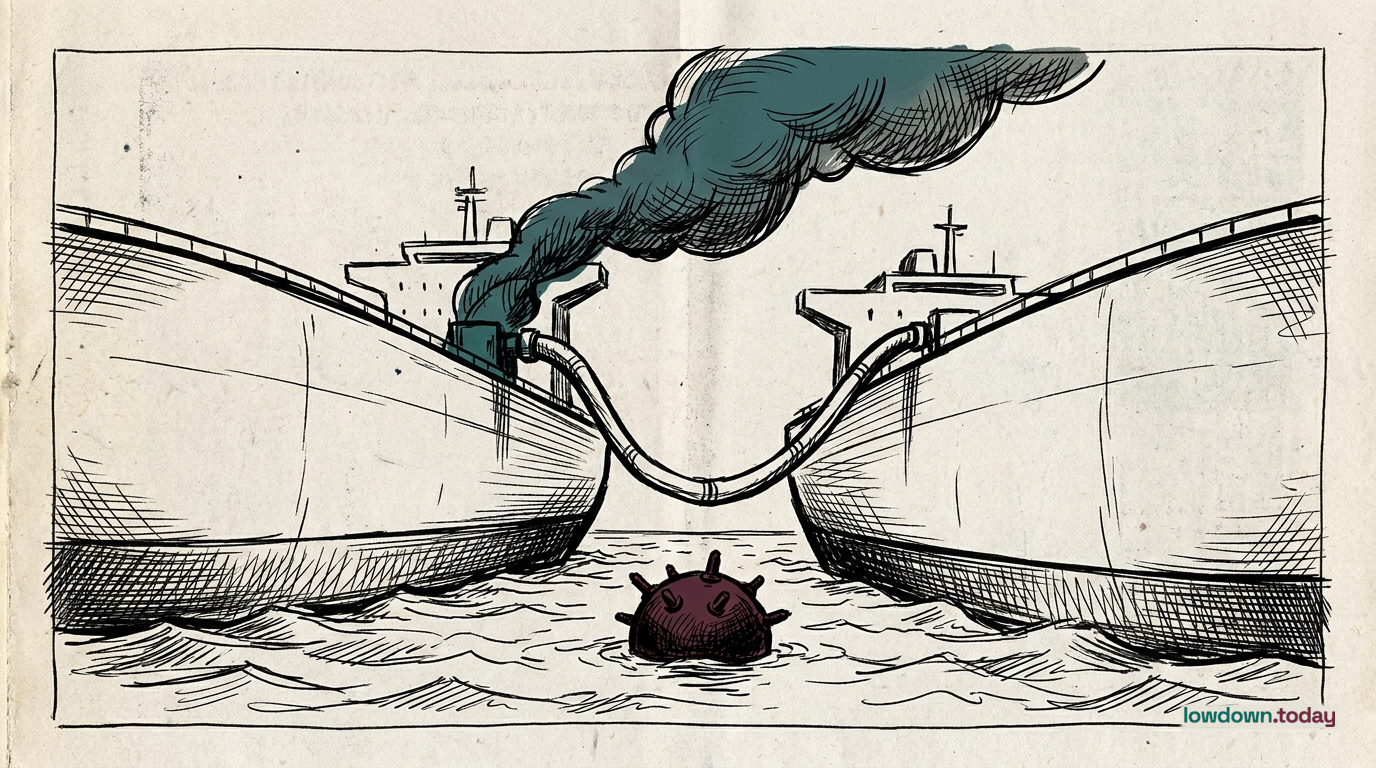
Brent crude has risen more than 16% since strikes began, and OPEC+'s production increase covers barely 1% of the strait's normal flow.

Sources profile:This story draws on centre-leaning sources from France
France
LeftRight

Brent Crude rose to $85-90 per barrel, up from a pre-strike level of approximately $73.

The price reflects a physical supply blockage — vessel traffic down 70%, all major carriers suspended — not speculative positioning, and the gap between $85–90 and bank forecasts of $98–130 measures the market's remaining assumption that the Hormuz closure will be resolved quickly. 

Sources:Euronews
Closing comments

Three vectors favour escalation: Israel's reserve mobilisation and open discussion of a Lebanon ground invasion; Kataib Hezbollah's declaration in Iraq that it 'will not remain neutral'; and the IRGC's dispersed provincial commands operating without central direction, which means units may escalate without any leadership authorising or restraining them. The primary de-escalation vector — the Oman channel — requires an Iranian interlocutor who can deliver compliance from forces that Araghchi himself described as beyond government control. Markets are pricing in escalation: Goldman Sachs's recession probability at 25%, Brent crude projections reaching $110, and JPMorgan flagging sustained Hormuz closure as the trigger variable all reflect expectations that the conflict widens before it narrows.

Emerging patterns

  • Multi-front Israeli military escalation concurrent with Iran campaign
  • Hezbollah direct strikes on Israeli military infrastructure inside sovereign territory
  • Lebanese state distancing from Hezbollah under pressure of multi-front regional war
  • Allied defection from US-led military action under domestic political pressure
  • Selective allied support limited to defensive framing while rejecting offensive participation
  • Retaliation against coalition enablers' sovereign territory
  • European diplomatic distancing from US military action
  • Great power rhetorical opposition without material military consequence
  • Conflict-driven commodity price surge from Strait of Hormuz disruption
Different Perspectives
Prime Minister Keir Starmer
Refused offensive participation in the Iran campaign after having authorised US use of Diego Garcia and RAF Fairford for strikes on 1 March. The reversal followed a drone strike on RAF Akrotiri within an hour of the base authorisation. Starmer explicitly invoked Iraq 2003 — the last time a British prime minister broke from the US on Middle East military action.
Prime Minister Nawaf Salam
Called Hezbollah's attack on Haifa 'irresponsible and suspicious' and convened an emergency cabinet session with the army chief. Previous Lebanese prime ministers maintained careful ambiguity toward Hezbollah's military operations even during the 2006 war.
India
India
Condemned Iran's retaliatory strikes on Gulf states at the United Nations but issued no statement on the initial US-Israeli strikes that killed Iran's Supreme Leader and destroyed the IRGC's command structure. The selective condemnation positions Delhi with its Gulf trade partners while avoiding direct criticism of either Washington or Tehran.
South Africa
South Africa
Has not criticised Washington's role in the strikes on Iran, despite having brought the ICJ genocide case against Israel over Gaza. The silence from Pretoria is a departure from its vocal positioning on Middle East issues.

