Skip to content
Briefings are running a touch slower this week while we rebuild the foundations.See roadmap
Iran Conflict 2026
3MAY

Navy calls Hormuz an Iranian kill box

4 min read
10:26UTC

The US Navy's own characterisation of the strait — a zone of pre-registered, concentrated fire — is an admission that 50,000 American troops in theatre cannot guarantee passage through a 21-mile-wide waterway.

ConflictDeveloping
Key takeaway

Hormuz is not a transit problem but a strategic trap with no clean military exit.

US Navy officials described the strait of Hormuz to the Wall Street Journal as an Iranian "Kill box" — a term with specific doctrinal meaning: a three-dimensional zone where fires are pre-coordinated, allowing rapid engagement of any target that enters without further authorisation. 300+ commercial ships are stranded in the Persian Gulf. 19 have been damaged since 28 February. Daily transits have collapsed to single digits against a historical average of 138. Fortune reported that extracting the stranded fleet at convoy pace could take months or years.

The progression from threat to execution was rapid. On 8 March, Iran's Foreign Ministry warned tankers to be "very careful" — the first diplomatic-level Hormuz threat. Two days later, the IRGC declared that "not a litre of oil" would pass . On 11 March, six vessels were struck in a 14-hour window across 200 kilometres of water from Hormuz to Iraq's Basra terminal , using anti-ship missiles, sea mines, and — for the first time — explosive-laden drone boats . The IMO counted 10 vessels attacked, 7 seafarers killed, and 20,000 stranded as of 10 March . Those figures have since worsened.

The Hormuz Chokepoint has been a theoretical vulnerability since the 1980s Tanker War, when Iran mined the strait and attacked Kuwaiti tankers. The Reagan administration's Operation Earnest Will provided naval escorts starting in 1987 — but against anti-ship missiles and contact mines, without GPS-guided anti-ship ballistic missiles, without explosive drone boats, and without the dense, pre-registered fire grid the IRGC has established across the strait's 21-mile width. Defence officials said escorts cannot begin until the threat of Iranian fire is "substantially reduced." Energy Secretary Wright said the Navy is "simply not ready" . These are operational admissions, not diplomatic hedges.

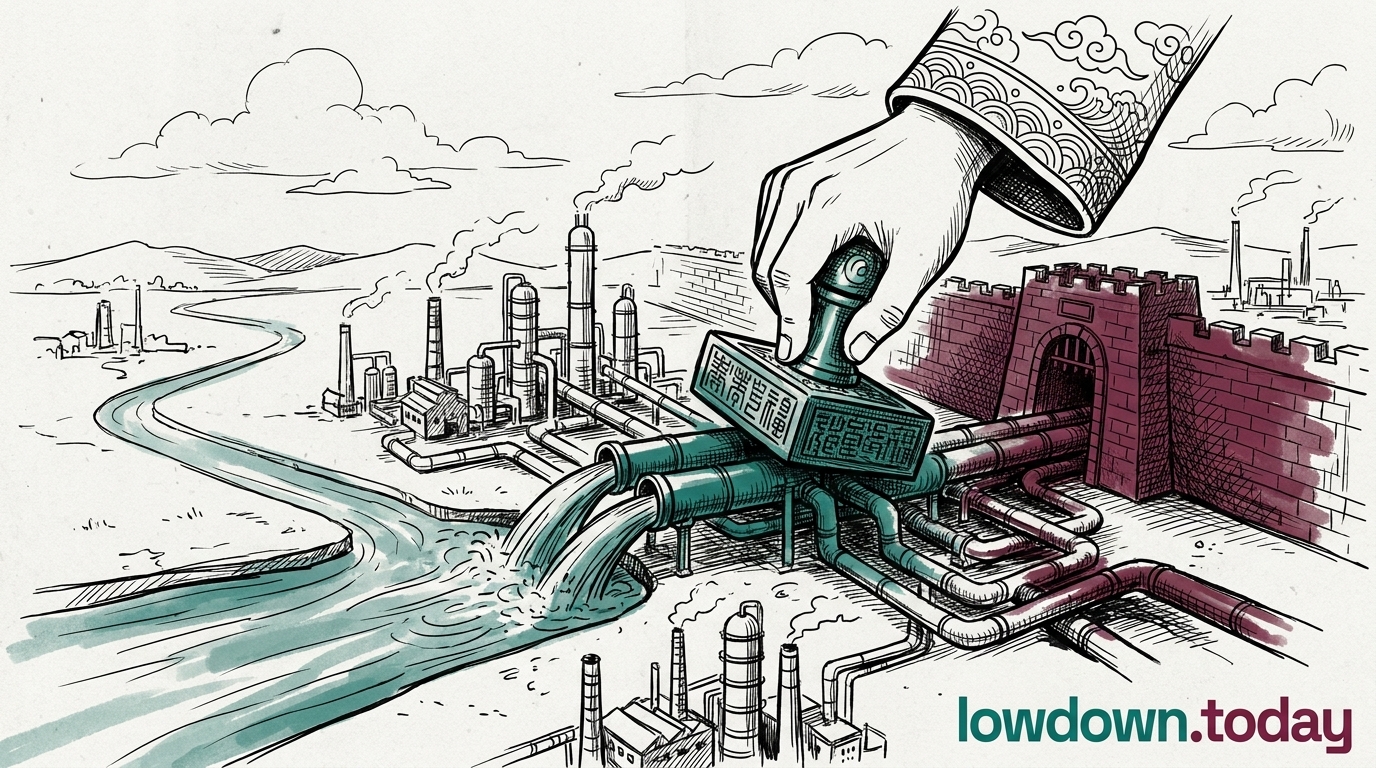
The China exception complicates the picture. Chinese-operated vessels have been transiting with de facto IRGC protection , broadcasting AIS messages emphasising Chinese ownership and crew composition. 11.7 million barrels of Iranian crude have passed through Hormuz since 28 February, all bound for China. Shadow fleet ships account for half of all March transits. Iran has not blockaded the strait — it has imposed selective access, deciding who passes and who does not. For non-Chinese commercial shipping, the strait is closed. For Beijing, it is open. The result is not a blockade in the traditional sense but a reordering of maritime access along geopolitical lines, enforced by pre-registered fire.

Deep Analysis

In plain English

The Strait of Hormuz is the world's most important oil chokepoint — roughly one-fifth of global oil supply moves through it. Iran has turned it into what military planners call a 'kill box': a zone where their weapons are pre-aimed and ready to fire at anything that moves. The US Navy wants to escort the stranded ships out safely, but says it cannot start until Iran's weapons are neutralised. Neutralising those weapons, however, risks triggering Iran's threat to destroy Gulf oil infrastructure. So both sides are waiting in a logical standoff — and over 300 ships full of cargo sit idle, unable to move in either direction.

Deep Analysis
Synthesis

The three incompatible administration descriptions of the same inability to reopen the strait expose a deeper problem: without agreed decision criteria for what 'threat substantially reduced' means, no official can authorise the transition to escorts. The blockade thus has no defined off-ramp on the US side — not because military options are absent but because political consensus on the trigger condition does not exist.

Root Causes

Iran's Hormuz strategy is the purpose-built culmination of post-1988 doctrine development following Iran's naval defeat in Operation Praying Mantis. The IRGC Navy's 'mosaic defence' concept accepts conventional naval inferiority and compensates with overlapping area-denial layers — shore-based Khalij Fars anti-ship ballistic missiles, fast-boat swarms, naval mines, and drone corridors — optimised for the strait's 21-nautical-mile minimum width. This is not improvised crisis response; it is thirty years of strategic planning made operational.

Escalation

The body presents threat-reduction and convoy escorts as sequential steps. They are in fact a logical trap: escorts require defeating the Iranian threat, but the act of defeating it constitutes the military operation that triggers Iran's oil-infrastructure counter-threat. There is no clean sequence — each step simultaneously unlocks the next escalation rung. The three incompatible administration statements reveal not just messaging incoherence but an absence of shared decision criteria for when military conditions are deemed met, which means the transition from blockade to convoy cannot be formally authorised.

What could happen next?
  • Risk

    Any convoy escort attempt without comprehensive Iranian threat suppression risks triggering the oil-infrastructure escalation ladder and convoy operation simultaneously.

    Immediate · Assessed
  • Consequence

    Japan and South Korea face acute LNG supply shortfalls within weeks if Hormuz remains at single-digit transits, with no viable alternative supply route at equivalent volume.

    Short term · Assessed
  • Risk

    Lloyd's war-risk premiums make commercial transit economically unviable independent of Iranian military posture, prolonging effective closure beyond any near-term ceasefire.

    Short term · Suggested
  • Precedent

    If Iran successfully maintains the blockade for weeks against a US carrier presence, it validates A2/AD doctrine as capable of defeating US naval superiority in littoral zones.

    Long term · Suggested
First Reported In

Update #35 · Kharg Island struck; oil terminal spared

Fortune· 14 Mar 2026
Read original
Causes and effects
This Event
Navy calls Hormuz an Iranian kill box
The functional closure of the Strait of Hormuz, with 300+ ships stranded and daily transits at single digits against a historical average of 138, represents the realisation of the scenario Western naval planners have war-gamed for four decades. The Navy's admission that escorts cannot begin until the threat is 'substantially reduced' means reopening the strait is a military precondition, not a diplomatic negotiation.
Different Perspectives
International human rights monitors (NetBlocks, IHR, Hengaw)
NetBlocks recorded 1,704 cumulative hours of near-total internet blackout for roughly 90 million Iranians on Day 74, while IHR documented ongoing executions under emergency provisions. These organisations are the only active monitoring windows into a civilian population cut off from the global internet for 71 consecutive days.
UK / France coalition
The Royal Navy confirmed HMS Dragon's Hormuz deployment on its own website on 11 May, converting a press-reported presence into declared force posture; UK and French defence ministers hosted a coalition meeting the same day. Britain and France are now the only named contributors to a Hormuz escort mission all five allies Trump originally asked had declined.
Saudi Aramco / Gulf producers
Saudi Aramco CEO Amin Nasser warned on 11 May that a Hormuz closure could remove 100 million barrels of weekly supply from global markets (roughly 15 million barrels per day for a week), a figure that dwarfs any OPEC+ swing capacity. The warning functions as both a price-floor signal and a public pressure on Washington to protect transit.
Beijing / Chinese Government
China has not publicly acknowledged the four Hong Kong-registered entities designated on 11 May or extended MOFCOM's Blocking Rules cover to HK-domiciled firms. Xi Jinping hosts Trump on 14–15 May having already de-risked state-bank balance sheets via NFRA's quiet loan halt, entering the summit partially compliant before any negotiation.
Tehran / Iranian Government
Foreign Minister Araghchi described Iran's 10-point counter-proposal as 'reasonable and responsible' via spokesman Baqaei on 11 May, and widened the mediator pool by meeting Turkish, Egyptian, and Dutch counterparts in a single day. Tehran is buying procedural runway while Trump's verbal rejection went unmatched by any written US counter.
Trump White House
Trump White House
Trump called the ceasefire 'on massive life support' and dismissed Iran's 10-point counter-proposal as 'a piece of garbage' on 11 May, while departing for Beijing two days later with no signed Iran instrument to show Congress. The verbal maximum and the paper void coexist: the administration is running a legal pressure campaign through Treasury while the president free-lances the rhetoric.