Skip to content
Briefings are running a touch slower this week while we rebuild the foundations.See roadmap
Iran Conflict 2026
1MAY

Trump delays grid strikes, claims deal

3 min read
10:38UTC

Three days after threatening to 'hit and obliterate' Iranian power plants, Trump claims a 15-point agreement that Iran says does not exist.

ConflictDeveloping
Key takeaway

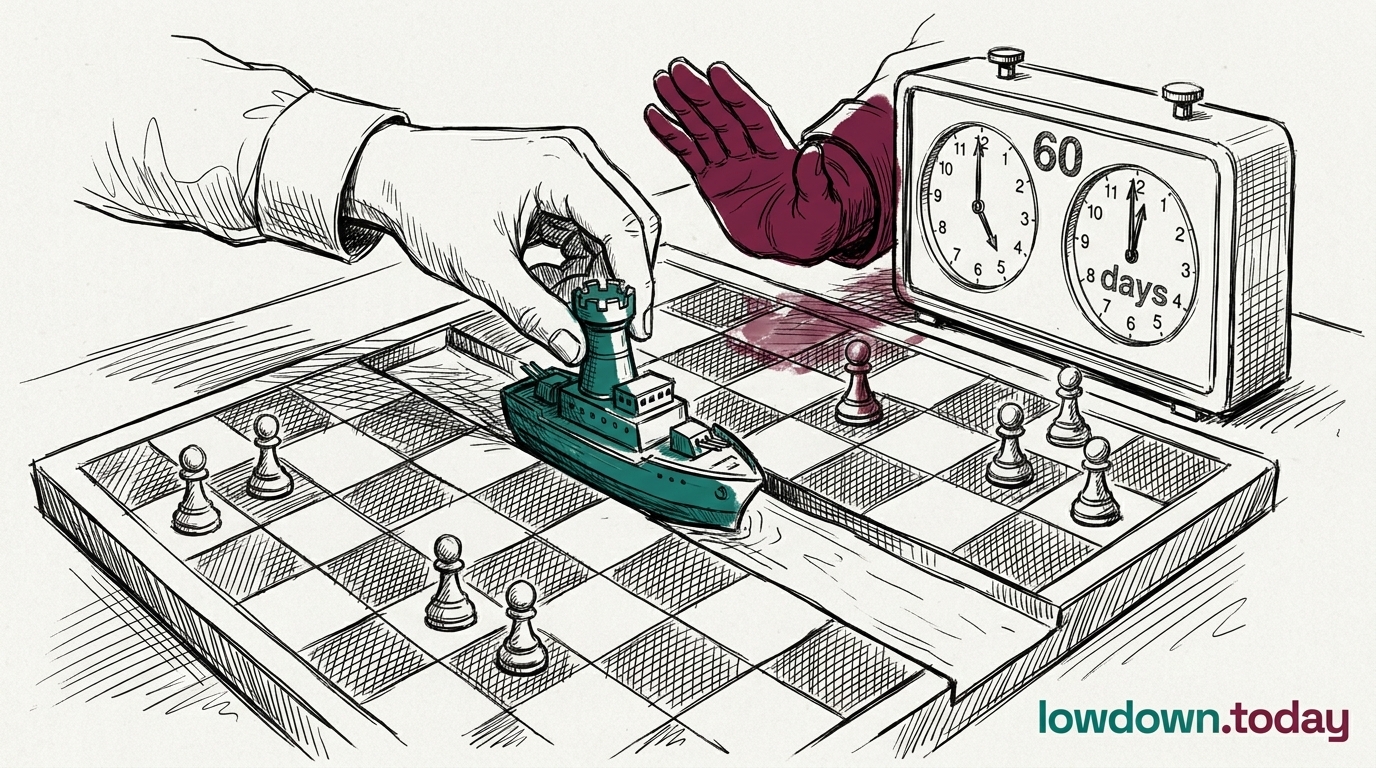
Trump's 5-day postponement creates a verifiable deadline, not a diplomatic framework.

Trump posted on Truth Social on Monday that he had "instructed the Department of War to postpone any and all military strikes against Iranian power plants and Energy infrastructure for a five day period." Three days earlier, he had threatened to "hit and obliterate" those same facilities within 48 hours . He NOW claims a 15-point deal with "major points of agreement," including Iran's commitment to "never have a nuclear weapon" 1. Axios identified parliamentary speaker Mohammad Bagher Ghalibaf as the Iranian interlocutor 2. CNN reported the US shared its 15-point list of expectations via Pakistan — a one-directional transmission, not a signed agreement 3.

The pattern echoes Trump's 2017–2018 North Korea approach, where escalating threats of "fire and Fury" preceded the Singapore summit. But Kim Jong-un acknowledged the Singapore process publicly. Iran has denied any negotiations occurred. No text of the claimed deal has been published. No mediator has confirmed its terms. The sole sourcing for a 15-point agreement is Trump's own post.

Netanyahu's framing carries a separate logic. He said Trump told him he "believes there is a chance to leverage the tremendous achievements of the IDF and the U.S. military in order to realise the war's objectives in an agreement" 4. This casts 25 days of strikes — 9,000 targets hit, 140 vessels destroyed — as coercive leverage for a diplomatic outcome. That logic requires Iran to perceive itself as losing. On the same day, Iran's Defence Council threatened to mine the entire Persian Gulf, and Ghalibaf — the man Trump claims as his negotiating partner — separately threatened the irreversible destruction of regional energy infrastructure . These are not concessions.

Trump had domestic reasons to pivot. The $200 billion war funding request faces bipartisan congressional opposition with Republican leaders unable to whip their own caucus . The Heritage Foundation warned the conflict risks converting an "economic boom into Stagflation" before Midterm elections 5. Brent Crude had peaked at $126 days earlier . The five-day window expires on 28 March. Whether Trump extends it, renews the threat, or declares victory may depend less on any Iranian response than on whether oil markets and his own Coalition tolerate continuation.

Deep Analysis

In plain English

Three days ago, Trump threatened to bomb Iran's power plants within 48 hours. Now he says he's waiting five days because talks are progressing well — but Iran says no talks are happening. Think of it like a landlord announcing he's reached an agreement with a tenant who immediately denies agreeing to anything. The practical question is whether this is a genuine diplomatic opening or a face-saving delay. It matters enormously because the 5-day clock creates a hard deadline: on 28 March, Trump must either strike, visibly back down, or produce evidence of a real deal.

Deep Analysis
Synthesis

The simultaneous US diplomatic announcement and Israeli strikes on Tehran reveals a coordinated coercive diplomacy architecture: one partner applies kinetic pressure while the other offers an off-ramp. This division of labour — standard in US-Israeli strategic coordination — is unacknowledged in either government's public statements, and its exposure undermines the credibility of the US diplomatic offer in Iranian eyes.

Root Causes

Trump's announcement coincides with the MAGA coalition fracturing over war funding and bipartisan opposition to the $200bn request. Domestic pressure to demonstrate diplomatic progress — reducing the political cost of the war without conceding military failure — is driving the announcement's timing independent of its factual accuracy.

Escalation

The 5-day structure forces a binary escalation choice on 28 March: strike Iran (validating US credibility but expanding the war) or extend the window (validating Iran's denial strategy and weakening future deterrence). Neither path is genuinely de-escalatory without a verified Iranian concession before the deadline.

What could happen next?
  • Risk

    If Iran's denial proves accurate and no meeting materialises before 28 March, Trump faces a credibility cliff: strike Iran or visibly retreat from his own publicly stated ultimatum.

    Immediate · Assessed
  • Precedent

    Announcing an unverified deal via social media to move oil markets sets a documented precedent for diplomatic announcements functioning as market instruments.

    Short term · Suggested
  • Consequence

    Concurrent Israeli strikes on Tehran while the US announces talks signals to Iran that the US cannot or will not restrain its partner — undermining US credibility as a neutral interlocutor.

    Short term · Assessed
  • Opportunity

    The 5-day window gives Pakistan and Oman genuine operational time to construct a face-saving framework allowing both sides to claim partial victory.

    Immediate · Suggested
First Reported In

Update #46 · Trump delays strikes; oil crashes to $99

Fox News· 24 Mar 2026
Read original
Different Perspectives
Oil markets
Oil markets
Brent fell $1.05 to $106.0 on summit Day 1 but remains $5-7 above the post-ceasefire equilibrium analysts modelled in March; the market is pricing a holding pattern, not a breakthrough. OilPrice.com and Aramco CEO Nasser converge on buffer-exhaustion before Hormuz reopens if the blockade extends past mid-June.
Iranian dissidents and human rights monitors
Hengaw documented a five-prison simultaneous execution cluster on 13 May, with Gorgan appearing for the first time in the wartime register. Espionage charges framed as Israel-linked moharebeh now extend across Mashhad, Karaj, and Gorgan, using the war as judicial cover for protest-era detainees.
BRICS / Global South
Araghchi's Delhi appearance positioned Iran as a victim of US aggression before non-Western foreign ministers, with Deputy FM Bagheri Kani calling on BRICS to act against US aggression. India, as the largest non-Chinese user of Iranian-routed crude, faces pressure to balance bloc solidarity against its own shipping and sanctions exposure.
China
China
Beijing accepted the Nvidia chip clearance on summit Day 1 and gave Rubio verbal acknowledgement of Iran as an Asian stability concern, having already put Pakistan on paper as the mediatory channel on 13 May (ID:3253), deflecting the US ask for direct Chinese action without refusing it.
Iran (government and civilian diplomatic track)
Araghchi denied any Hormuz obstruction at BRICS Delhi on 14 May while Iran's SNSC had finalised a Hormuz security plan the day before. Israel Hayom's single-sourced 15-year freeze offer gives Tehran a deployable figure in non-Western forums regardless of corroboration; the state attributed 3,468 wartime deaths with no independent verification.
United States (Trump administration and Senate moderates)
Trump signed a chip clearance for 10 Chinese firms on summit Day 1 and zero Iran instruments across 76 days; Rubio and Vance made verbal Iran asks without paper. Murkowski voted yes on the 49-50 war-powers resolution after Hegseth told the Senate that Article 2 makes an AUMF unnecessary.