Singapore summit
June 2018 Trump-Kim summit; first US-North Korea leader meeting; template for adversary-state presidential bilaterals.
Last refreshed: 12 May 2026 · Appears in 1 active topic
Does the Singapore playbook repeat in Beijing: symbolic communique, no verification, markets briefly rally?
Timeline for Singapore summit
Mentioned in: Tehran promises no pause of its own
Iran Conflict 2026Mentioned in: Trump's three pledges, China's silent readout
Iran Conflict 2026Mentioned in: Trump's Beijing trip holds off Iran action
Iran Conflict 2026Mentioned in: Trump delays grid strikes, claims deal
Iran Conflict 2026Mentioned in: Trump: Iran wants talks. Iran says no.
Iran Conflict 2026Background
The Singapore precedent is the analytic frame most frequently applied to the Trump-Xi summit of 14-15 May 2026 in Beijing. Carnegie Endowment scholars including Karim Sadjadpour draw the structural parallel: a high-stakes bilateral with adversary-engagement potential producing an ambiguous communique that markets and chancelleries interpret in opposite directions.
The specific Iran-conflict application is Trump's pattern of unsigned verbal output (Truth Social statements, Oval Office press scrums) over signed instruments. Singapore showed how that pattern generates apparent diplomatic momentum without enforceable text; analysts tracking the Beijing summit's Iran Ceasefire language apply the same scepticism to any joint statement on Hormuz access or arms transfers.
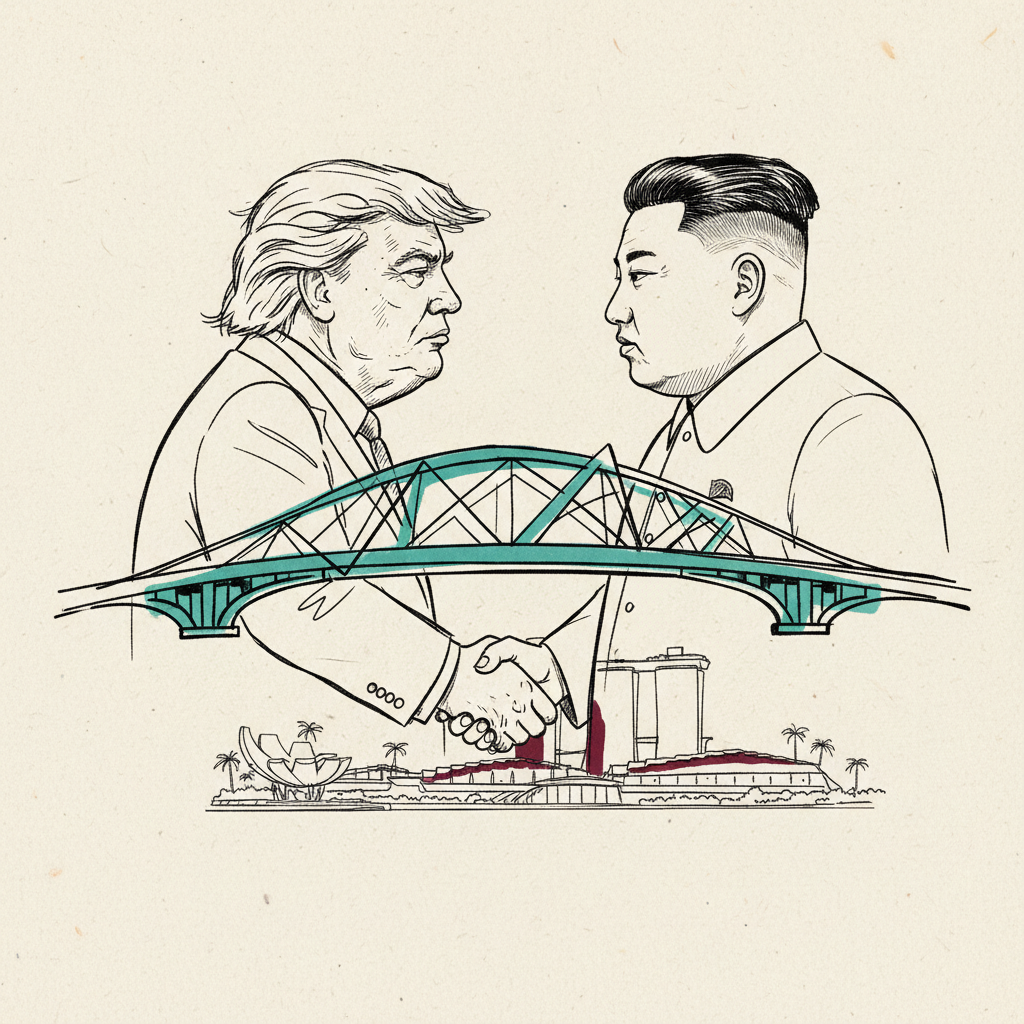
The Singapore summit was the first ever face-to-face meeting between a sitting US president and a North Korean leader, held at the Capella Hotel on Sentosa Island on 12 June 2018. Donald Trump and Kim Jong-un signed a four-point joint statement committing to denuclearisation of the Korean Peninsula and the return of US service personnel remains.
The summit produced no signed verification mechanism and no enforceable timetable; subsequent denuclearisation talks stalled by 2019. Observers including the Council on Foreign Relations and RAND Corporation treated it as a template for performative high-stakes diplomacy that delivered symbolic optics ahead of substantive commitments.
The summit remains the standard analytical reference when assessing US presidential bilaterals with adversary states, particularly where ambiguous joint communiques substitute for binding text. Its structural pattern surfaces in any context where a US president pursues direct leader-level engagement over formal multilateral processes.
Reference
What did Trump and Kim Jong-un sign at Singapore?
Did the Singapore summit lead to North Korea giving up nuclear weapons?
What happened at the 2018 Singapore summit between Trump and Kim?
How does the Singapore summit model apply to Iran diplomacy in 2026?
Why do analysts compare the 2026 Trump-Xi Beijing summit to the Singapore summit?
Why is the Singapore summit relevant to Iran 2026?


