Skip to content
Briefings are running a touch slower this week while we rebuild the foundations.See roadmap
Iran Conflict 2026
1MAY

Third US carrier reaches CENTCOM theatre

4 min read
10:38UTC

USS George H.W. Bush completed the largest CENTCOM carrier concentration since the 2003 Iraq invasion on 23-24 April; Trump's authorising paper still does not exist.

ConflictDeveloping
Key takeaway

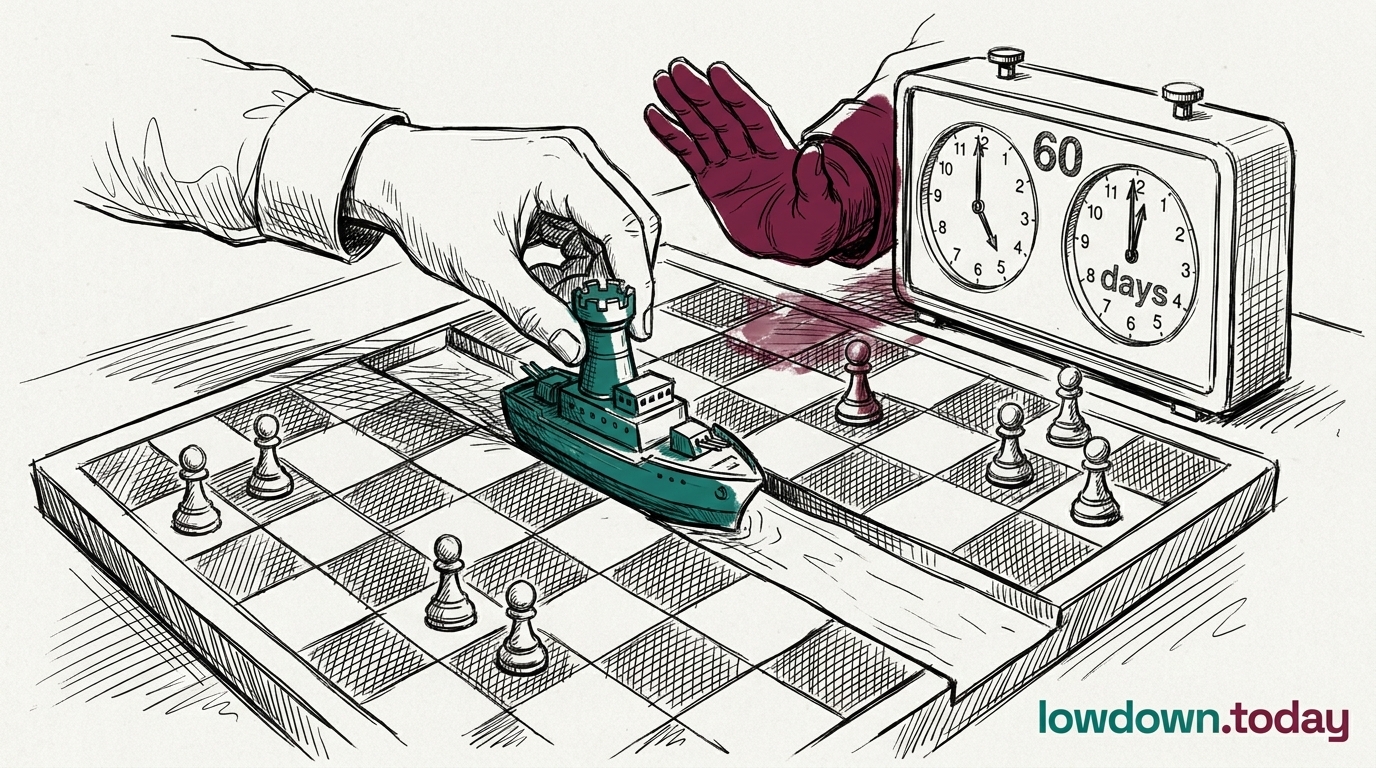
Three carriers in theatre, zero signed Iran instruments five days from the 1 May War Powers deadline.

USS George H.W. Bush (CVN-77), a Nimitz-class supercarrier, entered the CENTCOM area of responsibility on Thursday 23 April and Friday 24 April via the Cape Agulhas route, joining USS Abraham Lincoln in the Arabian Sea and USS Gerald R. Ford in the Red Sea 1. CENTCOM is the United States Central Command, the combatant command whose AOR covers The Gulf, Red Sea and Horn of Africa. Three carrier strike groups in that theatre is the largest such concentration since the March 2003 invasion of Iraq.

The Bush arrival was paired with Donald Trump's Thursday verbal order to the US Navy to "shoot and kill" Iranian crews laying mines in the Strait of Hormuz . Neither the deployment nor the order has produced a signed presidential instrument. The most recent action of any kind on the whitehouse.gov index is a 21 April "Nominations Sent to the Senate" filing 2: 57 days of war, zero signed Iran executive instruments. The Lebanon ceasefire was extended for three weeks on Thursday via signed Truth Social text , which proves the signing pen is available for other files; Iran specifically is not getting written paper.

The 2003 carrier concentration ran behind a Congressional Authorization for Use of Military Force passed in October 2002 and a UN Security Council resolution. The 2026 concentration sits behind a fifth War Powers Resolution defeated 46-51 four days ago and no presidential instrument naming Iran. Allied navies operating in adjacent waters, including the United Kingdom, France and the 30-nation Northwood planning group, lose any US text against which to deconflict their own rules of engagement. The bear case, that this is escalation-to-de-escalate pressure ahead of a deal, requires a credible terms sheet behind the platform set; none has surfaced.

Three-carrier presence consumes maintenance windows on at least two of the three hulls within roughly 60 to 90 days, so the deployment is not indefinite without rotation hulls behind it. Either a signed authorisation or a kinetic event will close the platform-versus-paper gap inside the 1 May window.

Deep Analysis

In plain English

An aircraft carrier strike group is the US military's most powerful deployable unit: one supercarrier, roughly 65-70 combat aircraft, and a ring of destroyers and submarines. The US normally keeps one or two in any given region. Three in one area at the same time is rare and historically has preceded major military action, as it did before the 2003 Iraq War. What is different this time is that every previous three-carrier deployment was backed by signed presidential and congressional authorisation. This one is not. The President has issued verbal orders but signed nothing, which means there is no written document explaining what the carriers are allowed to do if a confrontation starts.

Deep Analysis
Root Causes

The **War Powers Resolution**'s 60-day clock, which runs to 1 May, was designed around the assumption that an administration would seek authorisation before the clock expired. The Trump White House has instead run the clock down without producing a single signed Iran instrument, leaving the Navy deploying under verbal authority alone.

The **CENTCOM** three-carrier option requires rotation ships behind it. The **USS George H.W. Bush** deployment was almost certainly ordered before the indefinite ceasefire post on 21 April, locking in the arrival regardless of diplomatic status; routing via Cape Agulhas adds 12-16 days, which means the order preceded the ceasefire by several weeks.

The absence of any signed AUMF means no congressional text has scoped what the carriers are authorised to do, leaving rules of engagement to whoever holds the verbal order and producing no legal floor for de-escalation if a contact occurs.

What could happen next?
  • Meaning

    If 1 May passes without a signed presidential instrument, the US Navy will be operating three carriers in an active naval blockade under no executive authority other than a verbal order, a constitutional situation no prior administration has sustained past day 60.

    Short term · Assessed
  • Meaning

    Three-carrier maintenance cycles require hull rotation within 90 days; the deployment clock means two of the three carriers will need relief ships by late July 2026, creating a visible deadline for either a diplomatic resolution or a permanent three-carrier rotation commitment.

    Short term · Assessed
  • Meaning

    Allied navies drafting rules of engagement at Northwood cannot deconflict with US forces when there is no signed US document against which to test their own engagement rules.

    Short term · Assessed
First Reported In

Update #80 · Three carriers, zero instruments

Army Recognition / The War Zone· 26 Apr 2026
Read original
Causes and effects
This Event
Third US carrier reaches CENTCOM theatre
Three carrier strike groups now sit in theatre against Iran under a verbal shoot-kill order alone, with five days to the 1 May War Powers deadline.
Different Perspectives
Oil markets
Oil markets
Brent fell $1.05 to $106.0 on summit Day 1 but remains $5-7 above the post-ceasefire equilibrium analysts modelled in March; the market is pricing a holding pattern, not a breakthrough. OilPrice.com and Aramco CEO Nasser converge on buffer-exhaustion before Hormuz reopens if the blockade extends past mid-June.
Iranian dissidents and human rights monitors
Hengaw documented a five-prison simultaneous execution cluster on 13 May, with Gorgan appearing for the first time in the wartime register. Espionage charges framed as Israel-linked moharebeh now extend across Mashhad, Karaj, and Gorgan, using the war as judicial cover for protest-era detainees.
BRICS / Global South
Araghchi's Delhi appearance positioned Iran as a victim of US aggression before non-Western foreign ministers, with Deputy FM Bagheri Kani calling on BRICS to act against US aggression. India, as the largest non-Chinese user of Iranian-routed crude, faces pressure to balance bloc solidarity against its own shipping and sanctions exposure.
China
China
Beijing accepted the Nvidia chip clearance on summit Day 1 and gave Rubio verbal acknowledgement of Iran as an Asian stability concern, having already put Pakistan on paper as the mediatory channel on 13 May (ID:3253), deflecting the US ask for direct Chinese action without refusing it.
Iran (government and civilian diplomatic track)
Araghchi denied any Hormuz obstruction at BRICS Delhi on 14 May while Iran's SNSC had finalised a Hormuz security plan the day before. Israel Hayom's single-sourced 15-year freeze offer gives Tehran a deployable figure in non-Western forums regardless of corroboration; the state attributed 3,468 wartime deaths with no independent verification.
United States (Trump administration and Senate moderates)
Trump signed a chip clearance for 10 Chinese firms on summit Day 1 and zero Iran instruments across 76 days; Rubio and Vance made verbal Iran asks without paper. Murkowski voted yes on the 49-50 war-powers resolution after Hegseth told the Senate that Article 2 makes an AUMF unnecessary.