Skip to content
You can now search across every topic, entity and event.What's new
Iran Conflict 2026
21APR

IRGC Navy writes its own Hormuz transit rulebook

3 min read
10:51UTC

Iran's Revolutionary Guard wrote its own transit rulebook for the Strait of Hormuz in the IRGC-aligned Farsi outlet Tabnak. The foreign ministry had no seat at the drafting.

ConflictDeveloping
Key takeaway

Iran's Revolutionary Guard wrote the Hormuz transit rules itself, and its own foreign ministry's clearances no longer hold.

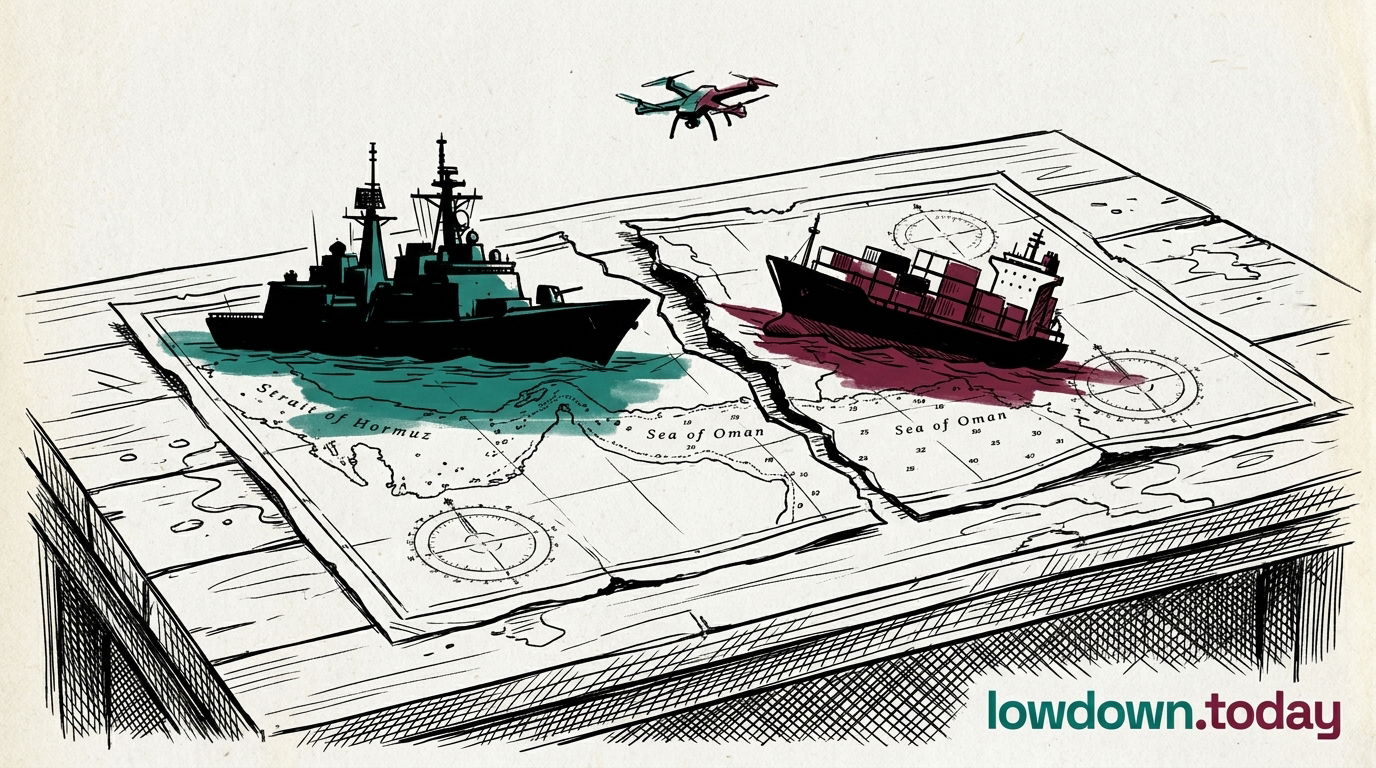
On 17 April the IRGC Navy (Islamic Revolutionary Guard Corps Navy, Iran's parallel naval force) published a formal four-condition order for the Strait of Hormuz in the IRGC-aligned Farsi outlet Tabnak 1. Non-military vessels may transit only by Iran-designated routes; military vessels are barred; every passage requires prior Guard Corps authorisation; the framework is tied to the Lebanon ceasefire holding.

The Tabnak publication lets Iran's military write over its diplomats in public. Two days later Foreign Minister Abbas Araghchi announced a civilian corridor opening, and the announcement lasted less than 24 hours. Despite the radio clearances Iran's own foreign ministry issued, the Guard Corps fired on the Indian-flagged Sanmar Herald and Jag Arnav on Saturday 18 April . A Sanmar Herald crew member was recorded on open channel saying Iran had cleared the vessel and was now firing on it anyway, which is the evidence the Tabnak order is load-bearing and the foreign ministry's clearances are not.

For shipowners routing hulls through the strait, the practical question is whose paper to obey. The rulebook the IRGC has now published is domestic Iranian doctrine with no signatory outside the Guard Corps. The 1968 Traffic Separation Scheme agreed between Iran, Oman and the IMO has governed Hormuz movement for 58 years, and Iran's own civilian foreign ministry is still a party to it. A counter-view from sympathetic commentators in Tehran is that the Tabnak order is a wartime clarification rather than a substitute for civilian law, and that a single ceasefire can fold it back. That reading is hard to sustain while the Guard Corps is firing on vessels the foreign ministry has cleared.

Deep Analysis

In plain English

Iran has two different armed forces: the regular military and the Islamic Revolutionary Guard Corps (IRGC), which is a separate, more ideologically driven force that reports to the Supreme Leader. On 17 April the IRGC Navy (its sea-going branch) published a set of four rules saying that no ship could cross the Strait of Hormuz without its personal permission, that military ships were banned entirely, and that the rules were tied to the Lebanon ceasefire holding. On 19 April Abbas Araghchi, Iran's Foreign Minister, separately announced the strait was open. Those two announcements directly contradict each other, and they came from two different parts of the same government. When Indian ships tried to follow the foreign minister's clearance, the IRGC fired on them anyway. The IRGC's written order, published two days earlier, turned out to be the one that governed the strait.

Deep Analysis
Root Causes

Iran never ratified the 1982 UN Convention on the Law of the Sea (UNCLOS), which grants transit passage rights through international straits. Tehran's domestic maritime law, updated in 2024, claims jurisdiction over 'hostile-linked vessels', a category broad enough to encompass any flag state that has sanctioned Iran.

The Tabnak four-condition order operationalises that domestic legal claim as a Guard Corps enforcement mechanism, creating a parallel legal architecture Iran can enforce without reference to international maritime law.

The IRGC Navy's institutional position since 2019 has been that Strait of Hormuz access is a tool of statecraft, not a neutral right. The Guard Corps has treated clearance authority as its own operational property through three rounds of tanker harassment. Araghchi's Friday corridor announcement conceded that institutional property without Guard Corps agreement, producing the split the Tabnak order makes legible.

What could happen next?
  • Precedent

    The Tabnak order establishes IRGC written doctrine as the operative transit framework, creating a model for future enforcement that bypasses Iran's civilian foreign policy machinery.

  • Risk

    Northwood planners drafting rules of engagement this week must write against a published adversary doctrine rather than a diplomatic silence, narrowing the range of enforceable coalition positions.

First Reported In

Update #74 · Two unsigned rulebooks collide at Hormuz

Tabnak· 20 Apr 2026
Read original
Causes and effects
Different Perspectives
International Group of P&I Clubs
The Group has kept its Hormuz war-risk exclusion in force through the entire shipping recovery, even as London hull war-risk premiums fell to about 2% of vessel value. A burning LNG carrier off Limah is now the fresh case for holding that line, with mutual pooling meaning one hit reprices the strait for every owner at once.
Jordan
Jordan
Jordan's government said no threats existed at Aqaba hours before Iranian missiles landed there, and has not addressed the IRGC's claim that Jordanian civilians and soldiers supplied targeting intelligence for the strike. Amman hosts forces it does not command and is saying as little as it can.
United States (CENTCOM)
The Pentagon named two of the seventeen American dead, 1st Lieutenant Tyler Feehan and Private Isabella Gonzales, both killed at Jordan's Muwaffaq Salti Air Base, days after its Amman embassy had warned citizens away from Aqaba's airport and seaport. Washington is naming its own cost while flagging threats it declines to attribute publicly.
Iran
Iran
Iran said on Monday it disabled two oil tankers crossing the Strait of Hormuz without its permission, asserting a right to license passage through the strait it borders. Tehran named neither vessel, and CENTCOM had already denied a comparable Iranian claim on 18 July.
Qatar
Qatar
Qatar moved from summoning Iran's deputy ambassador on 8 July to a dated written claim at the UN Security Council thirteen days later, citing Resolution 2817 and reserving its Article 51 right of self-defence. Doha is building a permanent record while still hosting CENTCOM's forward headquarters and mediating with Tehran.
CENTCOM
CENTCOM
CENTCOM confirmed a third American service member died in northern Iraq on 19 July clearing unexploded ordnance from a downed Iranian drone, and recovered unidentified remains at Muwaffaq Salti Air Base in Jordan. The Pentagon has framed its Khuzestan strikes as degrading IRGC capacity, a rationale that stretches to explain a reactor foundation with no nuclear material in it.