Skip to content
Briefings are running a touch slower this week while we rebuild the foundations.See roadmap
Iran Conflict 2026
18APR

Hormuz at sixteen ships; blackout sets record

3 min read
14:57UTC

Lowdown Bureau / Humanitarian. Strait traffic is far below baseline while Iran's internet shutdown sets a world record for duration.

ConflictDeveloping
Key takeaway

Two records in one day, sixteen vessels and over twelve hundred hours, measure the envelope Iran's war has produced.

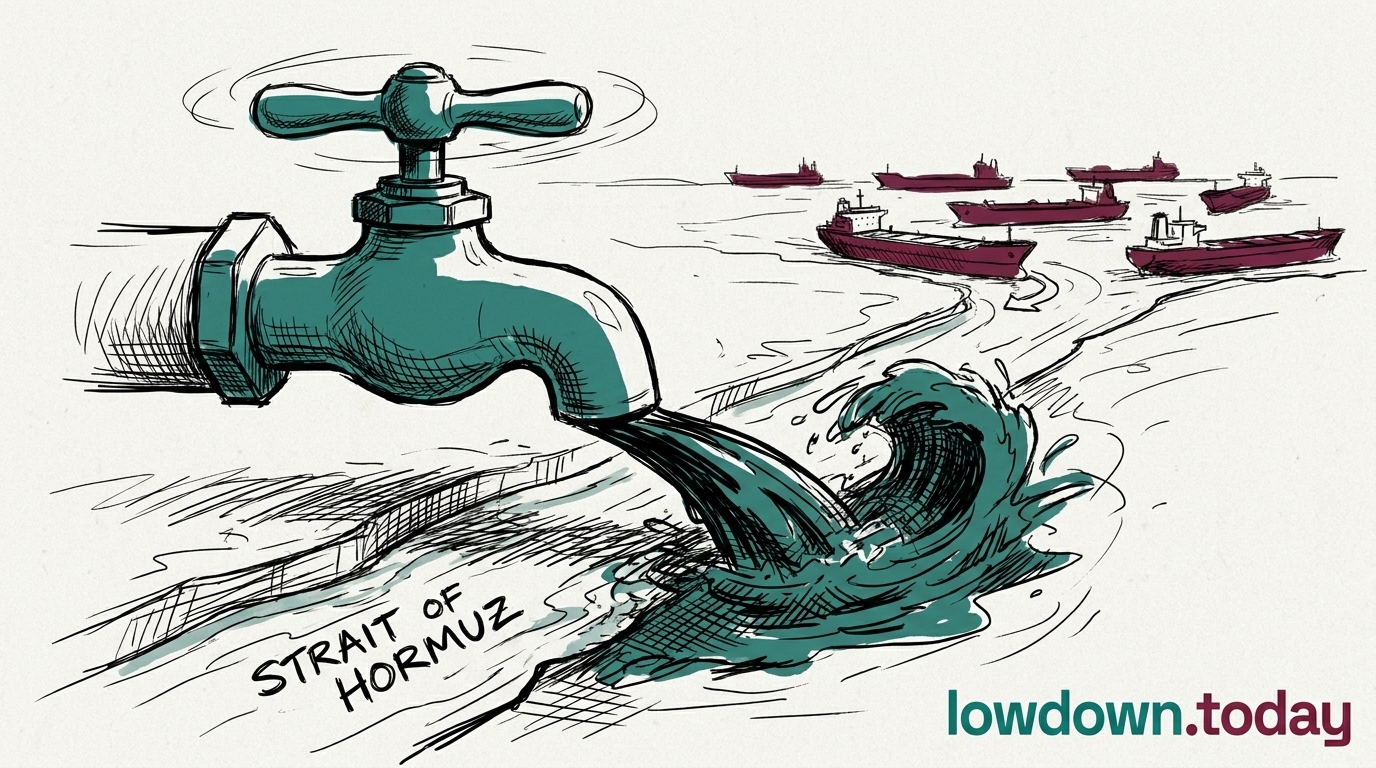
NetBlocks, the UK-based internet observatory, recorded Iran's nationwide internet blackout at one thousand two hundred and twenty-four hours on Day 52, the longest national shutdown on file. Al Jazeera reported partial restoration to 'favoured groups' on Monday, while most Iranians remained disconnected. Kpler data relayed by CNN showed sixteen vessel transits of the Strait of Hormuz the same day, against a pre-war baseline of one hundred and thirty-five per day, an eighty-eight per cent shortfall. Brent sat at roughly 94-96 dollars through the week, up from 73 before the strikes .

The Hormuz figure carries a carve-out worth naming. Two US-sanctioned Chinese tankers continued transiting unchallenged under what CNN described as CENTCOM's standing carve-out. A blockade that lets sanctioned Chinese crude through while denying clearance to Indian-flagged tankers is a blockade whose selection rules are not written down and whose enforcement pattern favours the counterparty Washington has most friction with. Saturday briefly touched twenty-plus transits before the Touska seizure reversed the recovery.

Iran's internet shutdown is running as a protest-era governance tool, not a wartime communications restriction. Al Jazeera's readout names 'favoured groups' as the recipients of partial restoration, pointing at state-linked institutions, financial clearing infrastructure, and security apparatus users rather than the general public. The Aban protest shutdown in Esfand 1398 ran for roughly one week at its peak; the current shutdown has now run more than seven times that length. The infrastructure to maintain a selective internet, with whitelisted IP ranges, domestic-only mesh, and state-controlled filtering, is mature in Iran in a way it was not then, and the war has given Tehran both the justification to deploy it and the excuse to let it harden past the Ceasefire.

Deep Analysis

In plain English

Two separate record-breaking situations are tracked in this event. First, Iran's internet shutdown has lasted 1,224 hours; more than 51 days; making it the longest national internet blackout ever recorded. Most Iranians still cannot access international websites, social media, or messaging apps. Some government agencies and banks got partial access restored, but ordinary citizens remain cut off. Second, the Strait of Hormuz; the narrow waterway through which much of the world's oil passes; now has only 16 ships moving through it each day. Before the war, 135 ships crossed every day. That is an 88% drop. Two Chinese tankers were allowed to pass unchallenged, which reveals that the US military is selectively enforcing the blockade; letting China's oil supply through while stopping others. Both figures illustrate that this conflict's economic costs are being felt by ordinary Iranians and by global energy markets simultaneously.

Deep Analysis
Root Causes

Iran's internet governance architecture explains both the blackout's duration and the selective restoration pattern. The NIN (National Information Network, شبکه ملی اطلاعات) was built specifically to enable state services to operate without international internet access. Banking, government, and military communications route through the NIN rather than the public internet, allowing the IRAN gateway to be closed while essential state functions continue.

The 88% Hormuz traffic drop and the 1,224-hour blackout are structurally connected: the Iranian government cannot permit real-time protest coordination in a period when maritime interdiction is producing daily visible domestic costs (fuel scarcity, import shortages, power fluctuations from reduced gas imports). The blackout's duration reflects the duration of the economic pressure from the blockade rather than a standalone domestic suppression operation.

What could happen next?
  • Consequence

    Iran's 1,224-hour blackout has now surpassed every prior national internet shutdown on record; the technical restoration sequence for a country of 90 million with degraded NIN-to-public-internet bridges will require weeks of staged rollout, not a single switch-on.

  • Risk

    The Chinese tanker CENTCOM carve-out, if publicly confirmed, provides Beijing with documented evidence that CENTCOM applies discriminatory enforcement; a precedent Iran could cite in UN Security Council proceedings to challenge the blockade's legality under UNCLOS Article 38 transit passage.

First Reported In

Update #75 · Ceasefire ends in the water, a day early

CNN· 21 Apr 2026
Read original
Different Perspectives
Lloyd's of London war-risk underwriters
Lloyd's kept its Hormuz war-risk designation unchanged at $10-14 million per voyage even as Brent spiked 7%, holding the split from futures that has run since late May. Underwriters require a Security Council resolution or government certification, not a presidential phone call.
Gulf Cooperation Council states
Gulf states, having written to the IMO rejecting Iran's Hormuz transit authority, watched a fresh missile exchange land on Kuwaiti soil. Riyadh and Abu Dhabi remain caught between US security guarantees and Iranian fire, with no Gulf state co-belligerent except Kuwait.
China
China
Beijing stayed out of the diplomatic rupture, sending no envoy and offering no public position on the suspended talks. China keeps its bilateral energy corridor with Tehran while declining the exposure of a mediating role Trump barred it from anyway.
Kuwait
Kuwait
Kuwait's air defences engaged two Iranian ballistic missiles aimed at US forces late on 31 May, the second interception in days after invoking Article 51. Repeated strikes test whether Kuwait's politics can sustain hosting US forces as a de facto co-belligerent.
Lebanon and Hezbollah
Lebanon announced a partial ceasefire under which Hezbollah pledged to stop attacking Israel, the concrete output of Trump's call. Beirut heads to Washington on 3 June with Israeli forces still inside the south, testing whether the truce survives contact.
Israel under Netanyahu
Netanyahu stood down the planned Beirut operation under Trump's pressure but kept his ground advance running toward the Zaharani river, the deepest incursion in 25 years, and disputed Trump's claim that troops had turned around. Israel signalled the halt is tactical, not a wind-down.