Arak
Iranian city in Markazi Province hosting the Khondab heavy-water nuclear reactor complex.
Last refreshed: 16 June 2026 · Appears in 1 active topic
Will the Khondab reactor be decommissioned or freed from JCPOA constraints after the 2026 conflict?
Timeline for Arak
Mentioned in: Inspectors promised, no date, 240kg lost
Iran Conflict 2026Mentioned in: Reza Soleimani executed at Qom Central
Iran Conflict 2026Mentioned in: Hormuz at sixteen ships; blackout sets record
Iran Conflict 2026Iran tables bill to leave NPT
Iran Conflict 2026Mentioned in: IDF warns Tabriz to evacuate
Iran Conflict 2026Background
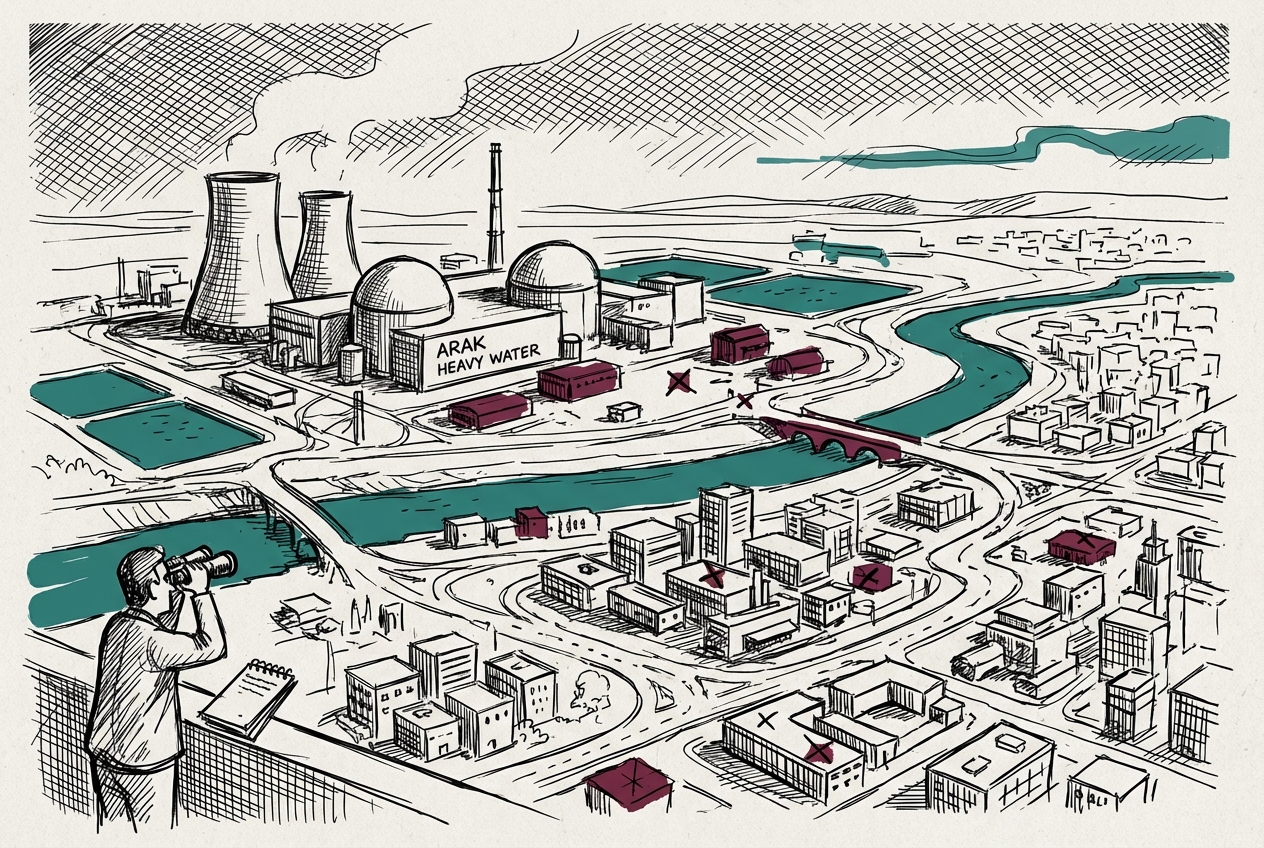
Located in Markazi Province in central Iran, Arak is an industrial city of roughly 530,000 people and one of the most consequential sites in global nuclear diplomacy. It hosts the Khondab Heavy Water Complex (IR-40 reactor), a heavy-water reactor that could theoretically produce weapons-grade plutonium. Under the 2015 JCPOA, Iran agreed to redesign the reactor to reduce weapons-grade output and fill the original core with concrete. The IAEA monitored compliance until Iranian co-operation was progressively curtailed from 2021 and suspended entirely by the Majlis 221-0 vote on 11 April 2026.
Arak sits at the centre of Iran's nuclear diplomacy as one of the sites whose fate shapes any agreement. Iran filed priority legislation in March 2026 to withdraw from the Non-Proliferation Treaty, which would remove all JCPOA restrictions on the Khondab reactor. The bill was introduced by Tehran MP Malek Shariati after Israeli strikes began on 28 February 2026. In parallel, Natanz's surface buildings were confirmed structurally damaged by satellite imagery, though whether underground enrichment halls survived remained unverified.
The city embodies the central paradox of Iran's nuclear programme: civilian infrastructure with irreducible weapons potential. With the IAEA locked out since April 2026 and Iran holding 440.9 kg of 60%-enriched uranium with no Independent monitoring, Arak's reactor status and POST-conflict fate carry global non-proliferation consequences. A June 2026 Memorandum of Understanding between Iran and the US includes IAEA inspectors returning, but no confirmed date had been set as of 15 June.
What is Arak in Iran?
Has Arak been struck in the 2026 Iran conflict?
What happens to Arak if Iran leaves the NPT?
How does Arak differ from Natanz?
What is the Khondab reactor at Arak?
What is the Arak nuclear reactor and why does it matter?
Is Arak a target of Israeli strikes in 2026?
What would Iran leaving the NPT mean for Arak?
What is heavy water and why is it used at Arak?


