Skip to content
Briefings are running a touch slower this week while we rebuild the foundations.See roadmap
Iran Conflict 2026
18APR

Fujairah hits 1.62 mbpd; ADCOP nears cap

4 min read
14:57UTC

Crude flow through Fujairah reached 1.62 million bpd by late March, a 38% rise within reach of the ADCOP pipeline's 2 million bpd design ceiling, while Khor Fakkan container handling rose 25-fold to 50,000 vessels per week.

ConflictDeveloping
Key takeaway

The Hormuz bypass route is approaching its ceiling as the IRGC claims the water above it.

Crude flow through Fujairah rose from 1.17 mbpd in February to 1.62 mbpd by late March 1, a 38% increase that puts the port within reach of the Abu Dhabi Crude Oil Pipeline (ADCOP) design ceiling of 2 mbpd. Khor Fakkan container handling went from 2,000 to 50,000 vessels per week, a 25-fold rise; six container ships were berthed and ten waiting on the day of the report.

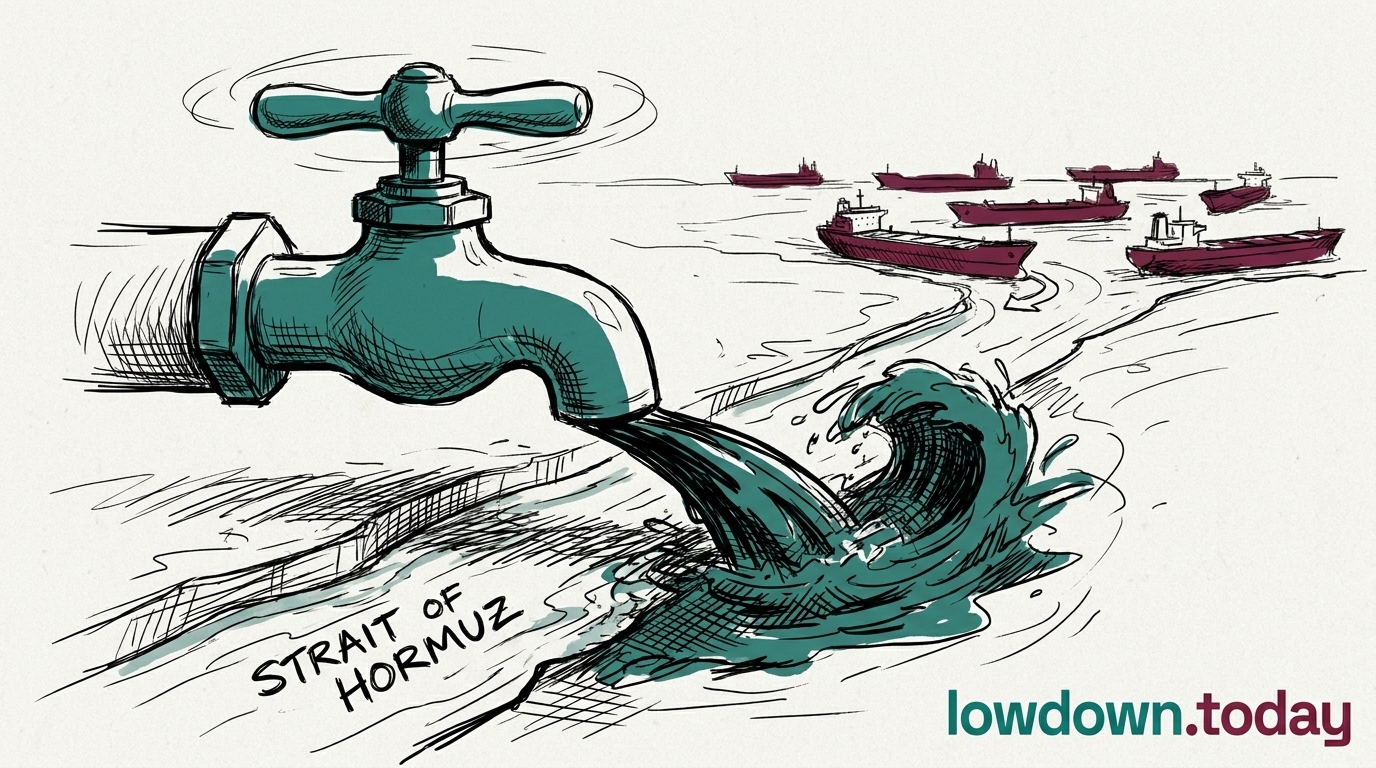
Fujairah and Khor Fakkan sit on the United Arab Emirates' eastern coast, on The Gulf of Oman side of the Strait of Hormuz. ADCOP runs 370 km from Habshan, a terminal in Abu Dhabi's interior, to Fujairah, bypassing the strait entirely. When Hormuz is closed or contested, every barrel that previously sailed out of the Persian Gulf has to find another route, and the two UAE eastern ports are the alternative.

That alternative is running out of room. ADCOP's 2 mbpd design ceiling has never been tested at sustained throughput. Pipeline infrastructure operating near design capacity under conflict-zone threat generates compressor and metering stress that maintenance schedules cannot absorb on a normal cycle; real-world ceiling likely sits 200,000 to 300,000 bpd below the published figure. The 1.62 mbpd reading leaves perhaps 80,000 to 180,000 bpd of usable headroom before the pipeline starts forcing maintenance trade-offs. Khor Fakkan's congestion is sharper still: a 25-fold rise in a year cannot be absorbed by adding berths on a weeks-to-months timeline.

The United Arab Emirates (UAE) foreign ministry has not commented directly on the legal pressure. The Islamic Revolutionary Guard Corps (IRGC) published a map on 5 May claiming maritime control zones along the UAE's eastern coastline, the legal escalation that followed the 4 May physical drone strike on the Fujairah Oil Industry Zone . The pattern is kinetic-then-legal: strike a target, then claim sovereignty over the water above it. International maritime law gives the IRGC's coastline claim no recognised standing, yet the 4 May drone strike demonstrated kinetic reach over the same water. If insurance markets price the legal claim, the bypass route's effective capacity falls before its physical capacity does.

A signed MOU would reopen Hormuz and end the toll system, taking the kinetic-then-legal pattern off the board. If Tehran's reply collapses against the 9 May expiry, the 380,000 bpd nominal headroom at Fujairah becomes the constraint that matters: the next significant Hormuz incident exhausts the surface alternative, and crude that cannot move by pipeline or by Khor Fakkan stays unloaded.

Deep Analysis

In plain English

The Strait of Hormuz is blocked, so oil that used to flow through it is going around the long way, through a pipeline in the UAE called ADCOP that runs from inland Abu Dhabi to the port of Fujairah on the UAE's eastern coast. By late March, that bypass route was handling 1.62 million barrels of oil per day. The problem: the pipeline was designed for 2 million barrels per day, and it is within about 380,000 barrels of that limit. Meanwhile, Iran's military struck the Fujairah oil terminal in a drone attack on 4 May and is now claiming legal authority over the sea in front of Fujairah. At current throughput growth rates, the bypass headroom runs out in roughly seven to nine weeks.

What could happen next?
  • Risk

    If the IRGC's 4 May drone strike on Fujairah Oil Industry Zone is followed by further kinetic action at the ADCOP terminal, the physical bypass capacity could drop below 1 million bpd within days, removing the only surface alternative to a blocked Hormuz.

  • Consequence

    Khor Fakkan's 25-fold rise to 50,000 vessels per week cannot be absorbed by berth expansion on any timeline shorter than 18 months; the congestion is a structural constraint, not a transient queue.

First Reported In

Update #91 · MOU in Tehran, missiles in the strait

AGBI· 8 May 2026
Read original
Causes and effects
This Event
Fujairah hits 1.62 mbpd; ADCOP nears cap
The only surface route around a blocked Hormuz is approaching its design ceiling at exactly the moment the IRGC is claiming legal authority over the water above it.
Different Perspectives
Lloyd's of London underwriters
Lloyd's held its Hormuz war-risk rate at $10-14 million per voyage; underwriters need a UN Security Council resolution or formal PGSA de-listing before repricing, not a Senate testimony. The PGSA remains on the SDN list under EO 13224, so any vessel transiting a nominally reopened strait still deals with a sanctioned counterparty.
Saudi Arabia and Gulf states
Brent crude at $95-97 on 2-3 June reflects Gulf producers benefiting from the conflict premium; a genuine Hormuz deal would likely cut that premium by $10-15 per barrel. Riyadh's $87 per barrel budget breakeven means the current price is comfortable, reducing the Gulf's urgency to push for a rapid settlement.
China
China
OFAC's Nobitex designation leaves China's informal bilateral currency-swap lines with Iran as the CBI's remaining rial-defence mechanism; Chinese financial institutions face secondary-sanctions risk if they interact with successor wallets. Beijing's MOFCOM Blocking Rules protect mainland refineries from direct designation but do not shield informal swap-line counterparties.
Lebanon / Hezbollah
Lebanon / Hezbollah
Lebanon's Washington delegation demanded full Israeli withdrawal and the return of 1.2 million displaced; Hezbollah deployed an FPV drone that killed an Israeli soldier at Yohmor while talks ran, demonstrating it can impose costs even at Israel's deepest penetration point. Lebanon's government cannot deliver the Hezbollah disarmament guarantee Israel demands.
Israel / Benjamin Netanyahu
Israeli forces seized Beaufort Castle above the Litani on 1-2 June and advanced to within 10 km of the Zaharani river while ceasefire delegations sat in Washington; the advance ran entirely outside the Beirut-only truce Netanyahu accepted on 1 June. Each kilometre taken raises Israel's withdrawal price before any permanent text is signed.
Iran: Foreign Ministry and domestic population
Araghchi rang six capitals in 48 hours to reopen talks the SNSC had suspended, calling the IRGC line 'speculation'; at home, 37 political prisoners were executed since 19 March while students marched in Tehran, Mashhad and Hamadan. The diplomatic thaw has not eased the state's wartime repression tempo.