Skip to content
Briefings are running a touch slower this week while we rebuild the foundations.See roadmap
Iran Conflict 2026
10APR

Twenty-seven days since Trump signed on Iran

3 min read
08:05UTC

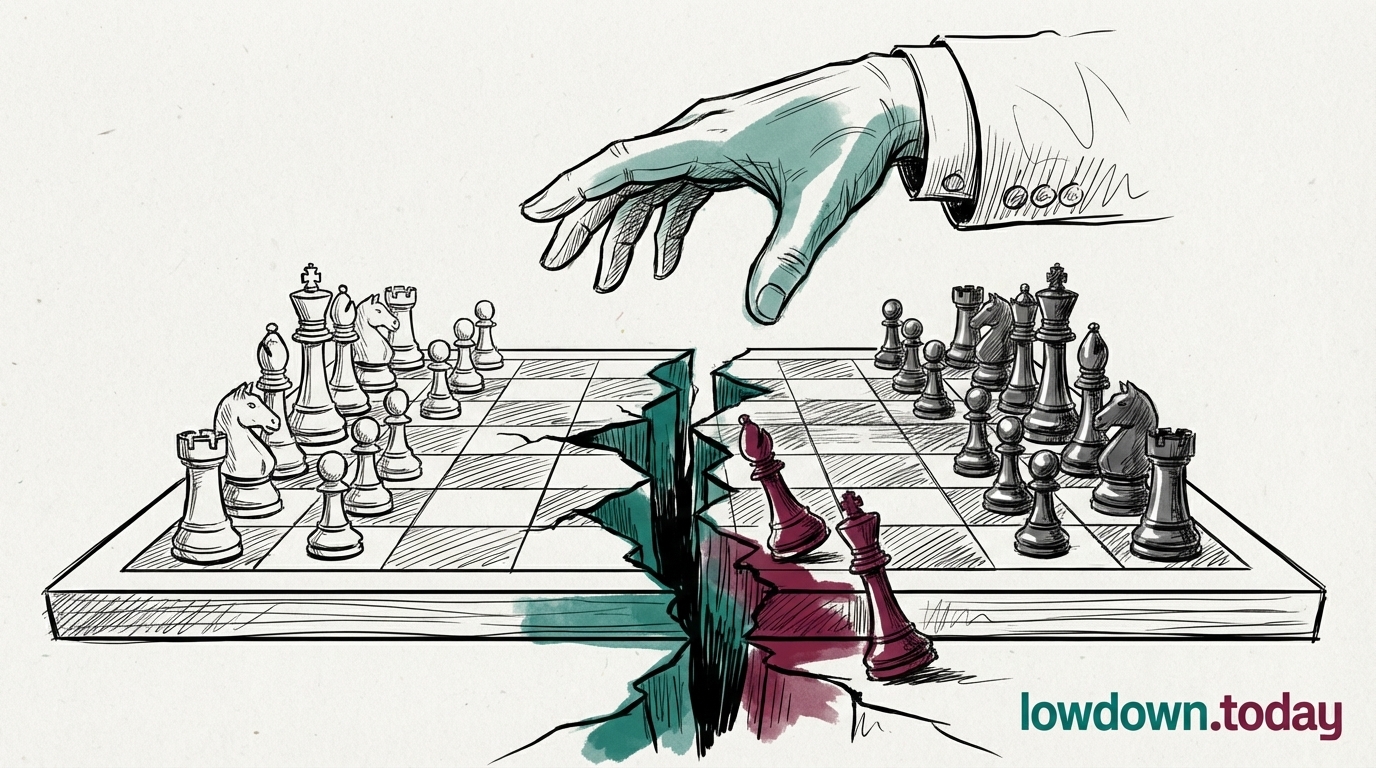
Twenty-seven days have passed since Donald Trump signed any Iran-related instrument. The blockade, the ceasefire and five Hormuz ultimatums all exist on Truth Social posts alone.

ConflictAssessed
Key takeaway

Blockade, ceasefire and toll list all rest on Truth Social posts; no signed presidential directive backs any of them.

Twenty-seven days have passed since Donald Trump put his name to any Iran-related presidential action. A 14 April audit of the White House presidential-actions page confirmed the two signed Iran instruments across 45 days of war remain those of 18 March : a Jones Act waiver for foreign-flagged tankers between US ports, and an authorisation for Venezuela's PDVSA (Petroleos de Venezuela) to resume sales to American refiners 1. Both were oil-price containment measures. Neither was a war-powers instrument. Every escalation since, the blockade order , the toll-interdiction list runs against it in the Senate), the 8 April ceasefire declaration and all five Hormuz ultimatums, exists only as Truth Social posts.

That absence is not a paperwork quibble. A US Navy captain boarding a foreign-flagged vessel on Saturday morning is acting on a social-media post, not a signed directive. Any flag state filing a maritime-law complaint, any master contesting the boarding, any officer later pulled into an accountability review has no presidential instrument to point to as legal cover. Agency counsels at Treasury, State and Defense have no authoritative text to implement, which is how you get Treasury's 25-day silence on GL-U , the CENTCOM operational order narrowing the blockade away from what Trump posted, and the Senate war-powers clock running against an action the White House has never formally filed .

Under the National Security Act and settled case law, a presidential social-media post is not a lawful directive to federal agencies. CENTCOM is operating under its existing statutory authority as an armed-forces command, not under a specific Iran war authority, which means the operational order it issued is self-generated in any legally reviewable sense. Congressional challenge via the War Powers Resolution is procedurally harder when no presidential report starts the statutory clock; Senate Democrats are adapting by forcing a vote anyway. The clock is still running, but it is running against a policy whose authoritative text is a screenshot.

Allies seeking legal assurance of US commitment have the same problem. France and Japan are formally protesting vessels on Trump's toll list that CENTCOM's order omits; neither government has a signed American instrument to negotiate against. Every subsequent ratchet, from Schumer's WPR push to European procurement decisions, is being made against a policy that exists only as posts.

Deep Analysis

In plain English

The United States government has been running a naval blockade of one of the world's most important shipping lanes for more than two weeks. But the president has not signed a single piece of paper authorising it. The blockade exists only as posts on the president's social media account. This matters more than it might sound. When the president signs a formal order, it becomes the law that government agencies, military commanders, courts, and allies must follow. Without a signed order, every part of the US government interprets the policy in its own way. That is why the Navy's actual blockade is narrower than what the president posted, and why the Treasury has been silent for 25 days about what happens to the 325 tanker-loads of Iranian oil covered by a permit that expires this weekend. It also means that other countries have no formal American document to complain about or negotiate against. France and Japan are protesting against a social media post. The US Congress is trying to vote on a war that has no written presidential authorisation. Normal rules do not quite apply.

Deep Analysis
Root Causes

The zero-instrument pattern reflects a specific feature of Trump's governing style: a preference for retaining policy flexibility by avoiding the legal constraints that executive instruments create. A signed order can be challenged in federal court, requires agency implementation rulemaking, and creates a text that Congress can quote back. A Truth Social post creates none of those constraints and all of the political credit.

The second structural cause is institutional fragmentation. Agency counsels at Treasury, State, and Defense have no authoritative text to implement, which means each department interprets the blockade's scope independently.

This is not accidental: the absence of a text permits the administration to endorse CENTCOM's narrowed operational order, deny the toll-interdiction provision that France and Japan are protesting, and claim the ceasefire simultaneously, because no single document contradicts any of those positions.

The War Powers Resolution's procedural architecture was not designed for this scenario. The 60-day clock is normally triggered by the president's congressional notification. With no notification filed, Senate Democrats have had to force a standalone vote to create any congressional record at all.

What could happen next?
  • Risk

    Agency counsels at Treasury, State, and Defense implementing the blockade without a signed presidential text are individually exposed to accountability if the operation produces casualties or illegal boardings.

    Short term · 0.75
  • Precedent

    A successful blockade run entirely on social-media posts would set a precedent that executive war-making requires no formal instrument, materially weakening the War Powers Resolution for all future administrations.

    Long term · 0.8
  • Consequence

    Allies seeking legal assurance of US commitment to the operation have no document to cite; coalition cohesion depends entirely on political trust in a White House that has not produced a signed instrument in 45 days.

    Immediate · 0.9
First Reported In

Update #68 · Sanctioned tankers slip the blockade

The White House· 14 Apr 2026
Read original
Causes and effects
This Event
Twenty-seven days since Trump signed on Iran
A naval blockade of one of the world's busiest shipping lanes is being run without a single signed presidential directive behind it.
Led to
Hormuz opens then closes in 24 hours
The Truth Social blockade post, the only US instrument behind the naval operation, provided the 'breach of trust' Iran cited when reimposing Hormuz restrictions within 24 hours.
Occurred 17 Apr 2026
Read story →
GL-U lapses on a cable-TV quote
The zero-instrument blockade resting on a Truth Social post provided context for Bessent confirming GL-U lapse on cable TV rather than via a Federal Register instrument.
Occurred 16 Apr 2026
Read story →
48 days of war, zero Iran executive instruments
The 17 April White House fetch confirming zero Iran instruments at day 48 escalates the day-45 finding of zero instruments, establishing an unbroken 48-day record.
Occurred 17 Apr 2026
Read story →
Day 50 of Iran war, zero signed instruments
ID:2367 established the 45-day no-instrument baseline; the 50-day milestone with GL-U lapse is a further escalation of the same documented pattern.
Occurred 19 Apr 2026
Read story →
Cooper claims halt; Kpler counts 8
Cooper's 'completely halted' claim sits inside the same instrument-free record the White House audit confirmed on 14 April, extending the gap from presidential to commander level.
Occurred 15 Apr 2026
Read story →
Bessent threat fails; Brent ignores Treasury
The confirmed absence of any Iran executive instrument across 45 days (ID:2367) was the instrument-gap context Bessent's announcement amplified without closing.
Occurred 15 Apr 2026
Read story →
Fetterman breaks Democratic line on Iran
The confirmed zero executive instruments (ID:2367) gave sponsors their procedural case that no presidential text exists for the WPR to replace.
Occurred 15 Apr 2026
Read story →
Different Perspectives
Lloyd's of London
Lloyd's of London
The Joint War Committee left Hormuz war-risk premiums at $10-14 million per voyage on 25 May, declining to move on Brent's 5% fall. The JWC's protocol requires a UN Security Council resolution or bilateral government certification letter before de-listing, and neither has arrived: a verbal understanding does not satisfy the formal condition the reinsurance market's treaty terms require.
Gulf Arab producers
Gulf Arab producers
Saudi Arabia and UAE depend on Hormuz for their own crude exports; Aramco CEO Nasser has warned no oil market recovery arrives until 2027 if the blockade continues past mid-June. Monday's $98.96 Brent settlement shortens nothing for Gulf producers without a signed instrument and a Pentagon mine-clearance timeline that runs up to six months post-ceasefire.
Qatar
Qatar
Qatar holds $12bn of frozen Iranian assets at the centre of the sequencing dispute but cannot release them without explicit US Treasury authorisation, given the original freeze was a US instrument. As the asset-holding state, Qatar's leverage is real but passive: it is the escrow holder, not the decision-maker, and any resolution requires US Treasury sign-off that Trump has withheld.
Pakistan
Pakistan
With both Prime Minister Sharif and army chief Munir simultaneously in Beijing on 25 May, Pakistan has for the first time consolidated its civilian and military mediation tracks under China's roof. Munir's direct Tehran-to-Beijing flight signals that the security and financial threads of the sequencing problem are now being worked in parallel rather than sequentially.
China
China
Beijing hosted Pakistan's principal mediators and Iran's China envoy Ghalibaf simultaneously on 25 May while its banking regulator capped new state-bank lending to five sanctioned refiners. China is simultaneously the most credible third-party underwriter of the $12bn sequencing and the state whose institutions face live OFAC secondary-sanctions exposure if the deadlock persists through GL V's expiry.
United States
United States
Trump posted on 24 May that the blockade holds until a deal is certified and signed, ruling out the informal MOU structure both sides had been building. The 'certified, and signed' condition is the first operational bar Trump has attached in 87 days, but it arrived without an executive instrument, maintaining the gap between posted ultimatum and signed US policy.