Skip to content
Briefings are running a touch slower this week while we rebuild the foundations.See roadmap
Iran Conflict 2026
6APR

Trump pauses Iran bombing, accepts 10-point framework

2 min read
09:43UTC

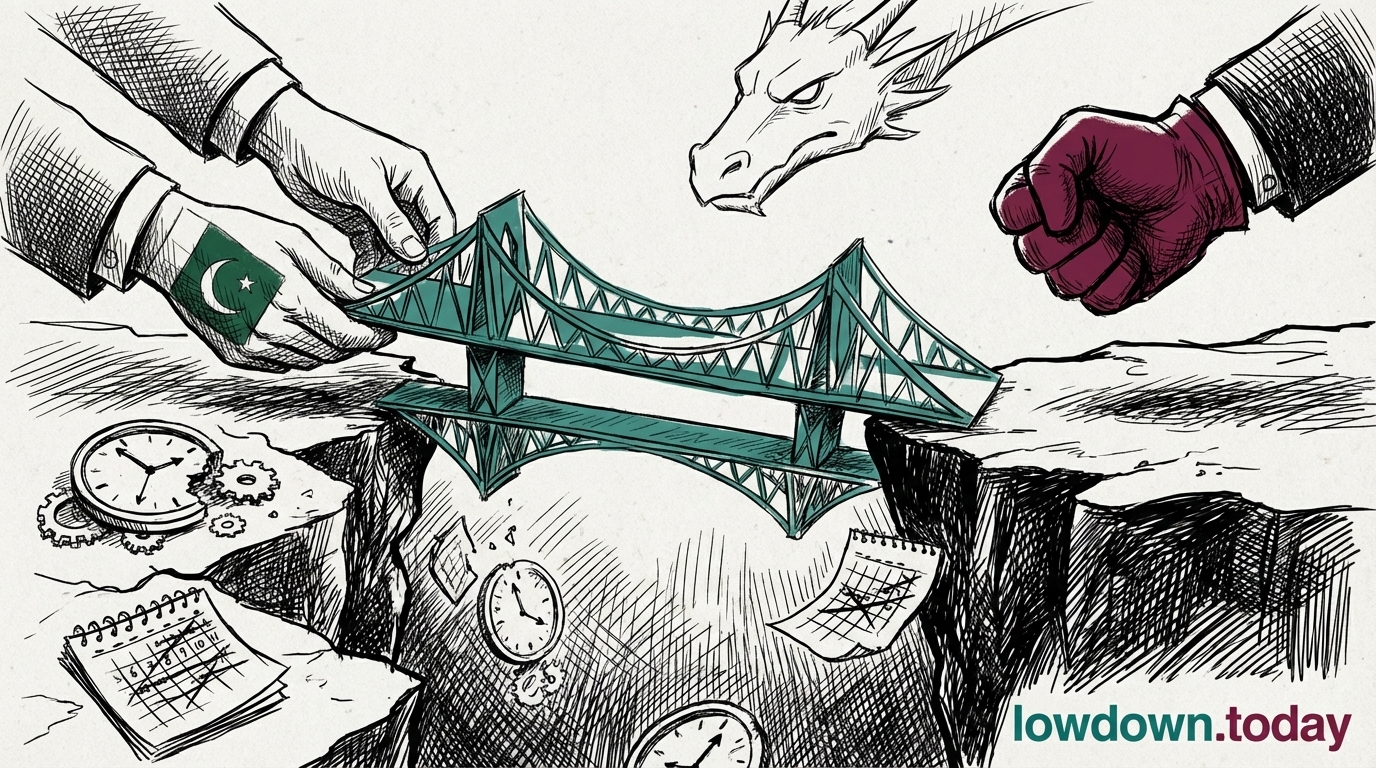
Two hours before his fifth Hormuz ultimatum was due to lapse, the president converted the deadline into a two-week diplomatic window.

ConflictDeveloping
Key takeaway

The sixth deadline produced a paused war signed against a goal list that no longer contains Hormuz.

Trump's Truth Social acceptance came as the carriers required to enforce the deadline remained 1,100 km from Iran's coast, repositioned out of the missile envelope . Each previous Hormuz reformulation had produced an extension under the same pattern: rising rhetoric, flat operational ceiling. The fifth extension on 6 April was the immediate predecessor ; the 10-point Iranian framework that Pakistan had brokered the same day became the document Trump now describes as 'workable'. The acceptance is the sixth deadline outcome.

The White House framing relies on a four-item Clear and Unchanging Objectives page dated 1 April that does not list reopening the strait of Hormuz. The 'met and exceeded' claim is narrowly true against that list and only that list. Briefing #61 documented the silent omission; today's signing confirms it was infrastructure for the climbdown, not a clerical accident.


Deep Analysis

In plain English

Trump had been threatening for six weeks to bomb Iran's power stations and refineries unless Iran reopened the Strait of Hormuz. Tonight he signed a two-week pause instead. The deal asks Iran to allow shipping through the Strait under Iran's coordination, which is what Iran has already been doing for friendly buyers since mid-March. Both sides are calling it victory.

Deep Analysis
Synthesis

The sixth deadline produced the outcome that the prior five had been pre-positioning: a face-saving exit framed as victory against a narrowed goal list.

Root Causes

The operational ceiling was flat throughout the war. Interceptor depletion at critical thresholds and Pacific-stock JASSM-ER consumption left no tool to convert civilization-ending rhetoric into operations.

The Hormuz objective was dropped from the official goal list before the ceasefire because retaining it would have required either a victory the operations could not deliver or an admission of failure the politics could not absorb.

Escalation

De-escalation without resolution. The pause holds for two weeks but contains no enforcement mechanism, no published text, and no agreed terms on Lebanon. Probability of resumption inside the window is non-trivial; probability of structural reversal of Iran's Hormuz position is near zero.

What could happen next?
  • Consequence

    The Islamabad meeting on 10 April becomes the test of whether a published text exists or the ceasefire is rhetorical only.

    Short term · High
  • Risk

    Without enforcement, a single high-volume Iranian strike or US escalation could collapse the pause inside its first week.

    Immediate · Medium
  • Precedent

    Any future US president inherits a Hormuz arrangement Iran controls, codified by acceptance rather than diplomacy.

    Long term · Medium
First Reported In

Update #62 · Two victories, two different lists

Times of Israel· 8 Apr 2026
Read original
Different Perspectives
Gulf shipping and insurance markets
With Hormuz and Bab el-Mandeb both hostile at once, war-risk underwriters face their first dual-chokepoint pricing problem; the rerouting hedge that absorbed one closure is gone for Israeli-linked hulls. Any deal that reopens Hormuz without a Houthi stand-down clause delivers only partial shipping relief.
Russia and China
Russia and China
Russia and China met IAEA chief Grossi jointly in Geneva on 5 June to coordinate an advance blocking position against Washington's censure resolution, the first documented instance of proactive pre-session obstruction rather than reactive post-vote dissent. Beijing's move came four days after OFAC designated Shanghai Qianye Energy under Iran energy sanctions.
Saudi Arabia
Saudi Arabia
Saudi Arabia was left out of the emergency $4.01 billion Patriot waiver Qatar received on 2 May as its own PAC-3 stocks ran near-empty from intercepting Iranian salvoes over Aramco facilities. Riyadh is on a standard 18-month FMS queue behind a production line booked through 2030, with no equivalent priority to Qatar's Al Udeid basing role.
Houthis (Ansar Allah)
The Houthis declared a complete ban on Israeli Red Sea navigation on 8 June and struck Jaffa, their first attack on Israeli territory since April, seven days after the Tasnim authorisation to activate other fronts including Bab el-Mandeb. The declaration put both chokepoints under hostile authority simultaneously.
Iran
Iran
Iran agreed the 9 June mutual halt after the Mahshahr exchange and coordinated with Russia and China to block Washington's IAEA censure resolution, using the Board as a second front while the bilateral pause held on the military one. Tehran's acceptance of the Lebanon carve-out contradicts the linkage position it stated on 1 June.
Benjamin Netanyahu and the IDF
Israel struck the Karun Petrochemical plant at Mahshahr on 8 June over Trump's explicit objection, then agreed a halt with Iran the following day scoped on Israeli terms with Lebanon carved out. Netanyahu's posture is that the IDF will not accept Iranian missile factories as off-limits regardless of US diplomatic timelines.



