Skip to content
You can now search across every topic, entity and event.What's new
Iran Conflict 2026
1APR

Iran hits Kuwait airport on victory day

2 min read
12:41UTC

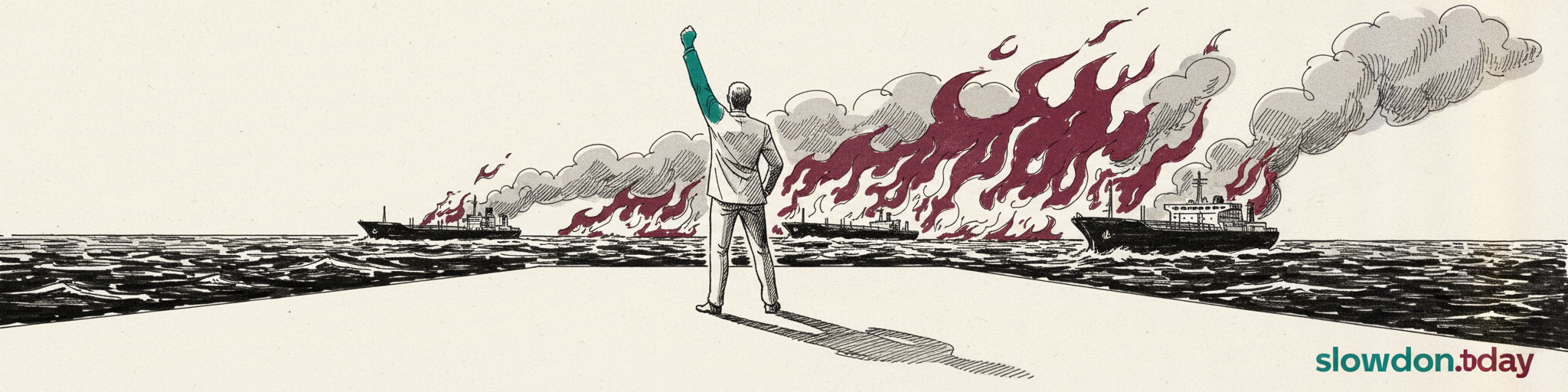
Iran struck a QatarEnergy tanker in Qatari waters and set Kuwait's airport fuel storage ablaze on the same day Trump declared the war won. Three US-aligned Gulf states absorbed Iranian strikes within hours of the Oval Office address.

ConflictAssessed
Key takeaway

Iran struck Qatar and Kuwait on Trump's victory day, demonstrating the war continues regardless of Washington's withdrawal framing.

Iranian drones struck fuel storage tanks at Kuwait International Airport on 1 April, sparking a large fire, while Iran simultaneously struck a QatarEnergy fuel oil tanker in Qatari territorial waters. The timing was deliberate: the strikes occurred while Trump was delivering his Oval Office victory address.

Iran did not hold fire while Trump spoke. Striking Qatar's state energy company in Qatari territorial waters, where Al Udeid Air Base is also located, and setting Kuwait's airport fuel tanks burning for several hours on the same day Trump declared the hard part done is a precise operational statement. Kuwait had already condemned Iran's killing of an Indian national at a desalination plant on 30 March , and had suffered a prior airport strike in the conflict's earlier days.

The pattern mirrors the industrial escalation against Gulf aluminium plants : maximum disruption, zero casualties, insufficient provocation to draw Gulf states into the war as belligerents. A QatarEnergy tanker struck with a second missile that entered the engine room unexploded is not an accident; it is a calibrated demonstration that Iran can hit the target and choose whether to detonate. Iran had explicitly threatened UAE infrastructure over Kharg Island operations , establishing the coercive intent behind these strikes.

Kuwait condemned the attack as 'blatant' but has not moved toward belligerent status. Iran has found the threshold: damaging enough to send a signal, restrained enough to avoid the trigger that would widen the war.


Deep Analysis

In plain English

On the same day the US president said the war was nearly over, Iran attacked two of America's Gulf allies. A missile hit a Qatari oil tanker in Qatari waters ; a second missile went into the engine room without exploding, which is how you signal you could have done far more damage but chose not to. Iranian drones also set fire to Kuwait's airport fuel tanks for nearly three days. Both Qatar and Kuwait host American military bases. Iran is telling these countries: we can reach you, we can hurt you, and we choose how much damage to cause. Neither country has joined the war. That is exactly the calculation Iran is making.

Deep Analysis
Root Causes

Gulf states hosting US military infrastructure are legitimate targets under Iran's declared war doctrine. Qatar's Al Udeid and Kuwait's operations support is integral to the US campaign, making their energy infrastructure militarily justifiable targets in Iran's framing.

Escalation

Iran has established a sustainable pattern of Gulf state strikes that cause economic damage without triggering military retaliation. The risk is that cumulative damage eventually crosses a threshold that compels a Gulf state response, particularly if Saudi Arabia or the UAE conclude the US umbrella is withdrawing.

What could happen next?
  • Risk

    Sustained strikes on Qatari LNG infrastructure could trigger a separate energy supply shock independent of the Hormuz oil disruption.

    Short term · Reported
  • Consequence

    Gulf states may reassess hosting US forces if Iran's targeting of their infrastructure continues and Washington withdraws before Hormuz reopens.

    Medium term · Reported
  • Precedent

    Striking a tanker inside a sovereign state's territorial waters establishes a precedent that no Gulf state's waters are safe zones.

    Long term · Assessed
First Reported In

Update #54 · Trump declares victory and withdrawal

Wana EN· 1 Apr 2026
Read original
Different Perspectives
Oil market and P&I insurers
Brent cleared $87 intraday only once CENTCOM's blockade became physical rather than declared, even though P&I Clubs had already excluded Hormuz war risk a week earlier on 7 July: capital hedged ahead of enforcement, but prices moved only after it.
UAE reporting
UAE reporting
UAE reporting placed the Omani tanker deaths at one seafarer against the International Maritime Agency's count of two, the first time in this war that a Gulf state's casualty figures have diverged from an international monitor's.
Jordan
Jordan
Iranian strikes reached Jordan again on 14 July as part of the Gulf-wide retaliation for the Hormuz blockade, extending the conflict's geographic footprint to a state with no direct stake in the strait itself.
Bahrain
Bahrain
Bahrain sounded air-raid sirens on 14 July during Iran's Gulf-wide retaliation, the same day CENTCOM's blockade order and fourth night of strikes pushed the conflict's physical reach into the wider Gulf littoral.
Kuwait
Kuwait
Kuwait intercepted Iranian missiles and drones on 14 July as Tehran's blockade retaliation reached Gulf states beyond Iran's immediate shoreline, confirming Kuwaiti airspace now sits inside Iran's retaliatory envelope.
Oman
Oman
Oman absorbed the war's first tanker casualties in its own waters on 14 July, with two supertankers disabled and seafarers killed, putting the sultanate's shipping lanes directly in the path of the blockade fight for the first time.



