Skip to content
Briefings are running a touch slower this week while we rebuild the foundations.See roadmap
Iran Conflict 2026
1APR

Iran's Hormuz Toll Matures Into Permanent Institution

3 min read
12:41UTC

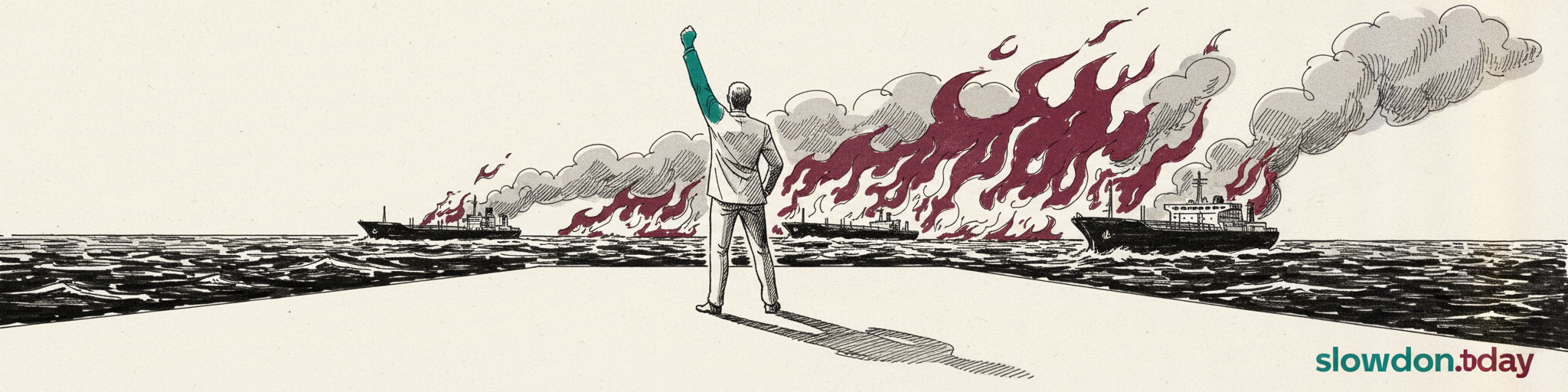
The IRGC built a customs authority, not a blockade. The infrastructure is designed for permanence, and the currency is yuan.

ConflictAssessed
Key takeaway

Iran built a customs authority, not a blockade; the infrastructure is permanent.

the strait of Hormuz toll system has matured from improvised blockade into something closer to a functioning customs authority , . Claims Journal and Bloomberg detail the mechanics: $1 per barrel paid in yuan or stablecoins. A Very Large Crude Carrier carrying two million barrels pays roughly $2 million per transit.

The IRGC's Hormozgan Provincial Command runs background checks on all vessels. Five tiers of country classification determine access. Ships must raise the flag of a deal-country, broadcast passcodes over VHF radio, and receive an IRGC patrol escort through the corridor. Some vessels are required to change flag registration entirely. Pakistan has secured deals for 20 vessels.

Weekly transits have risen to 53, up from 36 the previous week, driven by bilateral exemptions: the Philippines , France, Japan , Oman, and Iraq . But pre-war volume was roughly 966 transits per week. The recovery runs through Tehran's licensing desk. Each new deal normalises Iran's sovereignty claim over international waters. Ali Vaez of the International Crisis Group assessed that Hormuz control is much more potent than even a nuclear weapon. The yuan, not the dollar, is the currency of this chokepoint.

At $1 per barrel, the IRGC's annual revenue from Hormuz tolls, if pre-war volumes resumed, would exceed $7 billion. Even at current reduced volumes, the toll generates hundreds of millions annually. The stablecoin payment option creates a sanctions-resistant financial channel. This is a new revenue stream for the IRGC that exists independently of any ceasefire agreement.

Deep Analysis

In plain English

Iran is not just blocking ships; it has built a full toll system with security checks, country rankings, and digital payments in Chinese currency. Ships pay roughly $2 million each time they pass through. This looks like a permanent operation, not a temporary war measure. It affects the price of everything that moves through the strait, which carries roughly one-fifth of global oil supply.

Deep Analysis
Root Causes

The toll system emerged from a blockade that the US threatened to break but never did (five deadline extensions).

Each unfulfilled threat gave Iran more time to institutionalise its control. The bilateral exemption pattern (Philippines, France, Japan, Oman, Iraq, Pakistan) further normalises the system by giving individual nations incentives to cooperate rather than collectively resist.

Escalation

The toll system is itself an escalation that has been normalised through repetition. Each new bilateral deal raises the cost of reversing the system. The transition from blockade to customs authority represents a permanent alteration of the maritime order in the Persian Gulf that no ceasefire framework currently addresses.

What could happen next?
  • Yuan as the currency of Hormuz transit accelerates de-dollarisation of global energy trade

    months · Assessed
  • Precedent for sovereign toll claims on international waterways could spread to other chokepoints

    years · Suggested
  • Insurance and shipping markets must price IRGC compliance costs into every Hormuz-dependent route

    weeks · Assessed
First Reported In

Update #60 · Pakistan's Ceasefire Plan Fills the Vacuum

Claims Journal / Bloomberg· 6 Apr 2026
Read original
Different Perspectives
IAEA
IAEA
Director General Rafael Grossi appeared in person at the UNSC on 19 May and warned that a direct hit on an operating reactor 'could result in very high release of radioactivity'. The session produced a condemnation record but no resolution, and the Barakah perimeter was already struck on 17 May.
Hengaw (Kurdish rights monitor)
Hengaw documented three judicial executions and the detention of Kurdish writer Majid Karimi in Tehran on 19 May, establishing Khorasan Razavi province as the newest geography in Iran's wartime judicial record. The organisation's Norway-based operation continues to surface a domestic repression track running in parallel with every diplomatic and military development.
India
India
Six India-flagged vessels conducted a coordinated cluster transit under PGSA bilateral assurances during the 17 May window, paying no yuan tolls. New Delhi's inclusion in Iran's state-to-state passage track insulates Indian energy supply without requiring endorsement of the PGSA's yuan-toll architecture or alignment with the US coalition.
Pakistan
Pakistan
Pakistan is the only functioning diplomatic bridge between Tehran and Washington. Its role is relay, not mediation in the settlement sense: it conveyed Iran's 10-point counter-MOU in early May, relayed the US rejection, and is now passing 'corrective points' in the third documented exchange of this sub-cycle without either side working from a shared text.
UK and France (Northwood coalition)
Twenty-six coalition members have published no rules of engagement eight days after the Bahrain joint statement; Lloyd's underwriters have conditioned war-risk reopening on written ROE from either Iran or the coalition. Italian and French mine-countermeasures deployments are operating on the in-water clearance task CENTCOM Admiral Brad Cooper's 90% mine-stockpile claim does not address.
Saudi Arabia
Saudi Arabia
Riyadh has not publicly commented on the Barakah strike or the 50-47 discharge vote. Saudi output feeds the IEA's $106 base case; the $5 Brent premium above that model reflects institutional uncertainty no Gulf producer can compress through supply adjustment alone.