Skip to content
You can now search across every topic, entity and event.What's new
Iran Conflict 2026
21SEP

Iran airs draft deal; US calls it fake

3 min read
15:34UTC

Iran's state broadcaster aired draft terms showing Hormuz reopened within a month and managed jointly with Oman; within hours the White House called the report "a complete fabrication".

ConflictDeveloping
Key takeaway

If the draft is genuine, the real fight is over Hormuz control and US forces, not the uranium.

Iran's state broadcaster aired what it called draft terms of a Memorandum of Understanding (MoU), a non-binding framework, on 27 May: Hormuz commercial traffic restored to pre-war levels within a month of any agreement, the US naval blockade lifted, military vessels excluded, and Iran managing the strait alongside Oman 1. Within hours the White House issued a flat denial. "This report from Iranian controlled media is not true and the MOU they released is a complete fabrication" 2.

The Farsi outlet Tabnak then published what it described as the full draft text, citing a Saudi network source 3. Two clauses sit in brackets, the drafting convention for language both sides have failed to agree: Iran's claimed sovereignty over the strait of Hormuz, the 33 km channel carrying roughly 20% of global oil, and arrangements for US military presence near Iran. The nuclear question, the clause Washington keeps naming in public, is not bracketed at all. The text defers it wholesale to a separate 60-day round of talks, the same Phase 2 framing Iran has held since late May .

That reframes the deadlock. For weeks the public story has been a fight over uranium, the item Trump's Cabinet veto froze in place that same day. If the Tabnak text is genuine, the live disputes are instead about who controls the world's most important oil chokepoint and whether American forces stay parked beside Iran. Iran's war cabinet had returned from Doha on 26 May with nothing signed , and both sides then began arguing not over whether a deal was close but over what it even said.

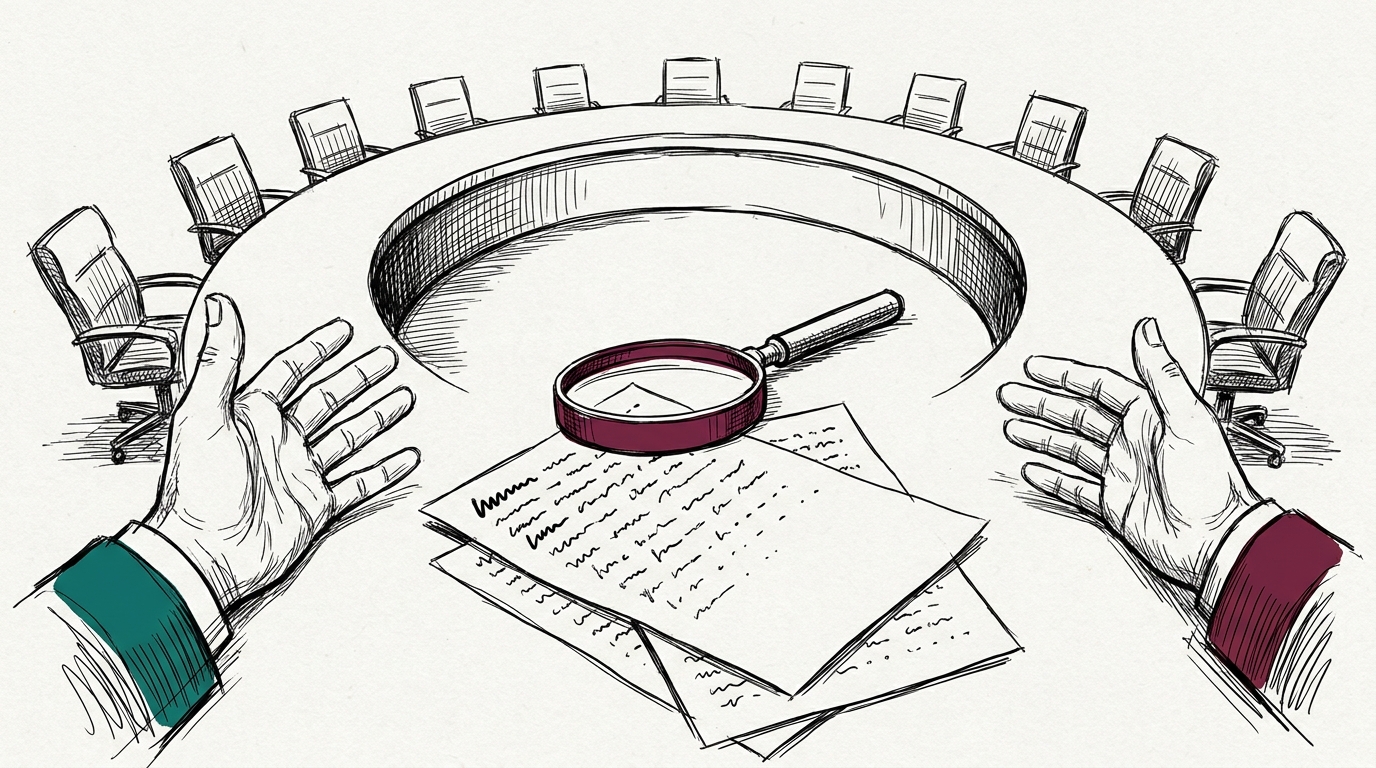
Bracketed text marks a redline, not a near-miss. That the nuclear clause reads clean while Hormuz sovereignty and US force posture are flagged suggests the uranium fight is positioning for domestic audiences, and the real impasse is territorial and military. A draft two governments cannot agree exists is one no mediator or market can act on.


Deep Analysis

In plain English

Imagine two sides in a dispute, each telling the press a different version of what they have agreed to. That is what happened on Wednesday between Iran and the United States. Iran's state television broadcast what it claimed were the terms of a draft agreement: the Strait of Hormuz, the waterway through which a fifth of the world's oil passes, would reopen within a month. Iran and Oman would manage it together. The US would eventually withdraw its military forces from the region. A White House spokesperson called the broadcast 'not true' and described the MOU it referenced as 'a complete fabrication'. Then an Iranian news outlet called Tabnak published what it claimed was the full text, showing that some of the biggest questions, including who controls the strait and where US forces can be stationed, are still marked as unsettled in brackets. Shipping companies, oil traders, and foreign governments now hold two irreconcilable public accounts of what has been agreed. Neither the Iranian government nor the White House has published a shared document to resolve the contradiction.

Deep Analysis
Root Causes

Three structural conditions produce a document war instead of agreed terms.

First, Iran's internal governance is split between the civilian diplomatic track (Araghchi, Pezeshkian) and the IRGC-aligned track (Shamkhani, Khamenei). Each track benefits from different versions of the text existing publicly. Araghchi's version emphasises a Hormuz reopening timeline; Shamkhani's version calls any nuclear demand a 'fantasy.' State television and Tabnak serve different audiences within that split.

Second, the White House's zero-signed-instrument posture, now at 90 days, means no authoritative written US position exists for either side to authenticate against. When there is no canonical US text, any Iranian version of the MOU is automatically contestable, and the White House denial carries less informational weight than it otherwise would.

Third, the five-nation mediating structure, involving Qatar, Pakistan, Oman, Saudi Arabia, and China in varying combinations, means any draft has passed through multiple editorial hands before publication. Attribution to a 'Saudi network source' in the Tabnak text suggests the document may have been altered as it passed through Riyadh, where interests diverge from Tehran's on the Oman co-management clause.

What could happen next?
  • Consequence

    The White House flat denial and the Tabnak fuller text now form two irreconcilable public records. Any eventual deal text will be scrutinised against both, making ratification communications significantly more complex.

    Immediate · Assessed
  • Risk

    Iran's domestic audience now has a public record showing the US rejected terms that included Hormuz restoration within a month. If no deal emerges, the Iranian government can attribute the failure to American rejection of its own published offers.

    Short term · Assessed
  • Precedent

    The Tabnak Saudi-network attribution, combined with Saudi Arabia's exclusion from negotiations, establishes a pattern where excluded regional powers can inject versions of contested texts into the public record.

    Medium term · Suggested
First Reported In

Update #110 · Trump vetoes Iran's only uranium exit

Bloomberg· 28 May 2026
Read original
Different Perspectives
Shipping and insurance industry
UKMTO counted about 20 US-facilitated Hormuz transits a day to 11 September against only 6 visible on AIS, with traffic still around 90% below the 138-a-day pre-war baseline. War-risk underwriters cannot price hulls they cannot see, or resolve whether the tanker El Gaia hit a mine, as Iran claims, or a missile and drone, as CENTCOM says.
European refiners
European refiners
European refiners, including Poland's Orlen, absorbed a roughly $26 gap between Dated Brent at $130.80 on 15 September and ICE Brent futures settling at $103.87 on 18 September, a spread that widened from $13.45 on 9 September rather than newly opening. Their futures hedges no longer cover what they now pay for physical barrels.
Saudi Arabia
Saudi Arabia
Saudi Aramco zeroed European term customers' October allocations and rerouted roughly 60 million barrels to Asia through Ras Tanura and Sohar, using Red Sea and Gulf terminal capacity built years ago to cut Hormuz exposure. Riyadh reallocated existing supply rather than negotiating a shortfall with Europe.
Qatar
Qatar
Qatar's energy minister Saad al-Kaabi told Bloomberg at the Qatar Economic Forum on 20 September that Bessent's two-year Hormuz-obsolescence forecast is wrong, and that Doha has deliberately built no bypass pipeline. Qatar's gas exports run through one waterway by choice, not oversight.
Iran (foreign ministry and Majlis)
Iran's foreign ministry and 130 Majlis deputies moved toward NPT withdrawal this week, with lawmaker Hossein-Ali Haji Deligani filing a triple-urgency bill on 20 September that Speaker Qalibaf has not yet scheduled. Tehran treats treaty membership as leverage still on the table, not yet spent.
Russia and China
Russia and China
Moscow and Beijing vetoed the Panel of Experts' renewal, maintaining Resolution 2231 lapsed in October 2025 and the 2025 snapback was never validly triggered, so the sanctions architecture the Panel enforces has no current legal standing. Both governments frame the veto as upholding law, not shielding Tehran.



