Twenty-six nations met in Bahrain on 12 May 2026 to formalise the Multinational Military Mission for the Strait of Hormuz. Eight days on, no rules of engagement have been published by the Coalition secretariat, the UK Permanent Joint Headquarters at Northwood, or any contributing national defence ministry. Italy's two Lerici-class minehunters, Belgium's BNS Primula, France's Charles de Gaulle, Germany's two vessels, the United Kingdom's HMS Dragon and Typhoon fighters, and Australia's E-7A Wedgetail surveillance aircraft are deployed under national rules. Lloyd's of London informally conditions the reopening of war-risk cover on either the coalition or Iran's PGSA publishing a written framework first. With neither side moving, two regulatory vacuums sit in stalemate on opposite shores of the same chokepoint, and the eight-day gap converts a posture decision into an insurance-market consequence.
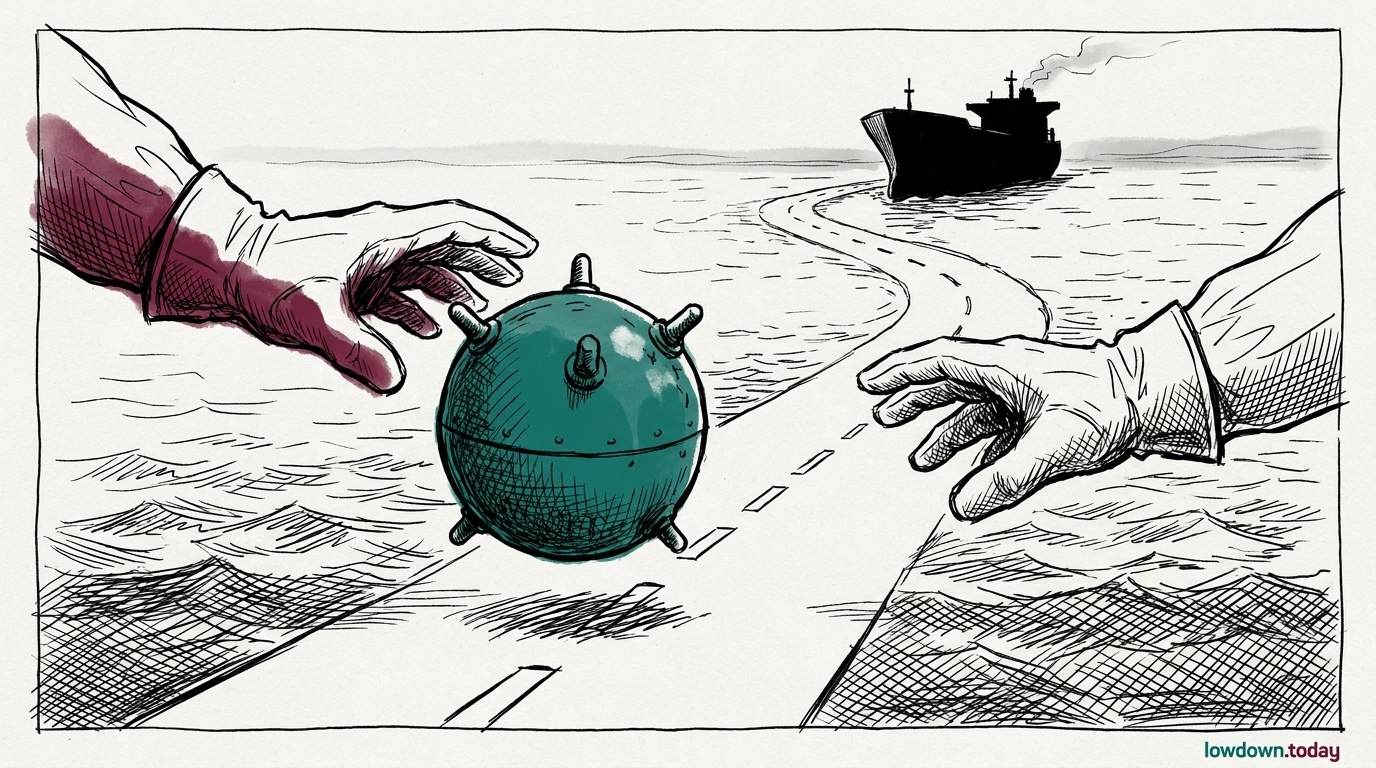
Hormuz coalition: 8 days deployed, no rules published
The 26-nation Hormuz Coalition formalised in Bahrain on 12 May has produced no written rules of engagement by 20 May 2026, despite Italian, Belgian, German, French, Australian and British platforms now operating in the strait.
Hormuz Coalition: 26 nations, 8 days deployed, no published rules of engagement; Lloyd's keeps war-risk cover closed pending text.
Deep Analysis
Twenty-six countries agreed eight days ago to send warships to police the strait of Hormuz. None of them have written down what their warships are actually allowed to do. Insurance companies refuse to cover oil tankers passing through until somebody writes the rules. Lloyd's of London, the main marine insurer, has kept its war-risk cover closed since 13 April. Until a published rulebook arrives from either the Coalition or Iran, oil tankers cannot get insurance, so they stay anchored outside the strait while warships patrol an empty channel.
Twenty-six sovereign nations cannot harmonise rules of engagement at speed because each contributing navy operates under national-parliament-approved engagement law. The UK Permanent Joint Headquarters at Northwood lacks authority to bind French, Italian or Australian commanders.
Lloyd's of London, in turn, requires a single binding text to underwrite war-risk cover; absent it, premiums stay infinite and commercial transit stays frozen. Two regulatory vacuums on opposite sides of the strait reinforce each other.
- Meaning
Watch the Lloyd's of London Joint Hull Committee circular cycle through May 2026; weekly Tuesday meetings set war-risk cover terms. A single circular reopening Hormuz cover at a defined premium would signal the coalition has produced written rules of engagement through closed channels even if no public document emerges. Conversely, a Lloyd's circular extending exclusion through end-May would price the institutional deadlock at roughly $8 per barrel above the IEA model.
Update #103 · Senate 50-47; UNSC at Barakah; no US paper



Written with AI from Lowdown's published reporting. Not individually reviewed by an editor. Editorial standards.