Skip to content
You can now search across every topic, entity and event.What's new
Iran Conflict 2026
31JUL

Putin blames Washington for killing uranium deal

4 min read
09:24UTC

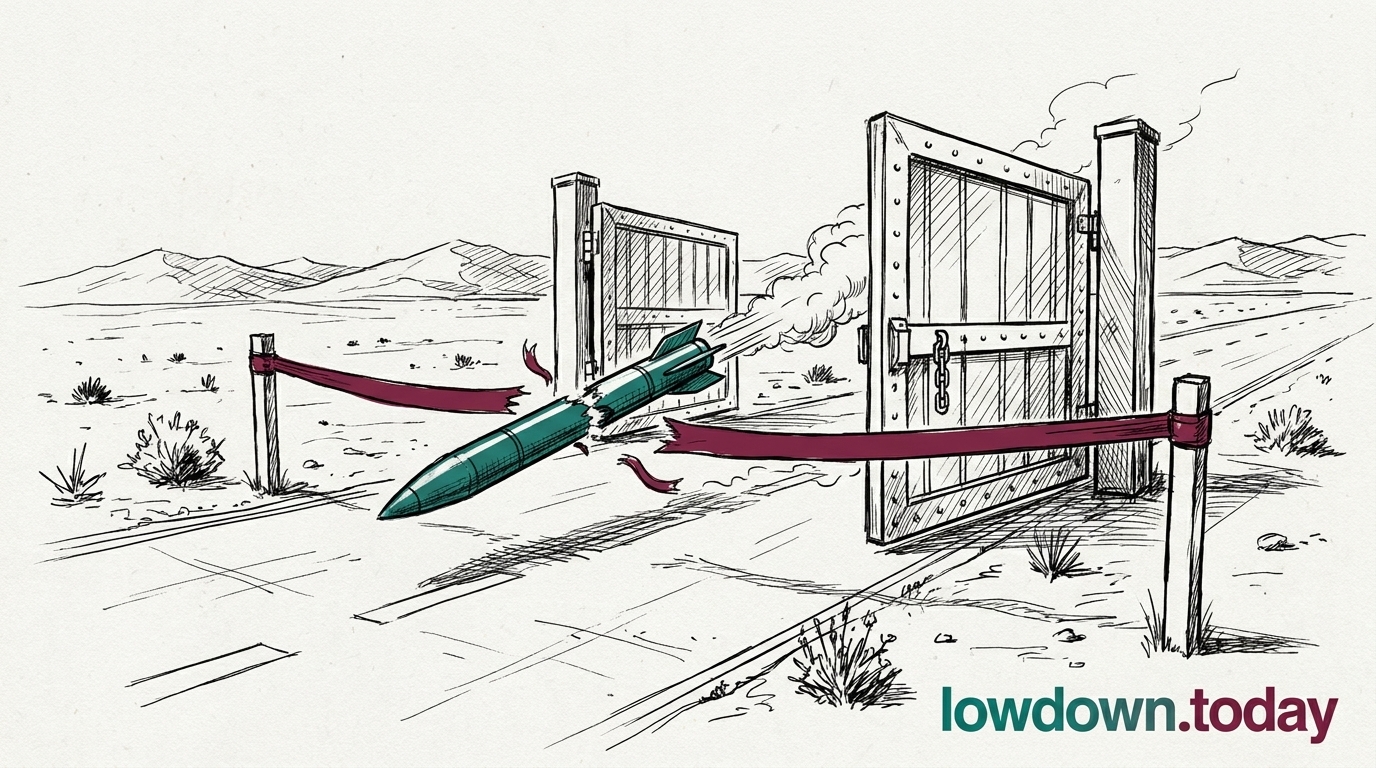
Putin told a Moscow press conference that Russia's uranium-custody offer for Iran still stands and that Washington, not Tehran, killed the arrangement by demanding US-territory storage.

ConflictDeveloping
Key takeaway

Putin said Washington killed the Russian uranium custody deal and the verification void leaves the claim untestable.

Vladimir Putin told a press conference in Moscow on 9-10 May 2026 that Russia's offer to take custody of Iran's enriched uranium "still stands" 1. Putin's procedural claim is the new material in his 9-10 May remarks. Putin said "initially everyone agreed" the uranium would go to Russia, and that "the United States hardened its position and demanded that the uranium be transported exclusively to US territory", at which point Iran hardened its own position. Tehran has not corroborated. Washington has not commented. The line was carried by Moscow Times, Eastern Herald, Dawn.com and Pravda USA, all second-tier outlets with Putin as the sole named source.

The IAEA (International Atomic Energy Agency, the UN nuclear-inspections body) has had no on-site access in Iran since the 11 April Majlis 221-0 cooperation suspension, which means no third party can audit Putin's account in real time. GOV/2026/8, dated 27 February 2026, remains the most recent Board of Governors report Vienna has issued. Rafael Grossi, the IAEA Director-General, told the AP on 29 April that 18 containers of approximately 200 kg of 60%-enriched uranium had entered the Isfahan Uranium Conversion Facility tunnel on 9 June 2025, four days before Israel's first strikes . That tunnel record is the last inspector-grade observation anyone has on the stockpile a Russian custody arrangement would notionally cover.

Putin is invoking a real precedent. Russia transported Iranian-enriched uranium under JCPOA Annex I procedures in 2015, with US, Russian and IAEA sign-off. The collapse he describes here merges three negotiation rounds into one procedural sequence: 2015, the 2024 "Anchorage" talks, and the 2026 MOU window. Even if true in part, the conflation simplifies a more textured record, and the verification void means no third party can audit it. Yuan-only PGSA tolls at up to $2m per ship sit beside the uranium claim as another off-dollar instrument running outside Western reach, which is the broader pattern Moscow is trading on.

For non-aligned audiences, the framing reframes the standard Western position that "Iran will not surrender its uranium". Washington's silence is itself a data point, and Russia gains a costless diplomatic surface ahead of any Trump-Xi or Trump-Putin window. A custody arrangement for material no inspector has counted in 14 months remains a paper offer, regardless of which side Putin places the blame on.


Deep Analysis

In plain English

Iran has about 200 kilograms of uranium enriched to 60% purity, the stuff that could, with further enrichment, be used to make a nuclear weapon. One potential solution to the crisis has been for Iran to hand this uranium over to Russia for safekeeping, rather than the US. Putin claimed at a press conference that originally everyone, including the US, agreed Russia would hold the uranium, but then Washington changed its mind and demanded the uranium go to the US instead, which made Iran dig in. Putin alone has gone on record with this sequence; Tehran has not corroborated and Washington has not commented. Neither Iran nor the US has confirmed his account. And the UN nuclear watchdog (the IAEA) has been blocked from entering Iran's nuclear sites since April, so no independent body can verify what's actually in those sites or what was agreed. The claim matters primarily because it gives non-Western countries a ready-made narrative that blames the US for blocking a deal.

Deep Analysis
Root Causes

Putin's claim operates at the intersection of three structural conditions, each of which amplifies the narrative impact independent of its factual accuracy.

First, the IAEA has been locked out of Iranian nuclear facilities since the Majlis 221-0 vote of 11 April 2026. No independent body can verify Putin's account, Iran's silence, or Washington's non-comment. The verification void that makes the uranium custody dispute central to the MOU also makes Putin's counter-narrative about that dispute structurally unverifiable.

Second, Putin's claim appeared in second-tier outlets (Moscow Times, Eastern Herald) rather than the Kremlin's primary English-language channels. This distribution pattern, carrying significant claims through outlets with lower editorial credibility, is consistent with a trial balloon rather than a formal policy statement.

It allows Moscow to introduce the narrative into global information flow, test the response from non-aligned audiences (BRICS+ members, Global South media), and deny it as misquoted or distorted if it produces diplomatic blowback.

Third, Rosatom's February-April 2026 offer to take custody of Iranian uranium, tabled through Kremlin spokesman Dmitry Peskov and Rosatom CEO Alexei Likhachev in three different technical formats (transfer and dilute, equivalent natural uranium, financial payment), was never formally accepted by either Iran or the US. Putin is retroactively characterising an unaccepted offer as a trilateral consensus that Washington destroyed, a reframing that requires no new facts.

What could happen next?
  • Consequence

    Putin's narrative, carried without Chinese corroboration, creates a US-blaming framework for the uranium custody failure that will circulate in BRICS+ diplomatic circuits independent of its accuracy, making future US demands for multilateral buy-in on Iran uranium disposal harder to achieve.

    Medium term · 0.74
  • Risk

    The distribution through second-tier outlets rather than Kremlin primary channels means the claim can be escalated or denied depending on Western and Iranian reactions, giving Moscow maximum narrative flexibility without a formal commitment to the account.

    Immediate · 0.78
  • Precedent

    If the 'US demanded US-only custody' account goes unchallenged by Washington, it may harden as the received narrative in non-aligned forums, setting a precedent that the US cannot achieve multilateral uranium-custody arrangements without formally rebutting the account in the UN Security Council or IAEA Board.

    Long term · 0.66
First Reported In

Update #94 · Tehran writes, Trump tweets, Brent breaks

Eastern Herald· 11 May 2026
Read original
Causes and effects
This Event
Putin blames Washington for killing uranium deal
A Russian-state press event has become the public default source on a US negotiation track that Washington has not contested on the record.
Different Perspectives
Shipping and insurance underwriters
Underwriters can price Houthi strikes because the group announces its targets, but an unclaimed drone at Damietta and a mandatory Iranian insurance scheme both deny them a pattern to price against. War-risk premiums are increasingly being set by the absence of a claimant, not the scale of the damage.
Jordan
Jordan
Azraq absorbed its fourth Iranian strike in seven weeks, again drawing no direct Jordanian retaliation, only an American one. Amman's exposure, hosting US basing without the Patriot density of Gulf allies, has not changed even as the war around it widens.
Houthi movement
Houthi movement
The Houthis' 20 July blockade of Saudi-linked shipping is the injury Riyadh's new 43-nation coalition directly answers, yet the group itself was never asked to join and remains outside every proposal on the table. Sanaa-aligned commentators call the coalition a paper reassurance for insurers rather than a deployable force.
Egypt's Cabinet
Egypt's Cabinet
Egypt confirmed the Damietta blaze was an attack, not an accident, on soil the war had never touched before. Cairo now faces an unclaimed threat to a facility supplying roughly 7% of its domestic gas, with no author to hold accountable and no pattern yet to defend against.
Oman
Oman
Muscat is running the only channel Iran will use, a voluntary Hormuz fee modelled on Malacca, but stayed out of Saudi Arabia's new naval coalition entirely. Oman's mediating leverage depends on treating Hormuz as shared and non-exclusive, the opposite of what Tehran is now demanding of it.
Iraq's Prime Minister
Al-Zaidi cancelled his first official Riyadh visit and convened the Coordination Framework, the coalition that keeps him in power and whose factions sit inside the PMF that Saudi jets just struck. He is caught between a five-year Saudi investment relationship and armed groups inside his own state he does not fully control.



