Skip to content
Welcome, thoughtbot's Giant Robots listeners!Start here
Iran Conflict 2026
24JUN

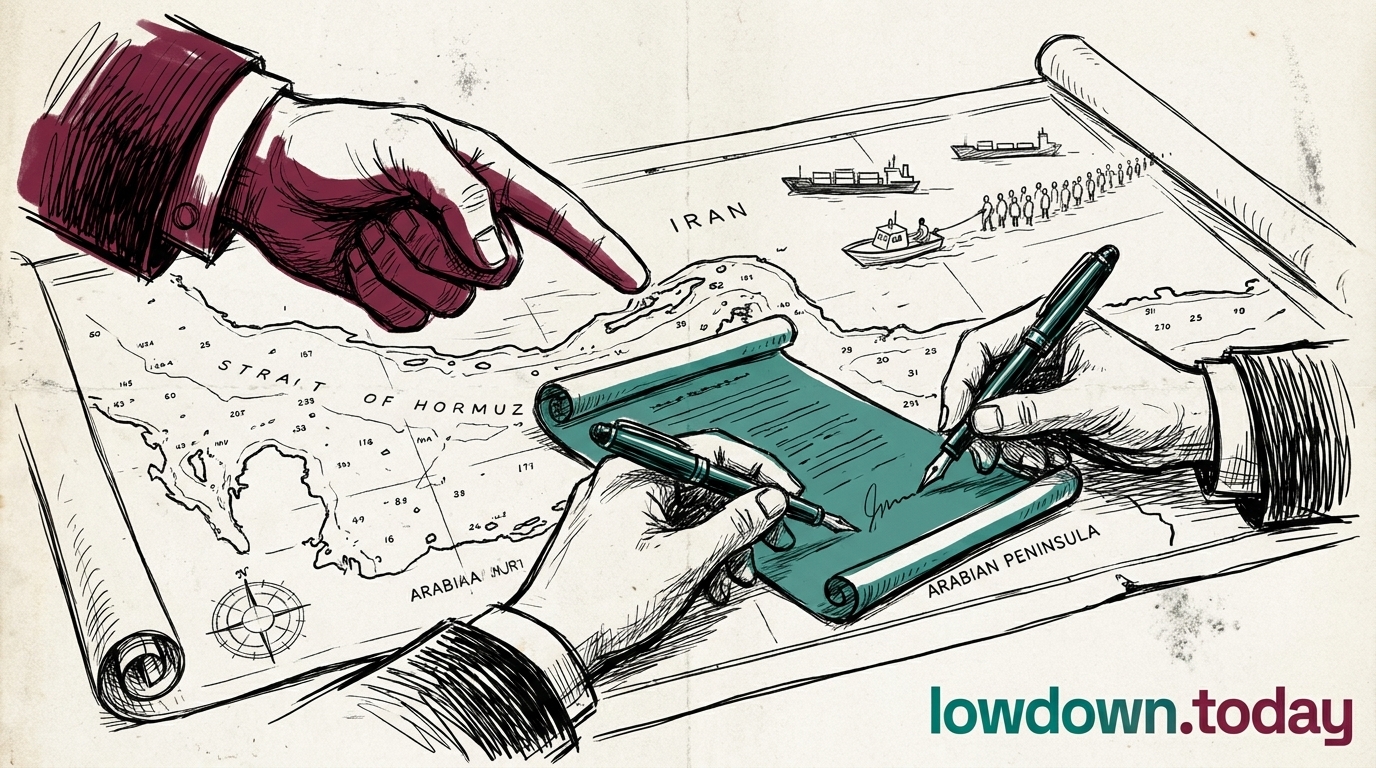
US warships transit Hormuz for mines

3 min read
09:14UTC

CENTCOM sent two destroyers through the strait on 11 April; the IRGC denied entry and threatened reprisal.

ConflictDeveloping
Key takeaway

CENTCOM's mine clearance during live talks signals the US is building a military track alongside diplomacy.

CENTCOM (US Central Command) announced on 11 April that USS Frank E. Petersen Jr. and USS Michael Murphy transited the Strait of Hormuz as part of a mine clearance mission. The operation was launched while Day 1 of the Islamabad talks was still under way. Trump framed it as "a favour to countries all over the world, including China, Japan, South Korea, France, Germany."

The IRGC Navy denied the ships had entered the strait at all, a direct contradiction of CENTCOM's own press release. Its statement went further: "Any attempt by military vessels to pass through the strait of Hormuz will be dealt with severely." The denial is notable because CENTCOM published the ships' names and mission profile; either the IRGC did not detect the transit or chose to deny it publicly while responding through other channels.

The operation is consistent with reporting that Iran deployed at least a dozen naval mines (Maham-3 moored and Maham-7 seabed limpet models) without systematically tracking every placement. Iran's inability to locate all its own mines created the operational rationale: the US framed clearance as a global service, not an act of aggression.

The timing carries its own message. Sending warships through a mined strait while your vice president is negotiating in a hotel 2,400 km away is not an accident. It sets a parallel track: diplomacy in Islamabad, military facts on the water. If the IRGC follows through on its threat, the confrontation would collapse the ceasefire window entirely.

Deep Analysis

In plain English

the strait of Hormuz is the narrow channel through which about a fifth of the world's oil normally flows. Iran placed naval mines in the water to block it during the war. The US Navy sent two destroyers to start clearing those mines, on the same day that diplomats from both sides were sitting down for talks in Islamabad. Iran said the ships never actually entered the strait, which directly contradicts the US military's own announcement. The practical problem: even if the mines were cleared, Iran says the strait 'will never return to its previous status', meaning they intend to keep controlling who passes through. So clearing the mines physically does not solve the political problem of Iran's control over the waterway.

Deep Analysis
Root Causes

Iran's mine deployment without systematic tracking (established) was almost certainly a doctrinal choice rather than an operational failure: by seeding mines whose locations were not fully mapped, the IRGC ensured that any mine clearance operation would require prolonged foreign military presence in the strait, creating a permanent provocation it could exploit.

CENTCOM's decision to run the operation on Day 1 of the Islamabad talks reflects a US doctrine of maintaining freedom of navigation as non-negotiable regardless of diplomatic context, the same doctrine that produced Operation Praying Mantis in 1988.

What could happen next?
  • Risk

    An unintentional mine contact by either CENTCOM vessel during the clearance operation, or by any of the 600-plus stranded vessels in the Gulf, would trigger an escalation sequence with no ceasefire management mechanism in place.

    Immediate · High
  • Consequence

    The IRGC's public denial that US ships entered the strait creates an information environment where any subsequent incident can be characterised by Iran as unprovoked, pre-positioning Tehran's narrative for escalation.

    Short term · High
  • Precedent

    If the US completes mine clearance without Iranian military response, it establishes the precedent that CENTCOM can operate in the strait during an active ceasefire without Iranian permission, a significant shift in the operational baseline.

    Medium term · Medium
First Reported In

Update #66 · Islamabad collapses: 10 days to expiry

CENTCOM· 12 Apr 2026
Read original →
Different Perspectives
Office for Budget Responsibility
The OBR's 28 October forecast assumed $82 oil for 2026 and 2027, from market prices for the ten working days to 19 August, and blamed dearer wholesale energy on the war without naming Iran. It expects CPI inflation close to 4% in early 2027 even at that price.
Hengaw, Kurdish rights group
Hengaw reported the 3 November hangings of Amirhossein Maleki and Amirhossein Ebrahimi in Isfahan, saying Ebrahimi was tortured into confessing and that nine of 12 people sentenced to death in the case have now been hanged. Iran's judiciary holds that the defendants killed members of the security forces.
FINTRAC, Canada's financial intelligence unit
FINTRAC worked with the US Treasury on the 6 November designation of eight money services businesses in British Columbia, Ontario and Quebec. Treasury says the businesses still operate, some under new names, so closing them falls to Ottawa.
Abdul Qadir al-Dakhil, Governor of Nineveh
Al-Dakhil cancelled three Mosul International Airport contracts on 7 November over alleged links to armed groups, after meeting Prime Minister Ali al-Zaidi in Baghdad. He named no group or company, and said the contracts will go to international companies.
Kuwait
Kuwait
Kuwait condemned the Houthi missile fired towards the Madinah region on 5 November and restated its support for Saudi Arabia, the Qatar News Agency reported. Its state tanker company, Kuwait Oil Tankers Company, is among the Gulf state fleets on Iran's expanded Hormuz list.
Scott Bessent, US Treasury Secretary
Treasury designated an alleged Chandigarh false-flag network on 4 November and eight Canadian exchangers on 6 November, while State sanctioned alleged MANPADS intermediaries. None of the actions touches an oil buyer; they target the paper, cash and procurement around Iran's trade.

Written with AI from Lowdown's published reporting. Not individually reviewed by an editor. Editorial standards.
