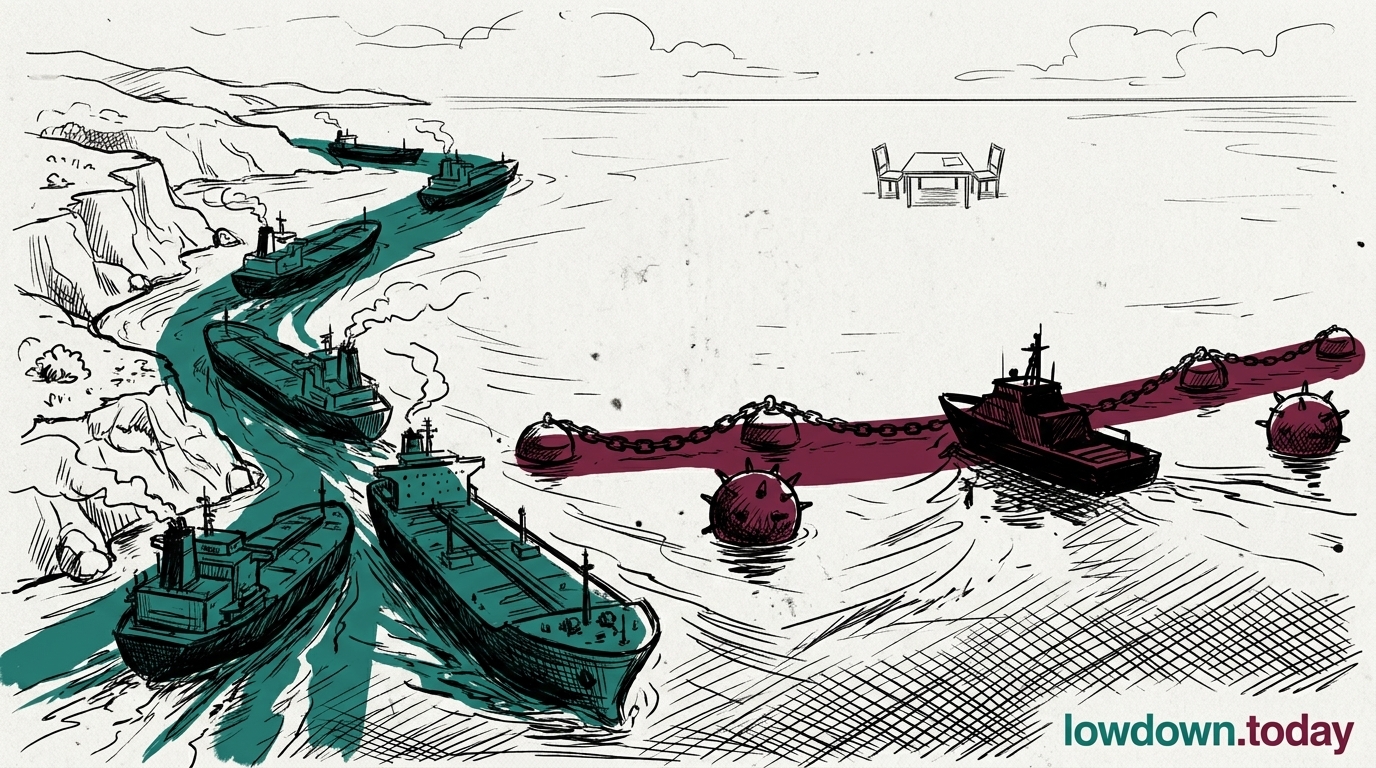
US Defense Secretary Pete Hegseth, UK Defence Secretary John Healey and Australian Deputy Prime Minister Richard Marles announced the first AUKUS Pillar II Signature Project on 30 May 2026, with the joint statement carried at the Shangri-La Dialogue in Singapore1. AUKUS is the trilateral security pact between Australia, the United Kingdom and the United States; Pillar II is its advanced-technology track. The project covers payloads and enabling systems for uncrewed underwater vehicles (UUV): sensors, navigation, common control of crewed and uncrewed craft, and offensive strike. Hardware deliveries begin in 2027, and no budget figure was disclosed.
The mission set covers protection of seabed cables and pipelines, mine countermeasures (MCM), anti-submarine warfare (ASW) and manoeuvre in contested coastal waters. Those are the tasks the Royal Navy's crewless minehunter sailed toward in the Strait of Hormuz a week earlier. The fact sheet names no vehicle, manufacturer or budget. In the first phase each nation develops its own payloads, each aimed at a different effect. The payloads are built to be interchangeable across all three navies' UUVs.
Pillar II is scoped to payloads and enabling systems, not hulls, so the UK may supply the autonomy software, sonar and sensing where BAE Systems and Thales are strong. That software layer carries higher intellectual-property value than the platform. BAE's Herne extra-large autonomous underwater vehicle (XLAUV), described in April as on track for Lloyd's Register certification and 2026 delivery, is not mentioned. Nor is any other vehicle, so the omission says nothing about UK hardware. US primes were already courting allied subsea work through British partners in May.



