
Skip to content
You can now search across every topic, entity and event.What's new
Iran Conflict 2026
21JUN

Day 114: Hormuz shuts as Vance flies to Geneva

3 min read
17:51UTC

JD Vance reversed his cancelled trip and met Iran's delegation in Switzerland on 21 June, the first direct talks since the Islamabad MOU. The IRGC closed the Strait of Hormuz again a day earlier, routing all traffic through Oman's waters. Five days after Trump declared the war over, the binding facts are being set by other hands.

Key takeaway

Iran's corps and PGSA are writing Hormuz's operative rules; Washington is producing declarations.

This briefing mapped
Diplomatic
Military
Regulatory
Legal
Economic

JD Vance flew to Switzerland on 21 June and sat across from Iran's Ghalibaf and Araghchi, two days after a wire report said he had cancelled the trip and Iran had pulled its negotiators.

Sources profile:This story draws on centre-left-leaning sources from Qatar
Qatar
Sources:Al Jazeera

The IRGC's Khatam al-Anbia command declared the Strait of Hormuz closed on 20 June, its second such order of the war. CENTCOM rejected it within hours.

Sources profile:This story draws on neutral-leaning sources from Iran
Iran
LeftRight

Iran's IRGC (Islamic Revolutionary Guard Corps) declared the strait of Hormuz closed on 20 June. Khatam al-Anbia HQ cited Israeli strikes in Lebanon as a breach of the Islamabad peace deal and ordered all shipping to stay clear. US Central Command rejected the order. 55 ships carried 17 million barrels through the strait the same day.

This was the second IRGC closure in ten days. Oil markets discounted both. The Oman territorial waters corridor kept barrels moving regardless. 

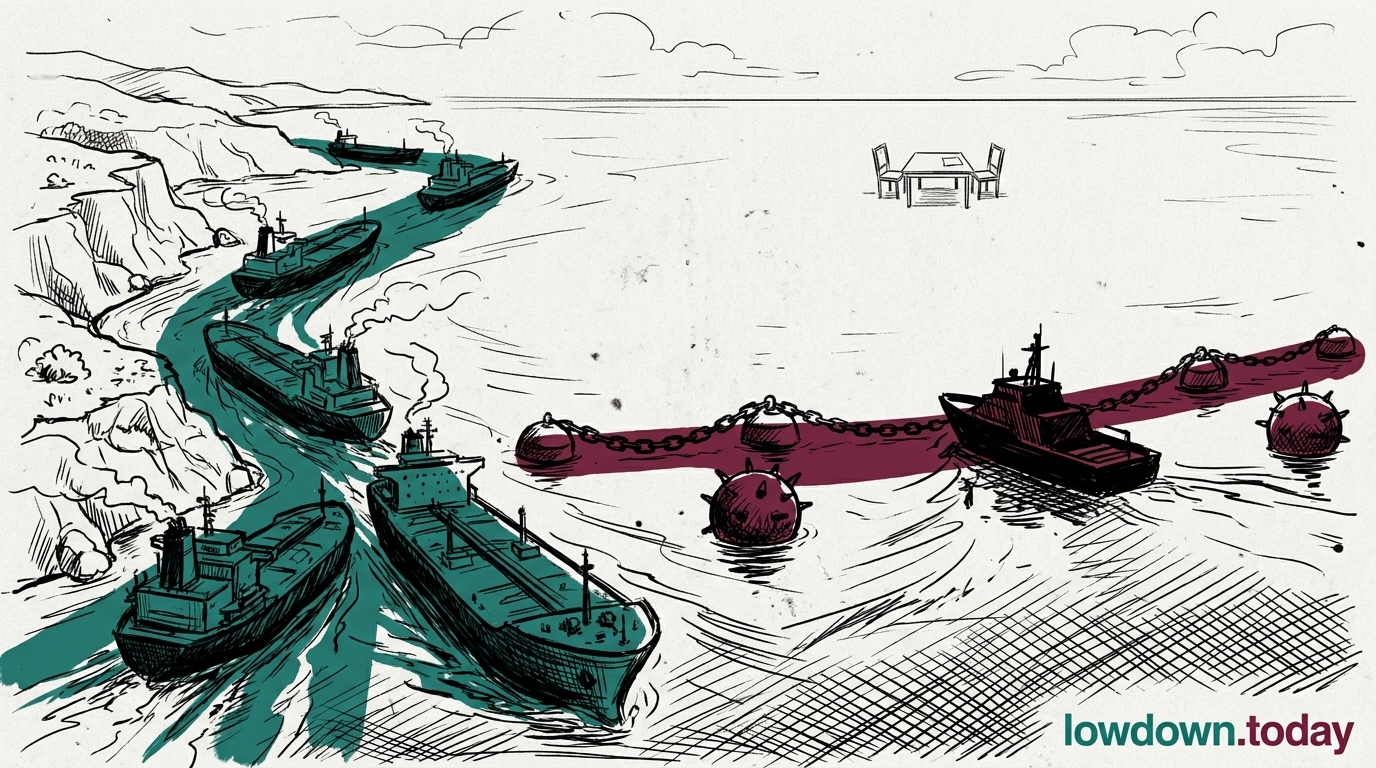
A US-led naval advisory on 20 June flagged mines in Hormuz's standard lanes and cleared one route through Oman's territorial waters. All 55 ships that transited that day used it.

Sources profile:This story draws on mixed-leaning sources from United States
United States

A US-led naval body warned on 20 June that the standard Hormuz shipping lanes may contain mines. It cleared a safer route through Oman's coastal waters. US Central Command reported 55 ships carrying 17 million barrels used that Omani route the same day.

This shifts effective control of the world's main oil chokepoint into Omani territorial waters. Oman, mediating between the US and Iran, now holds the operative key to Hormuz traffic. 

Iran's Persian Gulf Strait Authority made insurance compulsory on every Hormuz transit on 20 June, free for now, with fees reserved for after the MOU's 60-day window closes around 17 August.

Sources profile:This story draws on neutral-leaning sources from United Kingdom
United Kingdom

Iran's Persian Gulf Strait Authority made insurance compulsory on all Hormuz transits on 20 June, currently free, with fees reserved from August 2026. The authority is on the US sanctions list: buying its insurance exposes shipping companies to US penalties.

Most ships are avoiding the problem by using Oman's waters, which sit outside the authority's jurisdiction. August is Iran's deadline lever: no final deal means fees start on the only lane it can reach. 

Sources:Lloyd's List

Israeli forces killed at least 20 people in south Lebanon on 20 June and 16 more on 21 June, hours after a renewed ceasefire collapsed. Netanyahu and Katz ordered the IDF to hold its positions.

Sources profile:This story draws on centre-left-leaning sources from Israel
Israel

A Lebanon ceasefire renewed on 19 June collapsed within hours. Israeli forces killed at least 20 people on 20 June and 16 more on 21 June. Prime Minister Netanyahu ordered the Israel Defense Forces to hold positions in southern Lebanon.

Israel never signed the Iran-US peace deal. Its Lebanon operations cannot be controlled by that agreement. Iran's military has used these Israeli strikes as the legal pretext for two Strait of Hormuz closure declarations. 

OFAC designated a Muscat financial firm on 18 June for Hezbollah links, and through 21 June issued no Iran general licence and delisted no Iranian entity. The MOU promised relief within 48 hours.

Sources profile:This story draws on neutral-leaning sources

OFAC (the US sanctions office) had issued no relief for Iran by 21 June. This was five days after the Islamabad peace deal required waivers for Iranian crude exports 'immediately upon signing'. On 18 June OFAC instead designated a Hezbollah-linked company in Oman, the opposite of relief.

Washington fulfilled only its cheapest commitment: ending naval blockade enforcement. Oil-transaction waivers and delisting actions, both due within 48 hours of signing, have not arrived. 

Sources:OFAC·White House

Brent crude settled near $80.59 on 19 June and barely moved when the IRGC declared Hormuz shut the next day. It is the second closure this month that markets have priced as theatre.

Sources profile:This story draws on neutral-leaning sources

Brent Crude settled near $80.59 on Friday 19 June. When Iran's military declared Hormuz closed on Saturday, markets barely moved. The first closure on 11 June saw Brent fall from $96.34 to $89.25 by 12 June as traders priced it as leverage.

Oil markets are pricing the Oman route over Iran's words. 55 ships carrying 17 million barrels used Omani waters on 20 June; the closure declaration produced no supply shock because barrels kept flowing. 

Closing comments

Direction is sideways-to-up. The Geneva round on 21 June is a de-escalatory signal, but it was unlocked by the IRGC's 20 June Hormuz closure, the second in ten days. That pattern, corps escalates, diplomats negotiate, prices the next session at the cost of a military move. The concrete tipping mechanism is the PGSA's 17 August fee deadline: if OFAC has not issued an oil-transaction waiver by that date, the PGSA switches on fees for the only operating lane, pushing shippers into the sanctioned-insurer trap and returning Brent toward the $96 peak of 10 June 2026. The named decision point is OFAC: a general licence for Iranian crude issued before a second Geneva round breaks the escalation pattern; the White House Presidential Actions register carrying nothing by 1 August confirms the corps retains the initiative.

AI-assisted, human-edited under the editorial responsibility of Bannermedia Ltd. Reviewed by Ed Woodcock on 21 June 2026. Editorial standards.

Different Perspectives
United States (Vance / White House)
Vance attended the 21 June Geneva round but produced no joint statement, no OFAC waiver, and no signed instrument. Washington's operational posture remains active at sea, with CENTCOM clearing the Omani route, while its signed ledger stays empty five days after the MOU required action.
Iran (IRGC / Khatam al-Anbia)
Khatam al-Anbia HQ declared Hormuz closed for a second time, then watched Iran's civilian delegation fly to Geneva the next day. The corps's closure is leverage, not a blockade; it was designed to force Washington back to the table and it worked.
Oman
Oman
Oman's territorial waters carried all 55 ships and 17 million barrels that transited Hormuz on 20 June, installing Muscat as the strait's operative gatekeeper. The same week, OFAC designated Globe International SPC on Omani soil, testing whether Muscat can sustain its mediator role under US sanction pressure.
Israel
Israel
Netanyahu ordered the IDF to hold positions in south Lebanon, killing at least 20 on 20 June and 16 on 21 June. Israel never signed the Islamabad MOU and treats the Lebanon front as a sovereign decision; its operations give the IRGC an MOU-breach trigger Iran can activate at will.
Shippers and war-risk insurers
All 55 Hormuz transits on 20 June used the Omani corridor, outside PGSA jurisdiction but potentially uncovered by the Lloyd's-Chubb $400m consortium, which requires an OFAC waiver that has not arrived. The sanctioned-insurer trap means shippers face two non-compliant options on the only operating lane until OFAC acts.
Qatar
Qatar
Qatar co-mediated the 21 June Geneva round and its foreign ministry confirmed negotiations opened. The Pakistan-Qatar channel is the only architecture trusted by both the IRGC's general-officer track and the US National Security Council.