Skip to content
You can now search across every topic, entity and event.What's new
Iran Conflict 2026
17JUN

Trump strikes Iran with no war authority

3 min read
09:37UTC

Donald Trump ordered missiles onto Iranian soil with no AUMF and no UN notice, days after both chambers of Congress moved to constrain him.

ConflictDeveloping
Key takeaway

Trump executed an act of war while every document that would normally authorise it stayed unsigned.

Donald Trump ordered strikes on sovereign Iranian territory with no Article 51 notification to the UN Security Council and no new AUMF (authorisation for use of military force), the statute Congress would normally pass to sanction a war 1. He acted as both chambers moved against him. The House voted 215-208 on 3 June to wind down US involvement , and Senate cloture on a parallel war-powers resolution fell ten votes short . Congress voted to limit the president; the strike order on 9 June bypassed that vote within days of it.

Washington's legal defence rests on Article II self-defence: a president may protect US forces under fire without prior congressional authorisation, and the downed AH-64 Apache supplies the trigger 2. Critics will counter that striking radar sites across four locations on Iranian soil exceeds the immediate defence of one aircraft's crew, both of whom had already been recovered. Whether "self-defence" describes the rescue or the retaliation is the hinge on which the whole claim turns.

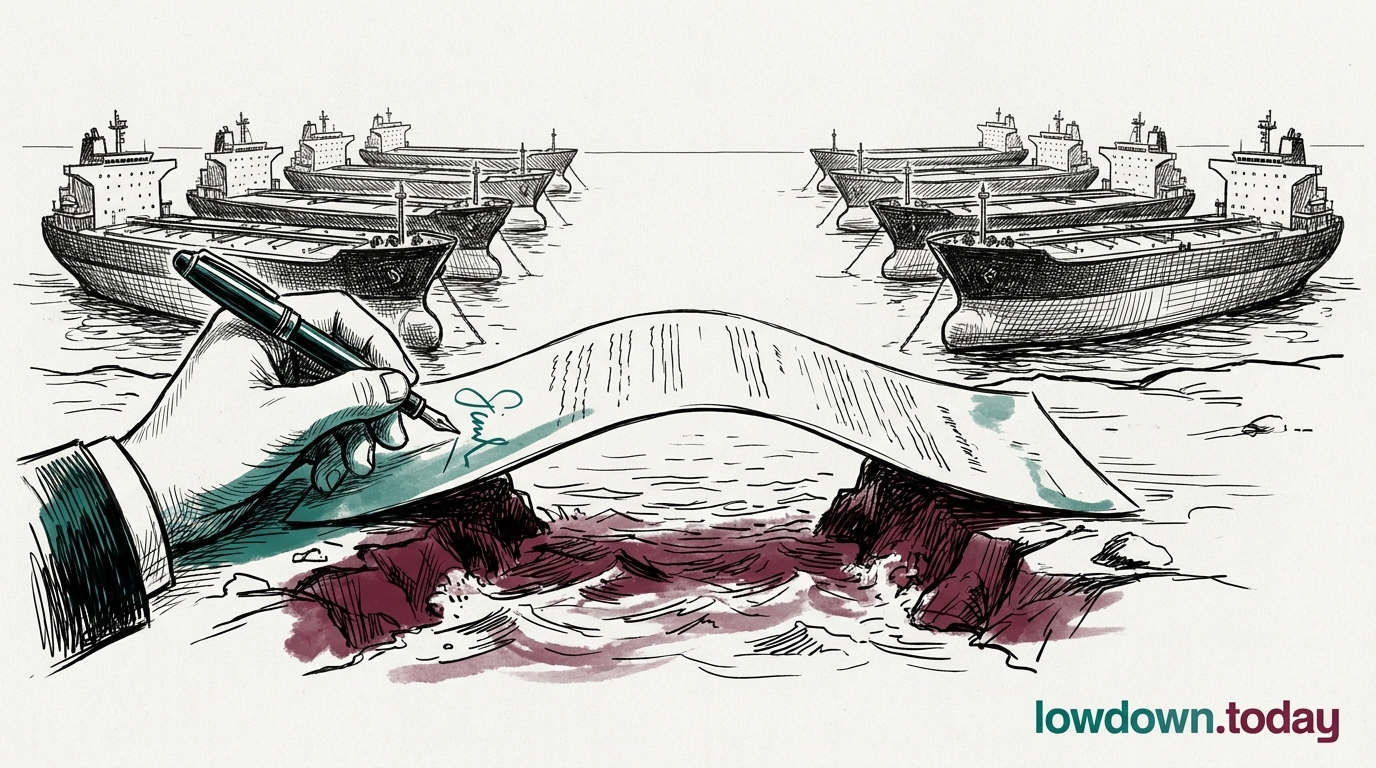
The self-defence framing matters because it sidesteps the AUMF question entirely. A defensive strike needs no fresh authorisation, so the recovered Apache crew become the legal pivot rather than a vote on the floor. Trump spent 100 days pairing optimistic deal talk with an unsigned MoU; his first instrument of consequence on Iran arrived as ordnance, not a signature. That distinction is the point. An act of war was executed while every document that would normally precede it stayed unsigned, which leaves Congress legislating against a fact already on the ground.


Deep Analysis

In plain English

In the United States, Congress has the power to declare war. Since 1973 there has also been a law called the War Powers Resolution that says the President must notify Congress within 48 hours of starting a military operation and must stop within 60 days unless Congress approves. President Trump ordered the 9 June strikes without asking Congress for permission, without notifying the United Nations, and days after the House of Representatives voted 215-208 to tell him to wind down the Iran conflict. The administration's legal argument is that the President can order strikes in self-defence as Commander-in-Chief without needing Congress. Critics, including Georgetown Law professors, argue that argument has never been tested in a case where Congress had just voted against the action.

Deep Analysis
Root Causes

Three converging structural conditions made the legal collision on 9 June inevitable. First, the Trump administration's deliberate policy of keeping all Iran-related authority on the verbal track rather than signed paper meant that when it needed a legal basis for strikes, Article II was the only instrument in the field. An AUMF would have required specifying objectives and constraints Congress could hold the administration to.

Second, the War Powers Resolution's own enforcement gap, demonstrated across three consecutive lapse cycles at Days 60, 72 and 93, signalled to the executive that Congress lacked both the votes and the institutional will to constrain it. A resolution that lapses unremedied three times becomes, in practice, a dead letter regardless of its statutory force.

Third, the House 215-208 margin was too thin and too recent to survive a Senate cloture test. With ten senators absent from the cloture count, the administration calculated, correctly in the short term, that no enforcement mechanism would activate before the strikes could be executed.

First Reported In

Update #123 · Trump orders strikes on Iranian soil

Al Jazeera· 10 Jun 2026
Read original
Different Perspectives
Lloyd's Market Association
War-risk underwriters price the Houthis' Red Sea attacks because the group announces its targets in advance, but the unclaimed Damietta drone gives insurers a hit with no author to price against. An attack nobody claims costs shipping more than one that is claimed, since premiums are set against a known pattern, not raw damage.
US Central Command
US Central Command
CENTCOM has announced no strike on Iran since resuming bombing on 30 July within hours of an IRGC salvo on Jordan, and centcom.mil did not respond to requests to confirm any pause. The command has gone quiet before while a larger operation was being weighed, so silence alone proves nothing about what it has or has not done.
Hengaw
Hengaw
Hengaw recorded at least 67 executions in Iran during July, of which the state acknowledged only eight, and reported the 1 August execution of protest detainee Arvin Kheirkhahan at Shahrud with no advance notice to his family. A family's first notice of a death sentence is now usually the instruction to collect a body.
Egypt
Egypt
Egypt's government asked media on 2 August to report the Damietta attack accurately, named no author, and said no findings will be published before its own investigation concludes. Cairo holds the debris and jurisdiction over an attack on its own soil, and naming a culprit now would pull it into a dispute it has avoided for five months.
Iran's Foreign Ministry
Araghchi called the Hormuz talks with Oman final-stage on 2 August, four days after his own deputy rejected Oman's lane proposal, and denied the Damietta drone strike as an Israeli false flag while two Iranian officials privately claimed it for Tehran. Iran's public position now contradicts itself on both files at once.
Bahrain and Kuwait
Bahrain and Kuwait
Bahraini and Kuwaiti aircraft flew their own strikes on Iranian depots in July with Emirati air cover behind them, and Ynetnews reports some Gulf capitals wanted the 2 August strike to proceed rather than stop. States that have already taken fire see a closing window on Iranian weakness, not a reason to pause.



