Skip to content
You can now search across every topic, entity and event.What's new
Iran Conflict 2026
17JUN

IRGC declares Hormuz will never reopen

3 min read
09:37UTC

Iran says mines stay in the water and the strait's pre-war status is gone permanently.

ConflictDeveloping
Key takeaway

Iran has declared the strait's pre-war status permanently over, not conditionally suspended.

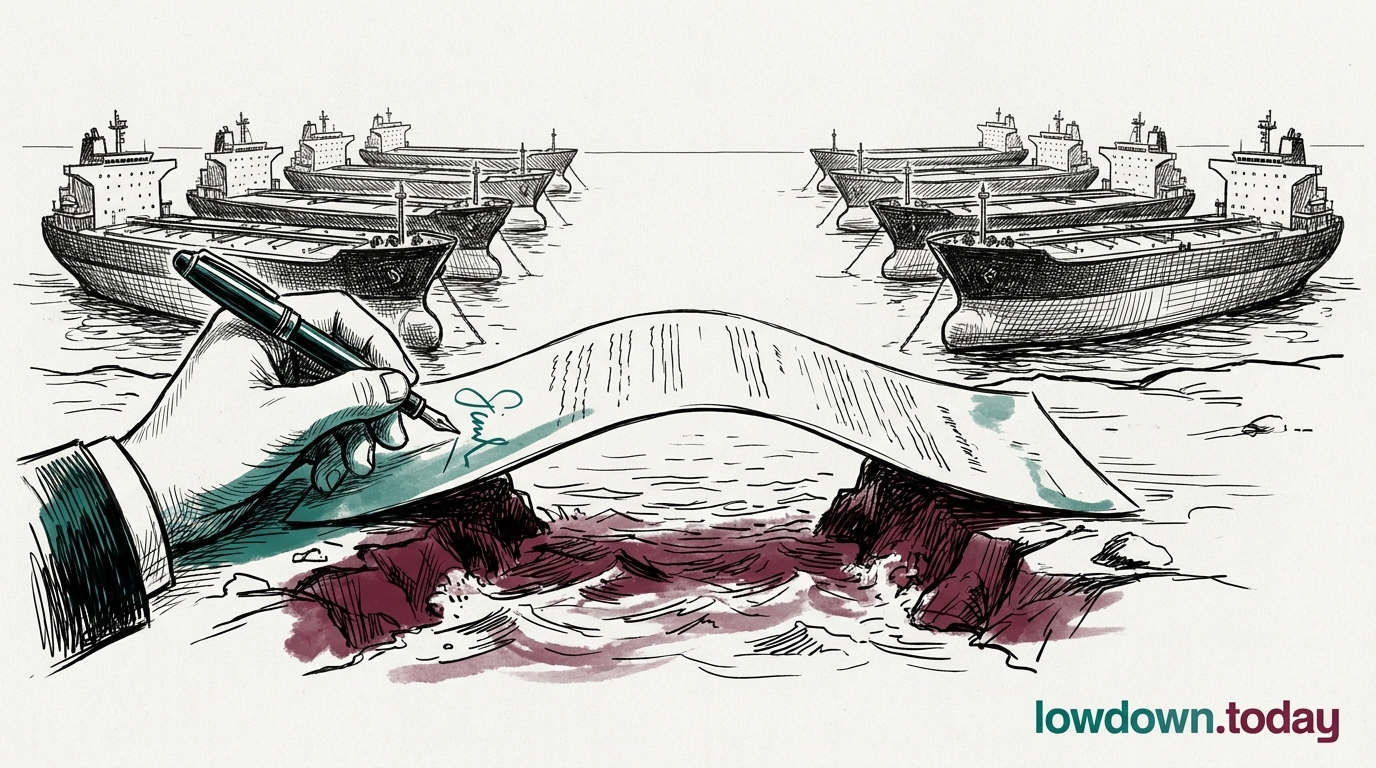
The IRGC (Islamic Revolutionary Guard Corps) stated that mines remain in the Strait of Hormuz and that the waterway "will never return to its previous status." Commercial traffic sits at roughly 8.0% of the pre-war daily baseline: Kpler data shows 5 to 11 transits per day against a pre-war norm of 120 to 140 .

More than 600 vessels, including 325 oil tankers, remain stranded inside the Gulf, according to Lloyd's List Intelligence. Iran is vetting each vessel individually before granting passage, a process that analysts expect will cap throughput at 10 to 15 ships per day even if the vetting posture loosens. At that rate, clearing the backlog alone would take weeks.

The IRGC's language is worth parsing carefully. "Will never return" is not a negotiating position; it is a declaration of a new permanent status. It aligns with Iran's Islamabad proposal, which sought to impose fees on every vessel passing through the strait, reportedly $1 to $2 million per ship. If formalised, that would create a precedent for every maritime chokepoint globally.

For consumers, the blockade's persistence translates directly. Roughly 20 million barrels per day of oil that normally passes through Hormuz is absent from global supply. Oxford Economics projects that disruption will cut world GDP growth by 1.2 percentage points in 2026. That cost is accumulating daily while the strait stays effectively closed.


Deep Analysis

In plain English

Before this war, about 120 ships a day passed through the Strait of Hormuz carrying oil to Asia, Europe, and North America. Now fewer than 10 a day are getting through, and Iran is choosing which ones. The IRGC, Iran's elite military force, has now said publicly that the strait 'will never return to its previous status'. That is a statement that even after any deal is done, they intend to keep some form of control over who passes through. There are also naval mines still in the water that Iran says it placed there, and some of which Iran itself cannot locate. Those mines are a physical danger to any ship trying to transit, separate from the political question of permission.

Deep Analysis
Root Causes

Iran's 'will never return' framing reflects a strategic objective that predates the current conflict: control over Hormuz transit has been an IRGC doctrine since the 1980s Tanker War, when the corps first demonstrated it could enforce selective passage. The ceasefire did not alter that doctrine; it merely paused its full implementation.

The $1-2 million per-vessel toll demand, reportedly already being charged informally, represents an attempt to monetise the closure into a permanent revenue stream. If institutionalised, Hormuz tolls would provide the IRGC with an independent hard-currency revenue source that bypasses sanctions on oil exports.

What could happen next?
  • Precedent

    If the IRGC's 'will never return' declaration stands unchallenged, it establishes the first successful post-1945 precedent for a coastal state permanently altering the legal status of an international strait, with implications for the Bab el-Mandeb, Malacca, and Taiwan Strait.

    Long term · Medium
  • Consequence

    The 325 stranded oil tankers represent approximately 16 days of total OECD oil reserve draw-down at current consumption rates; the longer they remain trapped, the greater the probability of strategic reserve releases that would cap but not eliminate the price spike.

    Short term · High
  • Risk

    Iran's acknowledged inability to locate all its own mine placements means the risk of an unintentional mine detonation by a commercial vessel is non-trivial and independent of any political or diplomatic development.

    Immediate · High
First Reported In

Update #66 · Islamabad collapses: 10 days to expiry

CENTCOM· 12 Apr 2026
Read original
Different Perspectives
Lloyd's Market Association
War-risk underwriters price the Houthis' Red Sea attacks because the group announces its targets in advance, but the unclaimed Damietta drone gives insurers a hit with no author to price against. An attack nobody claims costs shipping more than one that is claimed, since premiums are set against a known pattern, not raw damage.
US Central Command
US Central Command
CENTCOM has announced no strike on Iran since resuming bombing on 30 July within hours of an IRGC salvo on Jordan, and centcom.mil did not respond to requests to confirm any pause. The command has gone quiet before while a larger operation was being weighed, so silence alone proves nothing about what it has or has not done.
Hengaw
Hengaw
Hengaw recorded at least 67 executions in Iran during July, of which the state acknowledged only eight, and reported the 1 August execution of protest detainee Arvin Kheirkhahan at Shahrud with no advance notice to his family. A family's first notice of a death sentence is now usually the instruction to collect a body.
Egypt
Egypt
Egypt's government asked media on 2 August to report the Damietta attack accurately, named no author, and said no findings will be published before its own investigation concludes. Cairo holds the debris and jurisdiction over an attack on its own soil, and naming a culprit now would pull it into a dispute it has avoided for five months.
Iran's Foreign Ministry
Araghchi called the Hormuz talks with Oman final-stage on 2 August, four days after his own deputy rejected Oman's lane proposal, and denied the Damietta drone strike as an Israeli false flag while two Iranian officials privately claimed it for Tehran. Iran's public position now contradicts itself on both files at once.
Bahrain and Kuwait
Bahrain and Kuwait
Bahraini and Kuwaiti aircraft flew their own strikes on Iranian depots in July with Emirati air cover behind them, and Ynetnews reports some Gulf capitals wanted the 2 August strike to proceed rather than stop. States that have already taken fire see a closing window on Iranian weakness, not a reason to pause.



